


Pharmacokinetic determinants of cisplatin-induced subclinical kidney injury in oncology patients
- PMID: 30220072
- PMCID: PMC6656531
- DOI: 10.1007/s00228-018-2552-z
Pharmacokinetic determinants of cisplatin-induced subclinical kidney injury in oncology patients
Abstract
Purpose: The ability to predict and detect clinical and subclinical nephrotoxicity early in the course of therapy has the potential to improve long-term outcomes in cancer patients receiving cisplatin chemotherapy. Pharmacokinetic parameters could serve as predictors of cisplatin-induced nephrotoxicity.
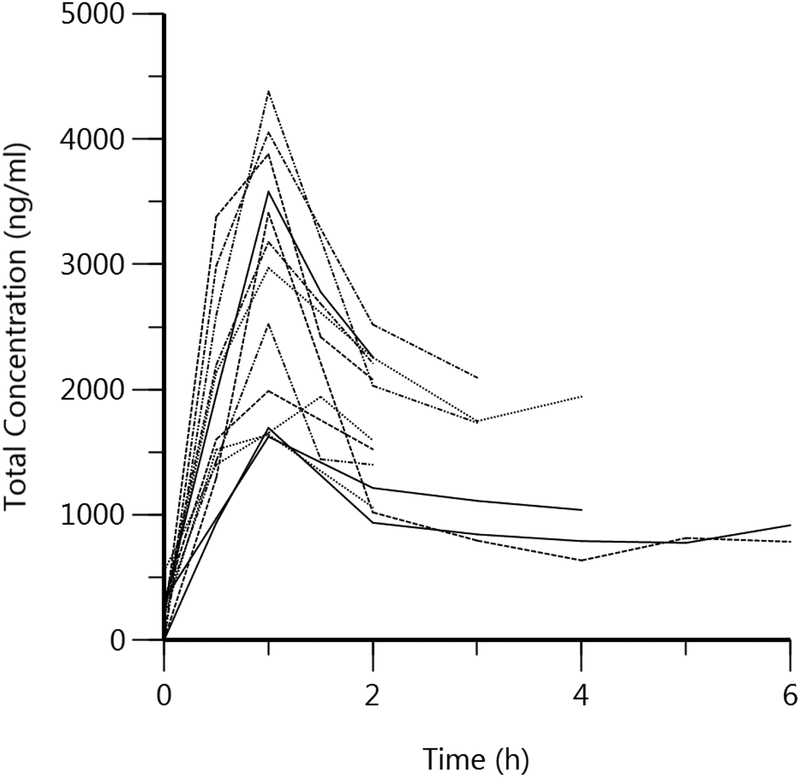
Methods: Participants [n = 13] were treated with a 1-h cisplatin infusion [30-75 mg/m2]. Blood was collected pre-dose and up to 6 h post-dose. Urinary biomarkers [KIM-1, calbindin, clusterin, GST-pi, β2M, albumin, NGAL, osteopontin, clusterin, MCP-1, cystatin C, and TFF3] were measured at baseline, days 3 and 10. Total and unbound platinum concentrations were measured using ICP/MS. Noncompartmental analysis was performed, and correlation and regression analyses evaluated the relationships between platinum pharmacokinetics and nephrotoxicity.
Results: Peak platinum urinary concentrations correlated with urinary levels of KIM-1, calbindin, clusterin, GST-pi, β2M, albumin, NGAL, osteopontin, clusterin, cystatin C, and TFF3 at day 10. Unbound platinum plasma concentrations at 2 h also correlated with urinary clusterin, β2M, cystatin C, NGAL, osteopontin, and TFF3 at day 3. Regression analyses suggested 2-h total plasma platinum concentrations greater than 2000 ng/ml, and peak urinary platinum concentrations above 24,000 ng/ml may serve as potential approximations for elevated risk of nephrotoxicity. Platinum area under the plasma concentration time curve was associated with serum creatinine and estimated glomerular filtration rate.
Conclusions: Peak plasma and urinary platinum concentrations and pharmacokinetic parameters were associated with risk of subclinical cisplatin-induced kidney injury as assessed using novel urinary biomarkers. Future studies will examine these relationships in larger clinical populations of cisplatin-induced acute kidney injury.
Keywords: Biomarkers; Cisplatin; Nephrotoxicity; Pharmacokinetics.
Conflict of interest statement
Conflict of Interest
The authors have stated explicitly that there are no conflicts of interest in connection with this article.
Figures

References
-
- Pabla N and Dong Z, Cisplatin nephrotoxicity: mechanisms and renoprotective strategies. Kidney Int, 2008. 73(9): p. 994–1007. - PubMed
-
- Arany I and Safirstein RL, Cisplatin nephrotoxicity. Semin Nephrol, 2003. 23(5): p. 460–4. - PubMed
-
- Khwaja A, KDIGO clinical practice guidelines for acute kidney injury. Nephron Clin Pract, 2012. 120(4): p. c179–84. - PubMed
-
- Dieterle F, et al. , Renal biomarker qualification submission: a dialog between the FDA-EMEA and Predictive Safety Testing Consortium. Nat Biotechnol, 2010. 28(5): p. 455–62. - PubMed
MeSH terms
Substances
Grants and funding
LinkOut - more resources
Full Text Sources
Other Literature Sources
Research Materials
Miscellaneous
