


The topology of between-herd cattle contacts in a mixed farming production system in western Kenya
- PMID: 30220395
- PMCID: PMC6152584
- DOI: 10.1016/j.prevetmed.2018.06.010
The topology of between-herd cattle contacts in a mixed farming production system in western Kenya
Abstract
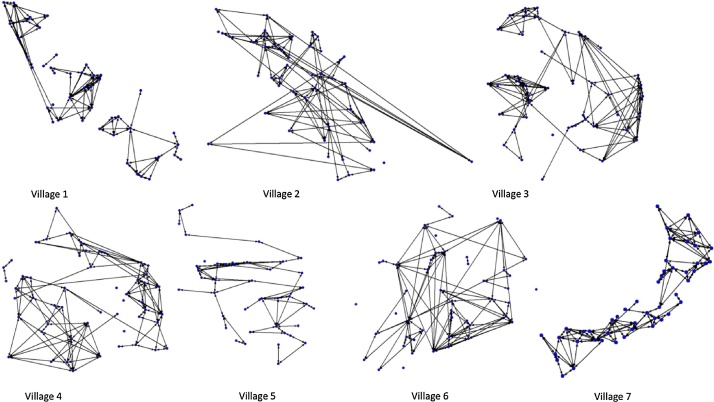
In many livestock production systems in sub-Saharan Africa, cattle are owned by individual keepers but regularly mix with animals from other herds while grazing communal land, at watering points or through the use of shared bulls for breeding and ploughing. Such contacts may have important implications for disease transmission and control but are not well documented. We describe between-farm contacts in Kimilili sub-county of Bungoma County, a mixed farming area of predominately smallholder farmers. Between-farm contacts occurring during grazing or at shared water points over the past four weeks were captured in seven randomly selected villages using a photo-elicitation tool. The use of shared bulls for breeding and ploughing and cattle introductions from farms within the same village in the past 12 months were also captured. Contact networks were constructed for each contact type in each village. In total 329 farms were included in the study. Networks resembled undirected scale-free graphs with a network density ranging between 9.6 and 14.0. Between 45.6 and 100% of the farms in each study village had been in contact over the past four weeks through grazing and watering contacts. Between 88.9 and 100% were considered to have been in contact over the past 12 months. The topology of the networks was heterogeneous, with some farms exhibiting a high degree of contact. The degree of farm contact and distances between farms were negatively correlated (Pearson correlation coefficient range -0.2 to -0.4). Effective disease control and surveillance must take into consideration the frequency and range of contacts that occur between farms within a single village. Cattle keepers are highly interconnected and pathogens that are transmitted through direct or indirect animal contact would be expected to spread rapidly in the study system. However, the observed heterogeneity in between-farm contact may present opportunities for interventions to be targeted to particular herds to limit infectious disease spread.
Keywords: Heterogeneity; Networks; Smallholder; Topology.
Copyright © 2018 The Authors. Published by Elsevier B.V. All rights reserved.
Figures



References
-
- Albert R., Jeong H., Barabasi A. Error and attack tolerance of complex networks. Nature. 2000;406:378–382. - PubMed
-
- Borgatti S.P., Everett M.G., Freeman L.C. Analytic Technologies; Needham, MA: 2002. UCINET for Windows. Software for Social Network Analysis.
-
- DeWalt K.M., DeWalt B.R. AltaMira Press; Walnut Creek, CA: 2002. Participant Observation: A Guide for Fieldworkers.
-
- Dube C., Ribble C., Kelton D., McNab B. A review of network analysis terminology and its application to foot-and-mouth disease modelling and policy development. Transbound. Emerg. Dis. 2009;56:73–85. - PubMed
MeSH terms
Grants and funding
LinkOut - more resources
Full Text Sources
Other Literature Sources
Medical
Miscellaneous
