Review
. 2018 Nov:71:135-147.
doi: 10.1016/j.dnarep.2018.08.017. Epub 2018 Aug 25.

Preserving replication fork integrity and competence via the homologous recombination pathway

Affiliations
Review

Preserving replication fork integrity and competence via the homologous recombination pathway

Anissia Ait Saada et al. DNA Repair (Amst). 2018 Nov.

Abstract

Flaws in the DNA replication process have emerged as a leading driver of genome instability in human diseases. Alteration to replication fork progression is a defining feature of replication stress and the consequent failure to maintain fork integrity and complete genome duplication within a single round of S-phase compromises genetic integrity. This includes increased mutation rates, small and large scale genomic rearrangement and deleterious consequences for the subsequent mitosis that result in the transmission of additional DNA damage to the daughter cells. Therefore, preserving fork integrity and replication competence is an important aspect of how cells respond to replication stress and avoid genetic change. Homologous recombination is a pivotal pathway in the maintenance of genome integrity in the face of replication stress. Here we review our recent understanding of the mechanisms by which homologous recombination acts to protect, restart and repair replication forks. We discuss the dynamics of these genetically distinct functions and their contribution to faithful mitoticsegregation.

Keywords: Fork integrity; Fork restart; Genome instability; Recombination; Replication stress.


Figures

Fig. 1
Fig. 1
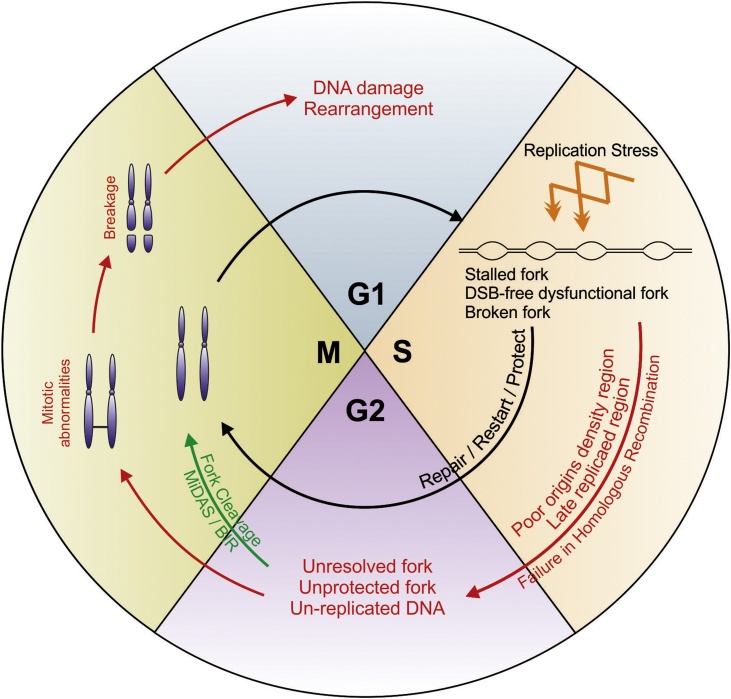
Pathways preventing transmission of DNA damage upon replication stress. Replication stress results in various types of corrupted replication forks. These include stalled forks that retain their replication competence and dysfunctional fork that have lost their replication competence. This later class can either be associated with a double strand break (broken fork) or be DSB-free. Sub-pathways of homologous recombination (HR) act to protect stalled forks from becoming dysfunctional, or restart and repair dysfunctional forks. In this way recombination factors ensure either successful merger with a converging fork (fork protection), or promote recombination-dependent replication (RDR) to allow replication to be completed when a converging fork is not available. HR therefore promotes the completion of DNA replication in a timely manner, avoiding mitotic catastrophe. When HR is genetically impaired (i.e. by mutations in HR genes) late replicated regions and/or regions with low origins densities can accumulate unprotected forks, unresolved replication intermediates and un-replicated DNA. These may persist through late G2 and into mitosis. Fork cleavage by structure-specific endonucleases (i.e. Mus81) offers the opportunity to resolve replication problems via break-induced replication (BIR) that results in mitotic DNA synthesis (MiDAS). The persistence of abnormal replication intermediates in mitosis jeopardizes faithful chromosome segregation, resulting in various types of mitotic abnormalities (i.e. chromatin bridges, ultra-fine bridges, lagging chromosomes and micronuclei). Mitotic abnormalities can trigger chromosomal breakage and rearrangement which are transmitted to the next generation.
Fig. 2
Fig. 2
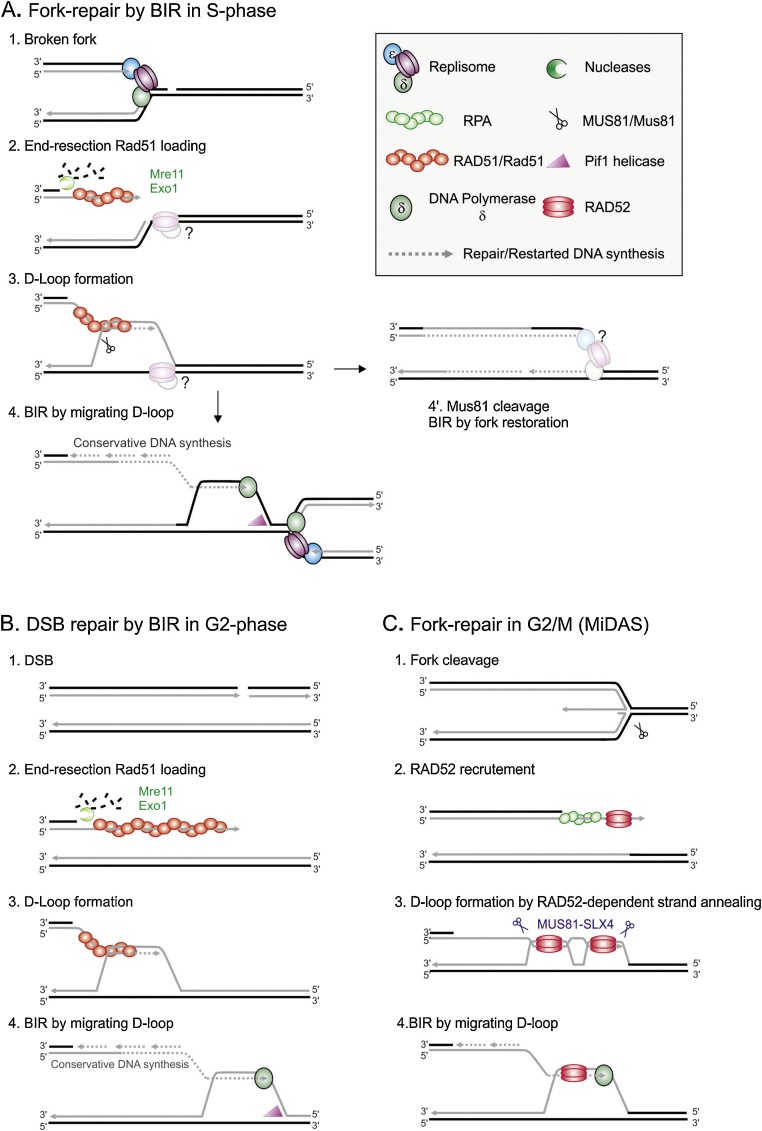
Models of DSB-initiated recombination-dependent replication. A. Replication forks encountering a DNA nick are converted into broken forks, which may be accompanied by the loss of replisome components (1). The DNA end-resection machinery (i.e. Mre11 and Exo1) generates a single-stranded 3′overhang that is coated by the RAD51 recombinase (2) which promotes strand invasion into the sister chromatid to form a D-loop structure from which DNA synthesis can be primed (3). In budding yeast, break-induced replication (BIR) proceeds by conservative DNA synthesis using a migrating D-loop that is mediated by the Pif1 helicase. The non-essential Pol32 sub-unit of the DNA polymerase delta is required for BIR, which is highly error-prone and limited by an incoming converging fork (4). Alternatively, Mus81 endonuclease can cleave the D-loop structure allowing the restoration of semi-conservative DNA synthesis (4′). It is not known if the replisome associated with such a re-set fork is canonical or not. B. BIR can be initiated by the breakage of a single chromatid in G2 (1,2). The migrating D-loop and its associated conservative DNA synthesis can proceed until the end of the chromosome (3). In the example shown, the sister chromatid provides the donor template, but BIR can employ ectopic homologous sequence during repair of a DSB. BIR in G2 generates long stretches of ssDNA (4) which is highly sensitive to mutations and formation of secondary recombination intermediates. C. Unresolved replication forks in mammalian cells are cleaved by MUS81 in late G2 and mitosis (1). The strand annealing activity of RAD52 (2) promotes the formation of joint-molecules (3) the nature of which remains elusive. Mitotic DNA synthesis (MiDAS) requires POLD3, a component of the DNA polymerase delta homologous to yeast Pol32. Here, the sister chromatid is shown as the donor template, but MiDAS can also result in ectopic micro-homology mediated BIR (MMBIR).
Fig. 3
Fig. 3
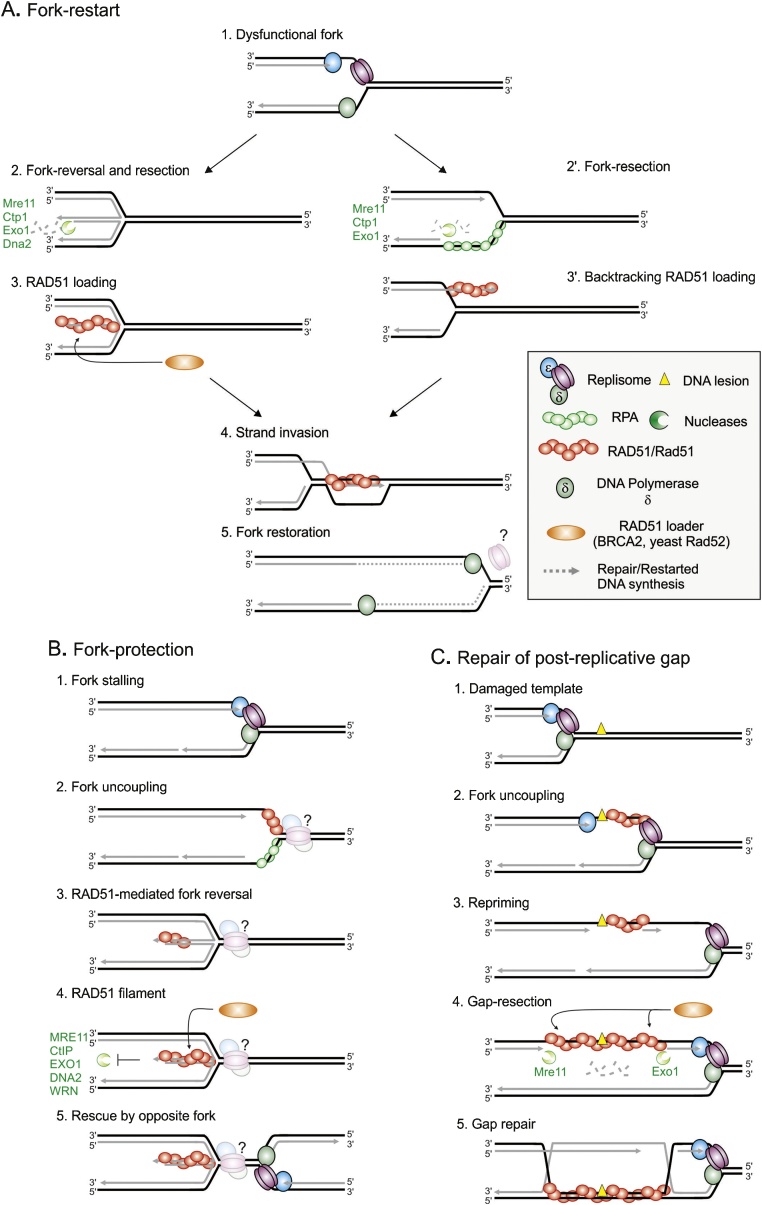
Model of DSB-free recombination-dependent replication. A. Restart of replication forks that have lost replication competence (1) requires recombination proteins. Several helicases and translocases can mediate fork reversal (2) allowing DNA-end resection to generate ssDNA on which Rad51 is loaded (3). The Rad51 filament then promotes strand invasion into the reformed parental DNA duplex to generate a D-loop intermediate (4) from which DNA synthesis is primed, restoring a functional but non-canonical fork (5). Alternatively, fork-restart may be initiated by resection of the lagging strand (2′) and the backtracking of the fork, generating an extruded leading strand onto which Rad51 is loaded (3′). In fission yeast, Rad51-mediated restarted forks are associated with a semi-conservative DNA synthesis during which both strands are synthetized by the DNA polymerase delta. B. Protection of stalled replication forks. Upon fork stalling (1), transient uncoupling allows RAD51 to bind to the ssDNA at the fork junction. This can occur independently of the BRCA2 loader (2). RAD51 promotes fork-reversal (3), possibly in a coordinated manner with additional helicases and translocases (i.e. SMARCAL1, ZRANB3, HTLF). BRCA2-dependent loading of RAD51 onto the fourth arm of the reversed fork protects the double-stranded DNA end from nucleolytic attack (4) by multiple exo- and endonucleases and helicases (i.e. DNA2, MRE11, CtIP, EXO1, WRN). Likely, RAD51-mediated fork reversal and protection maintain the integrity of the fork and allow appropriate merger with a converging forks (5). Whether limited end-resection is required for RAD51-mediated fork reversal and protection is unknown. The fate of the replisome at the reversed fork is also unknown. C. Repair of post-replicative gaps. When replicative DNA polymerases encounter a DNA lesion (1), transient and controlled uncoupling can occur, resulting in the formation of a ssDNA gap at the fork junction (2) which is subsequently coated by Rad51. DNA synthesis is resumed via repriming downstream the DNA lesion, leaving an internal ssDNA gap behind the moving fork (3). The ssDNA gap is enlarged by the DNA-end resection machinery facilitating further Rad51 loading by recombination mediators (4). The repair of the ssDNA gap is finalized in G2 phase (5).
Fig. 4
Fig. 4
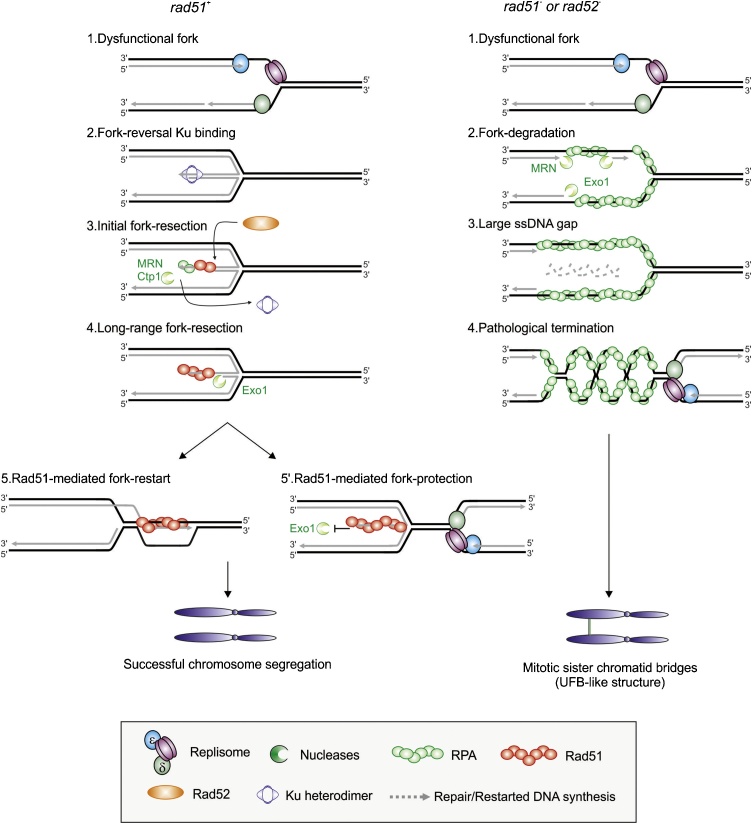
Model of Rad51-mediated fork-protection and restart to avoid mitotic sister chromatid bridges in fission yeast. A. A dysfunctional fork (1) undergoes fork-reversal providing a single double stranded DNA end for the non-homologous end joining heterodimer Ku to bind (2). Initial fork-resection mediated by Mre11/Rad50/Nbs1 (MRN) complex and Ctp1 (the fission orthologue of budding yeast Sae2 and mammalian CtIP), which remove Ku from the DSB end to generate short ssDNA gap onto which Rad51 can be loaded (3). The initial resection primes Exo1-mediated long-range resection to generate a larger ssDNA gap (4) onto which additional Rad51 is loaded. Rad51 promotes strand invasion into the parent duplex DNA, priming DNA synthesis and fork restoration (5). At the same time the Rad51 filament protects the reversed arm from extensive Exo1-dependent resection thus maintaining the fork structure in a form competent for merge with a converging fork (5′). Rad51-mediated fork protection and restart are genetically separable functions and the ultimate outcome depends strongly on the timing of the arrival of the converging fork. B. In the absence of Rad51 or Rad52, a dysfunctional fork (1) is not protected and undergoes uncontrolled resection by the DNA end-resection machinery (2). Large ssDNA gaps, up to 3 kb in size, form behind the fork (3) that are responsible for failure of termination of DNA replication (4). Such pathological termination events trigger mitotic sister chromatid bridges, a type of ultra-fine bridge that breaks during mitosis.
Fig. 5
Fig. 5
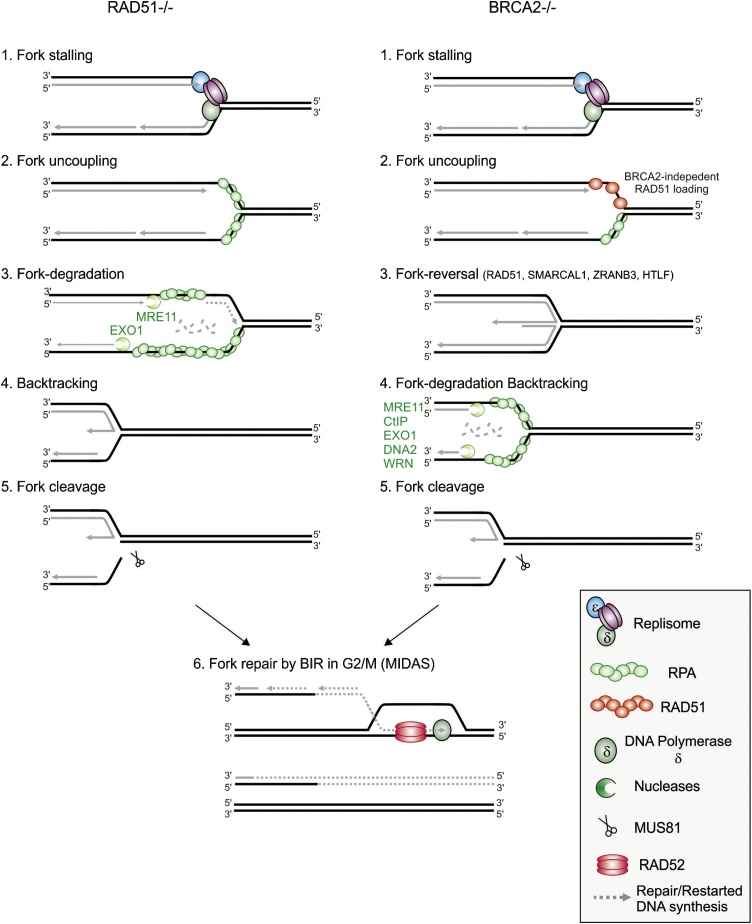
Abnormal replication intermediates in the absence of recombination factors. A. Without RAD51. Replication fork stalling (1) results in uncoupling and ssDNA gap formation at the fork junction (2). Resection of the ssDNA gap generates large stretched of ssDNA which cannot be repaired without RAD51 (3). Backtracking of the resected-fork (4) potentially provides a substrate to MUS81 (5). Fork-repair can subsequently be initiated in mitosis by RAD52 (6). B. Without BRCA2. Replication fork stalling (1) results in uncoupling and ssDNA gap formation. RAD51 binds independently of BRCA2 (2) and fork reversal is mediated by RAD51 cooperatively with helicases and translocases (i.e. SMARCAL1, ZRANB3, HTLF) (3). The reversed fork provides an entry point for the uncontrolled activity of the DNA end-resection machinery, resulting in a large ssDNA gap (4). As in (A), backtracking and fork cleavage can facilitate fork-repair in mitosis (5 and 6).

References

    1. Dewar J.M., Walter J.C. Mechanisms of DNA replication termination. Nat. Rev. Mol. Cell Biol. 2017;18:507–516. - PMC - PubMed
    1. Técher H., Koundrioukoff S., Nicolas A., Debatisse M. The impact of replication stress on replication dynamics and DNA damage in vertebrate cells. Nat. Rev. Genet. 2017;18:535–550. - PubMed
    1. Poli J., Tsaponina O., Crabbé L., Keszthelyi A., Pantesco V., Chabes A. dNTP pools determine fork progression and origin usage under replication stress. EMBO J. 2012;31:883–894. - PMC - PubMed
    1. Mantiero D., Mackenzie A., Donaldson A., Zegerman P. Limiting replication initiation factors execute the temporal programme of origin firing in budding yeast. EMBO J. 2011;30:4805–4814. - PMC - PubMed
    1. Gaillard H., García-Muse T., Aguilera A. Replication stress and cancer. Nat. Rev. Cancer. 2015;15:276–289. - PubMed

Publication types

LinkOut - more resources