


Temporal synchrony and audiovisual integration of speech and object stimuli in autism
- PMID: 30220908
- PMCID: PMC6135104
- DOI: 10.1016/j.rasd.2017.04.001
Temporal synchrony and audiovisual integration of speech and object stimuli in autism
Abstract
Background: Individuals with Autism Spectrum Disorders (ASD) have been shown to have multisensory integration deficits, which may lead to problems perceiving complex, multisensory environments. For example, understanding audiovisual speech requires integration of visual information from the lips and face with auditory information from the voice, and audiovisual speech integration deficits can lead to impaired understanding and comprehension. While there is strong evidence for an audiovisual speech integration impairment in ASD, it is unclear whether this impairment is due to low level perceptual processes that affect all types of audiovisual integration or if it is specific to speech processing.
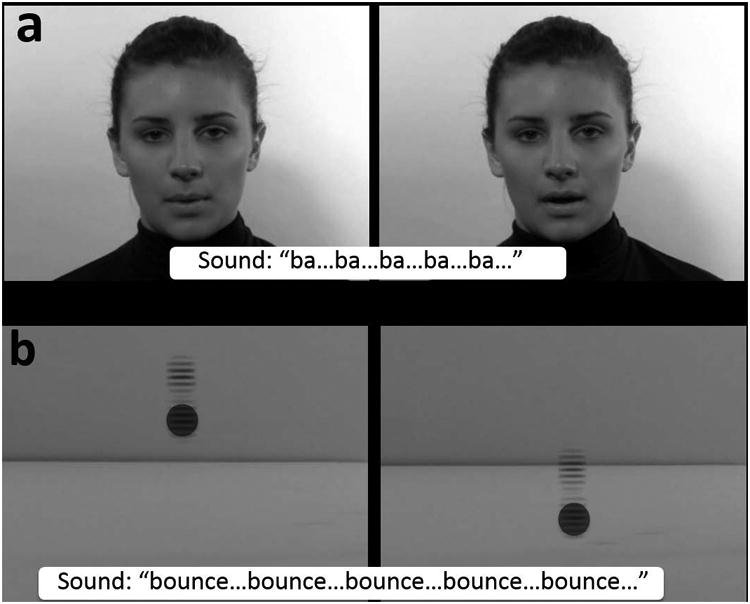
Method: Here, we measure audiovisual integration of basic speech (i.e., consonant-vowel utterances) and object stimuli (i.e., a bouncing ball) in adolescents with ASD and well-matched controls. We calculate a temporal window of integration (TWI) using each individual's ability to identify which of two videos (one temporally aligned and one misaligned) matches auditory stimuli. The TWI measures tolerance for temporal asynchrony between the auditory and visual streams, and is an important feature of audiovisual perception.
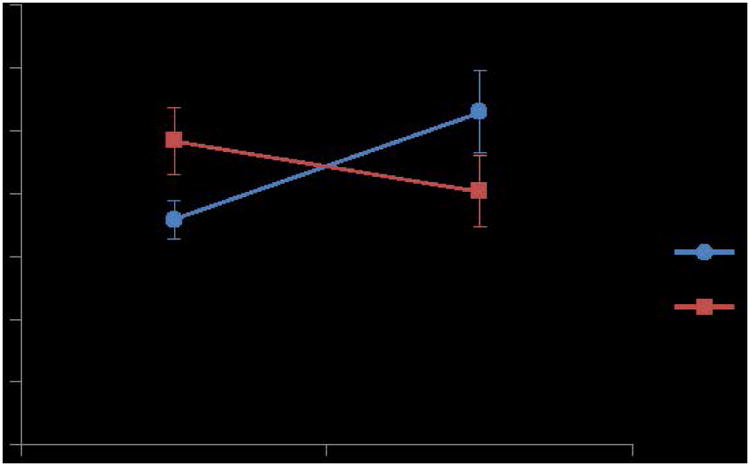
Results: While controls showed similar tolerance of asynchrony for the simple speech and object stimuli, individuals with ASD did not. Specifically, individuals with ASD showed less tolerance of asynchrony for speech stimuli compared to object stimuli. In individuals with ASD, decreased tolerance for asynchrony in speech stimuli was associated with higher ratings of autism symptom severity.
Conclusions: These results suggest that audiovisual perception in ASD may vary for speech and object stimuli beyond what can be accounted for by stimulus complexity.
Keywords: audiovisual integration; speech processing; temporal perception.
Figures


References
-
- Achenbach T, Rescorla L, McConaughey S, Pecora P, Wetherbee K, Ruffle T. Child behavior Checklist for Ages 6-18. Burlington, VT: 2001.
-
- Bebko JM, Weiss JA, Demark JL, Gomez P. Discrimination of temporal synchrony in intermodal events by children with autism and children with developmental disabilities without autism. Journal of Child Psychology and Psychiatry and Allied Disciplines. 2006;47(1):88–98. doi: 10.1111/j.1469-7610.2005.01443.x. - DOI - PubMed
-
- Boersma P, Weenink D. Praat: doing phonetics by computer. 2009 Retrived from http://www.praat.org/: Glot International.
Grants and funding
LinkOut - more resources
Full Text Sources
Other Literature Sources