


Microbial maceration: a sustainable approach for phytochemical extraction
- PMID: 30221114
- PMCID: PMC6128812
- DOI: 10.1007/s13205-018-1423-8
Microbial maceration: a sustainable approach for phytochemical extraction
Abstract
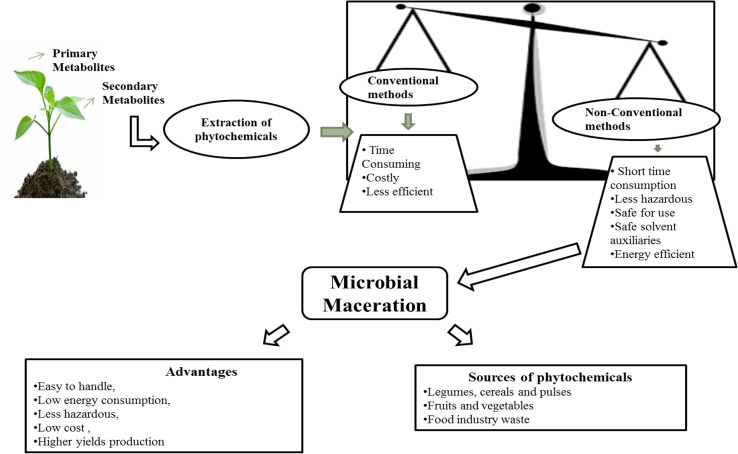
A rapid change in the lifestyle has witnessed poor health with the increased incidences of numerous diseases in the recent years, and ultimately increasing the demand of nutritious foods containing phytochemicals. A wide range of phytochemicals (secondary metabolites) is being synthesized in plants, which influence the human health upon consumption as dietary component. Recently, a number of the technologies (conventional and non-conventional methods) have been standardized by the different researchers for the extraction of these phytochemicals depending upon the raw material. However, selection of extraction method for commercial use depends upon various factors such as extraction efficiency, time required, and cost of operation. Considering these factors, microbial maceration is one of the viable approaches which is easy to handle, cost-effective, energy efficient, less hazardous and having high extraction rate. Recently, researchers have utilized this technique for the maceration of different plant-based substrates (such as legumes, cereals, pulses, fruits and vegetables) and their respective wastes for the efficient extraction of numerous phytochemicals with increased efficiency. However, scale up studies and analysis of toxic compounds produced by microbes are still a lacking field and need to be explored further by the researchers and industrialists to bring it into reality. Therefore, the present review aims to document the recent findings related to microbial maceration in a crisp way to provide the complete information to the readers.
Keywords: Bioactive compounds; Microbial maceration; Phytochemical extraction.
Conflict of interest statement
Compliance with ethical standardsThe authors declare that there is no conflict of interest regarding publication of this paper.
Figures
References
-
- Ajila CM, Gassara F, Brar SK, Verma M, Tyagi RD, Valero JR. Polyphenolic antioxidant mobilization in apple pomace by different methods of solid-state fermentation and evaluation of its antioxidant activity. Food Bioproc Tech. 2012;5(7):2697–2707. doi: 10.1007/s11947-011-0582-y. - DOI
-
- Azmir J, Zaidul IS, Rahman MM, Sharif KM, Mohamed A, Sahena F, Jahurul MH, Ghafoor K, Norulaini NA, Omar AK. Techniques for extraction of bioactive compounds from plant materials: a review. J Food Eng. 2013;117(4):426–436. doi: 10.1016/j.jfoodeng.2013.01.014. - DOI
-
- Azwanida NN. A review on the extraction methods use in medicinal plants, principle, strength and limitation. Med Aromat Plants. 2015;4(196):2167–0412.
-
- Bhanja T, Rout S, Banerjee R, Bhattacharyya BC. Studies on the performance of a new bioreactor for improving antioxidant potential of rice. LWT-Food Sci Technol. 2008;41(8):1459–1465. doi: 10.1016/j.lwt.2007.08.015. - DOI
Publication types
LinkOut - more resources
Full Text Sources
Other Literature Sources
