


Optimization of 13 C-urea breath test threshold levels for the detection of Helicobacter pylori infection in a national referral laboratory
- PMID: 30221401
- PMCID: PMC6818586
- DOI: 10.1002/jcla.22674
Optimization of 13 C-urea breath test threshold levels for the detection of Helicobacter pylori infection in a national referral laboratory
Abstract
Background: Threshold values for 13 C-urea breath test (13C-UBT) positivity may be affected by various sociodemographic, host, bacterial, and laboratory factors. Manufacturer recommended cutoffs for 13C-UBT assays may not be applicable in all settings. Optimizing 13C-UBT cutoffs may have profound public health ramifications. We aimed to determine the optimal threshold for 13C-UBT positivity in our population.
Methods: Consecutive test samples collected at our central laboratory from patients undergoing a first-time 13C-UBT between 1 January 2010 and 31 December 2015 were included. The difference between values at 30 minutes and at baseline (T30-T0) was expressed as delta over baseline (DOB). Cluster analysis was performed on the 13C-UBT test results to determine the optimal cutoff point with minimal interclass variance.
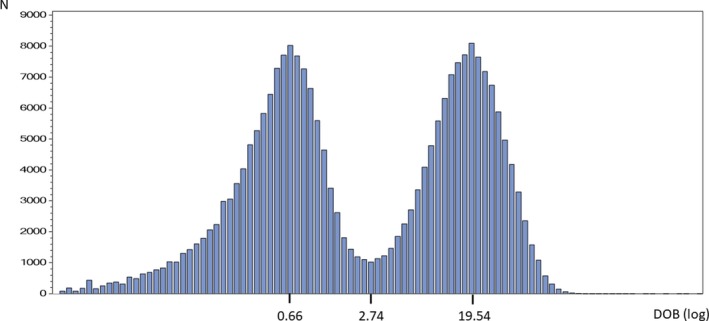
Results: Two lakhs thirty four thousand eight hundred thirty one patients (87 291 (37.2%) male, age 39.9 ± 19.9) underwent a first-time 13C-UBT, including 124 701 (53.1%) negative and 110 130 (46.9%) positive tests, using the manufacturer-recommended cutoff of 3.5 DOB. Cluster analysis determined an optimized cutoff of 2.74 DOB, representing an additional 2180 (0.93%) positive subjects who had been previously categorized as negative according to the manufacturer-specified cutoff of 3.5 DOB. Mean positive and negative DOB values were 19.54 ± 14.95 and 0.66 ± 0.51, respectively. The cutoffs for male and female subjects were 2.23 and 3.05 DOB, respectively. Threshold values for <45-year-olds, 45-60-year-olds and >60-year-olds were 2.67, 2.55, and 2.93 DOB, respectively. Of the 2180 (0.93%) patients with DOB 2.73-3.49, 289 (13.3%) performed a subsequent 13C-UBT and 140 (48.4%) remained positive when tested at 20.3 ± 14.4 months.
Conclusions: Major referral laboratories should optimize threshold values for 13C-UBT positivity for their geographical location. Different cutoff values should be applied for male and female subjects.
Keywords: Helicobacter pylori; 13C-urea breath test; cluster; cutoff; threshold.
© 2018 Wiley Periodicals, Inc.
Figures
References
-
- Malfertheiner P, Megraud F, O'Morain CA, et al. Management of Helicobacter pylori infection‐the Maastricht V/Florence consensus report. Gut. 2017;66:6‐30. - PubMed
-
- Lotterer E, Ramaker J, Lüdtke FE, Tegeler R, Geletneky JV, Bauer FE. The simplified 13C‐urea breath test–one point analysis for detection of Helicobacter pylori infection. Z Gastroenterol. 1991;29:590‐594. - PubMed
-
- Goddard AF, Logan RP. Review article: urea breath tests for detecting Helicobacter pylori . Aliment Pharmacol Ther. 1997;11:641‐649. - PubMed
MeSH terms
Substances
LinkOut - more resources
Full Text Sources
Other Literature Sources
Medical
