


A transcriptomics model of estrogen action in the ovine fetal hypothalamus: evidence for estrogenic effects of ICI 182,780
- PMID: 30221477
- PMCID: PMC6139289
- DOI: 10.14814/phy2.13871
A transcriptomics model of estrogen action in the ovine fetal hypothalamus: evidence for estrogenic effects of ICI 182,780
Abstract
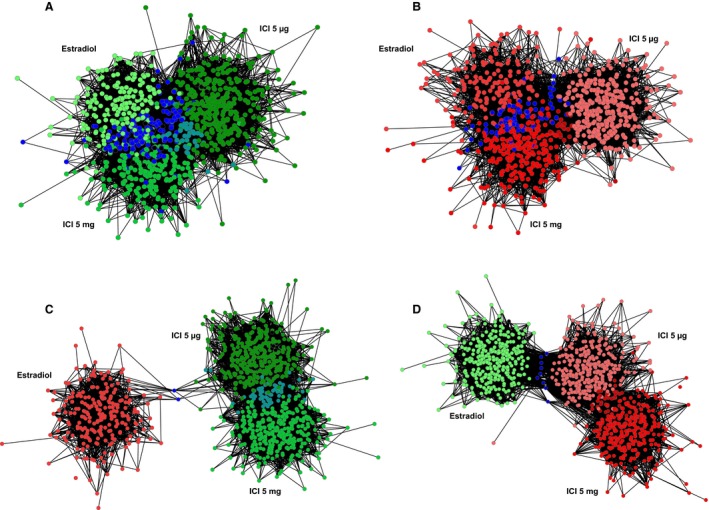
Estradiol plays a critical role in stimulating the fetal hypothalamus-pituitary-adrenal axis at the end of gestation. Estradiol action is mediated through nuclear and membrane receptors that can be modulated by ICI 182,780, a pure antiestrogen compound. The objective of this study was to evaluate the transcriptomic profile of estradiol and ICI 182,780, testing the hypothesis that ICI 182,780 antagonizes the action of estradiol in the fetal hypothalamus. Chronically catheterized ovine fetuses were infused for 48 h with: vehicle (Control, n = 6), 17β-estradiol 500 μg/kg/day (Estradiol, n = 4), ICI 182,780 5 μg/kg/day (ICI 5 μg, n = 4) and ICI 182,780 5 mg/kg/day (ICI 5 mg, n = 5). Fetal hypothalami were collected afterward, and gene expression was measured through microarray. Statistical analysis of transcriptomic data was performed with Bioconductor-R and Cytoscape software. Unexpectedly, 35% and 15.5% of the upregulated differentially expressed genes (DEG) by Estradiol significantly overlapped (P < 0.05) with upregulated DEG by ICI 5 mg and ICI 5 μg, respectively. For the downregulated DEG, these percentages were 29.9% and 15.5%, respectively. There was almost no overlap for DEG following opposite directions between Estradiol and ICI ICI 5 mg or ICI 5 μg. Furthermore, most of the genes in the estrogen signaling pathway - after activation of the epidermal growth factor receptor - followed the same direction in Estradiol, ICI 5 μg or ICI 5 mg compared to Control. In conclusion, estradiol and ICI 182,780 have estrogenic genomic effects in the developing brain, suggesting the possibility that the major action of estradiol on the fetal hypothalamus involves another receptor system rather than estrogen receptors.
Keywords: Brain development; estrogen signaling pathway; fetal programming; microarray.
© 2018 The Authors. Physiological Reports published by Wiley Periodicals, Inc. on behalf of The Physiological Society and the American Physiological Society.
Figures



References
-
- Alvarez‐Delgado, C. , Mendoza‐Rodríguez C. A., Picazo O. and Cerbón M.. 2010. Different expression of alpha and beta mitochondrial estrogen receptors in the aging rat brain: interaction with respiratory complex V. Exp. Gerontol. 45:580–585. - PubMed
-
- Brown, T. J. , Scherz B., Hochberg R. B. and MacLusky N. J.. 1996. Regulation of estrogen receptor concentrations in the rat brain: effects of sustained androgen and estrogen exposure. Neuroendocrinology 63:53–60. - PubMed
-
- Brzozowski, A. M. , Pike A. C., Dauter Z., Hubbard R. E., Bonn T., Engström O., et al. 1997. Molecular basis of agonism and antagonism in the oestrogen receptor. Nature 389:753–758. - PubMed
-
- Cambiasso, M. J. , and Carrer H. F.. 2001. Nongenomic mechanism mediates estradiol stimulation of axon growth in male rat hypothalamic neurons in vitro. J. Neurosci. Res. 66:475–481. - PubMed
Publication types
MeSH terms
Substances
Grants and funding
LinkOut - more resources
Full Text Sources
Other Literature Sources
Molecular Biology Databases
Research Materials
