


Biopsy-Proven Small-Fiber Neuropathy in Primary Sjögren's Syndrome: Neuropathic Pain Characteristics, Autoantibody Findings, and Histopathologic Features
- PMID: 30221483
- PMCID: PMC7556316
- DOI: 10.1002/acr.23762
Biopsy-Proven Small-Fiber Neuropathy in Primary Sjögren's Syndrome: Neuropathic Pain Characteristics, Autoantibody Findings, and Histopathologic Features
Erratum in
-
Erratum.Arthritis Care Res (Hoboken). 2019 Sep;71(9):1283. doi: 10.1002/acr.24041. Arthritis Care Res (Hoboken). 2019. PMID: 31469257 No abstract available.
Abstract
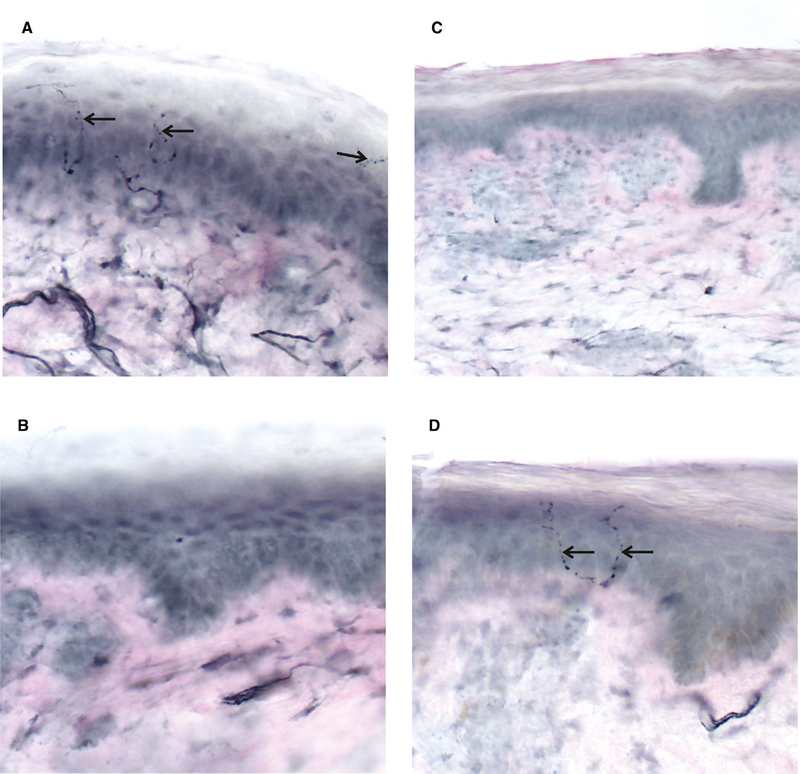
Objective: Painful small-fiber neuropathies (SFNs) in primary Sjögren's syndrome (SS) may present as pure or mixed with concurrent large-fiber involvement. SFN can be diagnosed by punch skin biopsy results that identify decreased intra-epidermal nerve-fiber density (IENFD) of unmyelinated nerves.
Methods: We compared 23 consecutively evaluated patients with SS with pure and mixed SFN versus 98 patients without SFN. We distinguished between markers of dorsal root ganglia (DRG) degeneration (decreased IENFD in the proximal thigh versus the distal leg) versus axonal degeneration (decreased IENFD in the distal leg versus the proximal thigh).
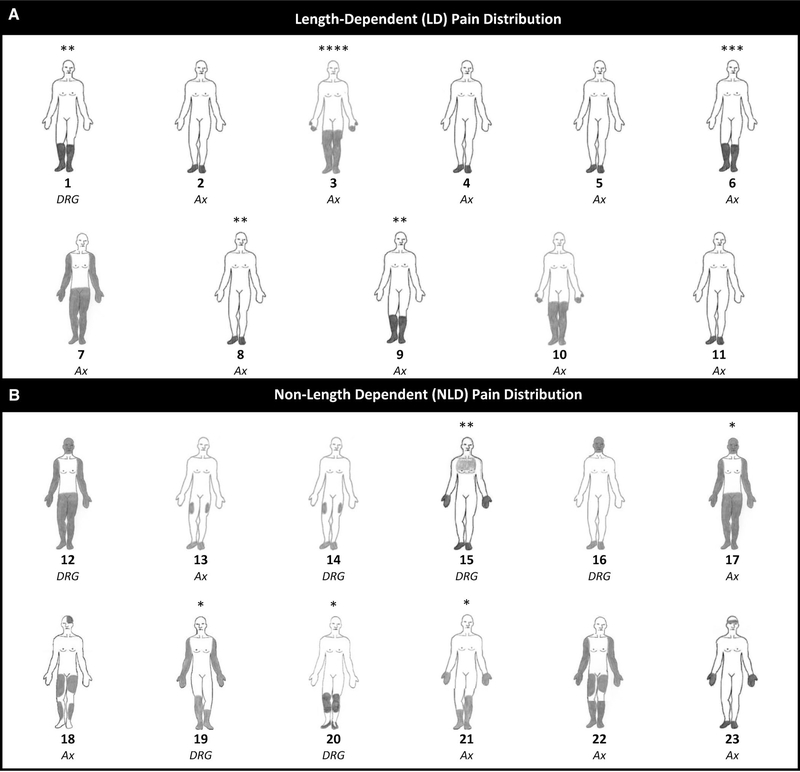
Results: There were no differences in pain intensity, pain quality, and treatment characteristics in the comparison of 13 patients with pure SFN versus 10 patients with mixed SFN. Ten patients with SFN (approximately 45%) had neuropathic pain preceding sicca symptoms. Opioid analgesics were prescribed to approximately 45% of patients with SFN. When compared to 98 patients without SFN, the 23 patients with SFN had an increased frequency of male sex (30% versus 9%; P < 0.01), a decreased frequency of anti-Ro 52 (P = 0.01) and anti-Ro 60 antibodies (P = 0.01), rheumatoid factor positivity (P < 0.01), and polyclonal gammopathy (P < 0.01). Eleven patients had stocking-and-glove pain, and 12 patients had nonstocking-and-glove pain. Skin biopsy results disclosed patterns of axonal (16 patients) and DRG injury (7 patients).
Conclusion: SS SFN had an increased frequency among male patients, a decreased frequency of multiple antibodies, frequent treatment with opioid analgesics, and the presence of nonstocking-and-glove pain. Distinguishing between DRG versus axonal injury is significant, especially given that mechanisms targeting the DRG may result in irreversible neuronal cell death. Altogether, these findings highlight clinical, autoantibody, and pathologic features that can help to define mechanisms and treatment strategies.
© 2018, American College of Rheumatology.
Conflict of interest statement
No potential conflicts of interest relevant to this article were reported.
Figures
References
-
- Birnbaum J. Peripheral nervous system manifestations of Sjogren syndrome: clinical patterns, diagnostic paradigms, etiopathogenesis, and therapeutic strategies. Neurologist 2010;16:287–97. - PubMed
-
- Pavlakis PP, Alexopoulos H, Kosmidis ML, Stamboulis E, Routsias JG, Tzartos SJ, et al. Peripheral neuropathies in Sjogren syndrome: a new reappraisal. J Neurol Neurosurg Psychiatry 2011;82:798–802. - PubMed
-
- Chan AC, Wilder-Smith EP. Small fiber neuropathy: getting bigger! Muscle Nerve 2016;53:671–82. - PubMed
-
- Chai J, Herrmann DN, Stanton M, Barbano RL, Logigian EL. Painful small-fiber neuropathy in Sjogren syndrome. Neurology 2005;65:925–7. - PubMed
-
- Ebenezer GJ, Hauer P, Gibbons C, McArthur JC, Polydefkis M. Assessment of epidermal nerve fibers: a new diagnostic and predictive tool for peripheral neuropathies. J Neuropathol Exp Neurol 2007;66:1059–73. - PubMed
Publication types
MeSH terms
Substances
Grants and funding
LinkOut - more resources
Full Text Sources
Other Literature Sources
Medical
Research Materials
Miscellaneous
