


DREAMS-START (Dementia RElAted Manual for Sleep; STrAtegies for RelaTives) for people with dementia and sleep disturbances: a single-blind feasibility and acceptability randomized controlled trial
- PMID: 30221615
- PMCID: PMC6474714
- DOI: 10.1017/S1041610218000753
DREAMS-START (Dementia RElAted Manual for Sleep; STrAtegies for RelaTives) for people with dementia and sleep disturbances: a single-blind feasibility and acceptability randomized controlled trial
Abstract
ABSTRACTBackground:40% of people with dementia have disturbed sleep but there are currently no known effective treatments. Studies of sleep hygiene and light therapy have not been powered to indicate feasibility and acceptability and have shown 40-50% retention. We tested the feasibility and acceptability of a six-session manualized evidence-based non-pharmacological therapy; Dementia RElAted Manual for Sleep; STrAtegies for RelaTives (DREAMS-START) for sleep disturbance in people with dementia.
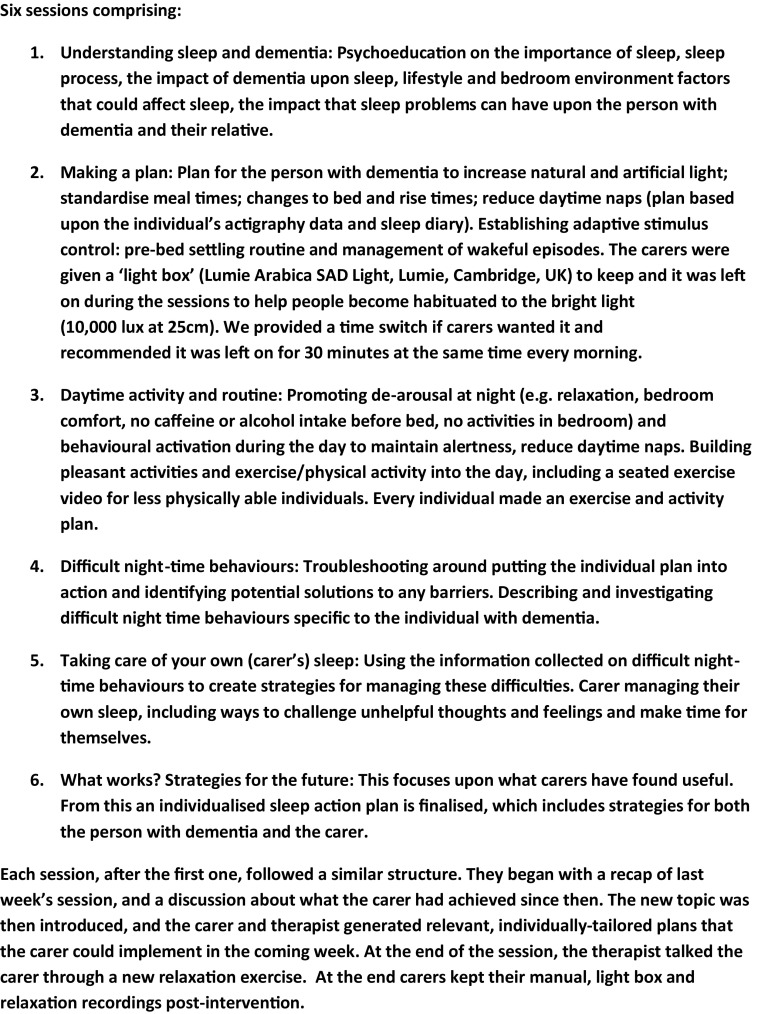
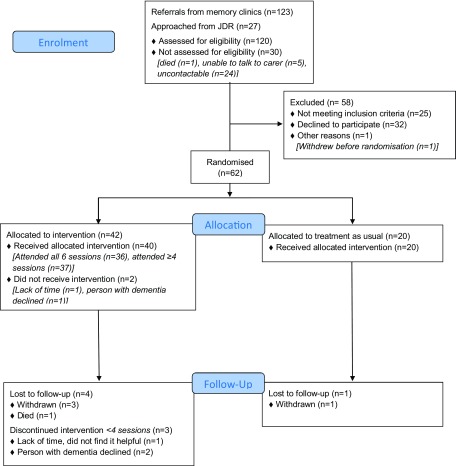
Methods: We conducted a parallel, two-armed, single-blind randomized trial and randomized 2:1 to intervention: Treatment as Usual. Eligible participants had dementia and sleep disturbances (scoring ≥4 on one Sleep Disorders Inventory item) and a family carer and were recruited from two London memory services and Join Dementia Research. Participants wore an actiwatch for two weeks pre-randomization. Trained, clinically supervised psychology graduates delivered DREAMS-START to carers randomized to intervention; covering Understanding sleep and dementia; Making a plan (incorporating actiwatch information, light exposure using a light box); Daytime activity and routine; Difficult night-time behaviors; Taking care of your own (carer's) sleep; and What works? Strategies for the future. Carers kept their manual, light box, and relaxation recordings post-intervention. Outcome assessment was masked to allocation. The co-primary outcomes were feasibility (≥50% eligible people consenting to the study) and acceptability (≥75% of intervention group attending ≥4 intervention sessions).
Results: In total, 63out of 95 (66%; 95% CI: 56-76%) eligible referrals consented between 04/08/2016 and 24/03/2017; 62 (65%; 95% CI: 55-75%) were randomized, and 37 out of 42 (88%; 95% CI: 75-96%) adhered to the intervention.
Conclusions: DREAM-START for sleep disorders in dementia is feasible and acceptable.
Keywords: carers; cognitive behavioral therapy (CBT); physical activity; randomized controlled trial (RCT); sleep disorders.
Figures
References
-
- Barry T. L., Kaiser K. L. and Atwood J. R. (2007). Reliability, validity, and scoring of the Health Status Questionnaire-12 version 2.0. Journal of Nursing Measurement, 15, 24–35. - PubMed
-
- Bjelland I., Dahl A. A., Haug T. T. and Neckelmann D. (2002). The validity of the hospital anxiety and depression scale. an updated literature review. Journal of Psychosomatic Research, 52, 69–77. - PubMed
-
- Buysse D. J., Reynolds C. F. III, Monk T. H., Berman S. R. and Kupfer D. J. (1989). The Pittsburgh sleep quality index: a new instrument for psychiatric practice and research. Psychiatry Research, 28, 193–213. - PubMed
-
- Cummings J. L., Mega M., Gray K., Rosenberg-Thompson S., Carusi D. A. and Gornbein J. (1994). The neuropsychiatric inventory: comprehensive assessment of psychopathology in dementia. Neurology, 44, 2308–14. - PubMed
-
- Dauvilliers Y. (2007). Insomnia in patients with neurodegenerative conditions. Sleep Medicine, 8, S27–S34. - PubMed
Publication types
MeSH terms
Associated data
Grants and funding
LinkOut - more resources
Full Text Sources
Other Literature Sources
Medical
