


Venous congestion and pulmonary vascular function in Fontan circulation: Implications for prognosis and treatment
- PMID: 30223363
- PMCID: PMC6146405
- DOI: 10.1016/j.ijcard.2018.05.039
Venous congestion and pulmonary vascular function in Fontan circulation: Implications for prognosis and treatment
Abstract
Background: Elevation in central venous pressure (CVP) plays a fundamental pathophysiologic role in Fontan circulation. Because there is no sub-pulmonary ventricle in this system, CVP also provides the driving force for pulmonary blood flow. We hypothesized that this would make Fontan patients more susceptible to even low-level elevation in pulmonary vascular resistance index (PVRI), resulting in greater systemic venous congestion and adverse outcomes.
Methods: Adult Fontan patients and controls without congenital heart disease undergoing clinical evaluation that included cardiac catheterization and echocardiography were examined retrospectively. Outcomes including all-cause mortality and the development of Fontan associated diseases (FAD, defined as protein losing enteropathy, cirrhosis, heart failure hospitalization, arrhythmia, or thromboembolism) were assessed from longitudinal assessment.
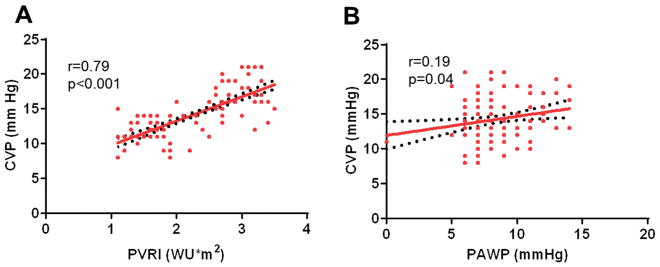
Results: As compared to controls (n = 82), Fontan patients (n = 164) were younger (36 vs 45 years, p < 0.001), more likely to be on anticoagulation or antiplatelet therapy, and more likely to have atrial arrhythmia or cirrhosis. There was a strong correlation between CVP and PVRI in the Fontan group (r = 0.79, p < 0.001), but there was no such relationship in controls. Elevated PVRI identified patients at increased risk for FAD (HR 1.92, 95% CI 1.39-2.41, p = 0.01), and composite endpoint of FAD and/or death (HR 1.89, 95% CI 1.32-2.53, p = 0.01) per 1 WU∗m2 increment.
Conclusions: Systemic venous congestion, which is the primary factor in the pathogenesis of FAD and death, is related to even low-level abnormalities in pulmonary vascular function. Multicenter studies are needed to determine whether interventions targeting pulmonary vascular structure and function can improve outcomes in the Fontan population.
Keywords: Central venous pressure; Fontan associated diseases; Fontan failure; Pulmonary vascular resistance.
Copyright © 2018 Elsevier B.V. All rights reserved.
Conflict of interest statement
None
Figures
References
-
- Budts W, Roos-Hesselink J, Radle-Hurst T, Eicken A, McDonagh TA, Lambrinou E, Crespo-Leiro MG, Walker F, Frogoudaki AA. Treatment of heart failure in adult congenital heart disease: a position paper of the Working Group of Grown-Up Congenital Heart Disease and the Heart Failure Association of the European Society of Cardiology. Eur Heart J. 2016;37:1419–27. - PMC - PubMed
-
- John AS, Johnson JA, Khan M, Driscoll DJ, Warnes CA, Cetta F. Clinical outcomes and improved survival in patients with protein-losing enteropathy after the Fontan operation. J Am Coll Cardiol. 2014;64:54–62. - PubMed
-
- Mori M, Hebson C, Shioda K, Elder RW, Kogon BE, Rodriguez FH, Jokhadar M, Book WM. Catheter-measured Hemodynamics of Adult Fontan Circulation: Associations with Adverse Event and End-organ Dysfunctions. Congenit Heart Dis. 2016;11:589–597. - PubMed
MeSH terms
Grants and funding
LinkOut - more resources
Full Text Sources
Other Literature Sources
Research Materials
