


Neuropathologic Correlates of Psychiatric Symptoms in Alzheimer's Disease
- PMID: 30223398
- PMCID: PMC6381997
- DOI: 10.3233/JAD-180688
Neuropathologic Correlates of Psychiatric Symptoms in Alzheimer's Disease
Abstract
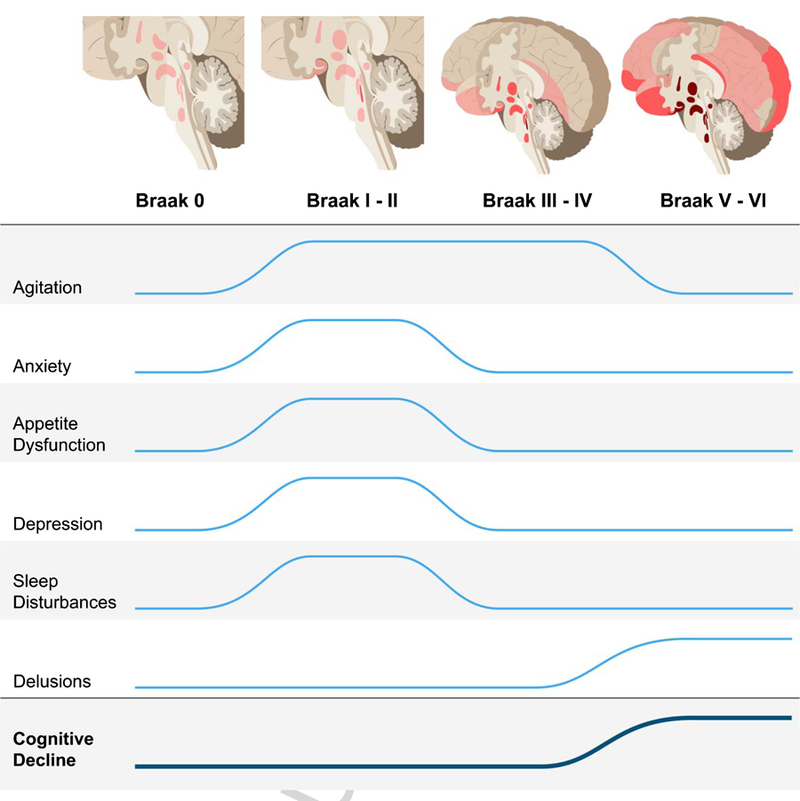
Clarifying the relationships between neuropsychiatric symptoms and Alzheimer's disease (AD)-related pathology may open avenues for effective treatments. Here, we investigate the odds of developing neuropsychiatric symptoms across increasing burdens of neurofibrillary tangle and amyloid-β pathology. Participants who passed away between 2004 and 2014 underwent comprehensive neuropathologic evaluation at the Biobank for Aging Studies from the Faculty of Medicine at the University of São Paulo. Postmortem interviews with reliable informants were used to collect information regarding neuropsychiatric and cognitive status. Of 1,092 cases collected, those with any non-Alzheimer pathology were excluded, bringing the cohort to 455 cases. Braak staging was used to evaluate neurofibrillary tangle burden, and the CERAD neuropathology score was used to evaluate amyloid-β burden. The 12-item neuropsychiatric inventory was used to evaluate neuropsychiatric symptoms and CDR-SOB score was used to evaluate dementia status. In Braak I/II, significantly increased odds were detected for agitation, anxiety, appetite changes, depression, and sleep disturbances, compared to controls. Increased odds of agitation continue into Braak III/IV. Braak V/VI is associated with higher odds for delusions. No increased odds for neuropsychiatric symptoms were found to correlate with amyloid-β pathology. Increased odds of neuropsychiatric symptoms are associated with early neurofibrillary tangle pathology, suggesting that subcortical neurofibrillary tangle accumulation with minimal cortical pathology is sufficient to impact quality of life and that neuropsychiatric symptoms are a manifestation of AD biological processes.
Keywords: Alzheimer’s disease; amyloid plaques; anxiety; appetite behavior; depression; neurofibrillary tangles; neuropathology; neuropsychiatry; sleep; tau protein.
Figures
References
-
- Morris JC (2005) Early-stage and preclinical Alzheimer disease. Alzheimer Dis Assoc Disord 19, 163–165. - PubMed
-
- Montine TJ, Phelps CH, Beach TG, Bigio EH, Cairns NJ, Dickson DW, Duyckaerts C, Frosch MP, Masliah E, Mirra SS, Nelson PT, Schneider JA, Thal DR, Trojanowski JQ, Vinters HV, Hyman BT, National Institute on Aging, Alzheimer’s Association (2012) National Institute on Aging-Alzheimer’s Association guidelines for the neuropathologic assessment of Alzheimer’s disease: A practical approach. Acta Neuropathol 123, 1–11. - PMC - PubMed
-
- Gomez-Isla T, Hollister R, West H, Mui S, Growdon JH, Petersen RC, Parisi JE, Hyman BT (1997) Neuronal loss correlates with but exceeds neurofibrillary tangles in Alzheimer’s disease. Ann Neurol 41, 17–24. - PubMed
-
- Giannakopoulos P, Herrmann FR, Bussiere T, Bouras C, Kovari E, Perl DP, Morrison JH, Gold G, Hof PR (2003) Tangle and neuron numbers, but not amyloid load, predict cognitive status in Alzheimer’s disease. Neurology 60, 1495–1500. - PubMed
-
- Braak H, Braak E (1991) Neuropathological stageing of Alzheimer-related changes. Acta Neuropathol 82, 239–259. - PubMed
Publication types
MeSH terms
Grants and funding
LinkOut - more resources
Full Text Sources
Other Literature Sources
Medical
