


Molecular genetic and biochemical evidence for adaptive evolution of leaf abaxial epicuticular wax crystals in the genus Lithocarpus (Fagaceae)
- PMID: 30223774
- PMCID: PMC6142356
- DOI: 10.1186/s12870-018-1420-4
Molecular genetic and biochemical evidence for adaptive evolution of leaf abaxial epicuticular wax crystals in the genus Lithocarpus (Fagaceae)
Abstract
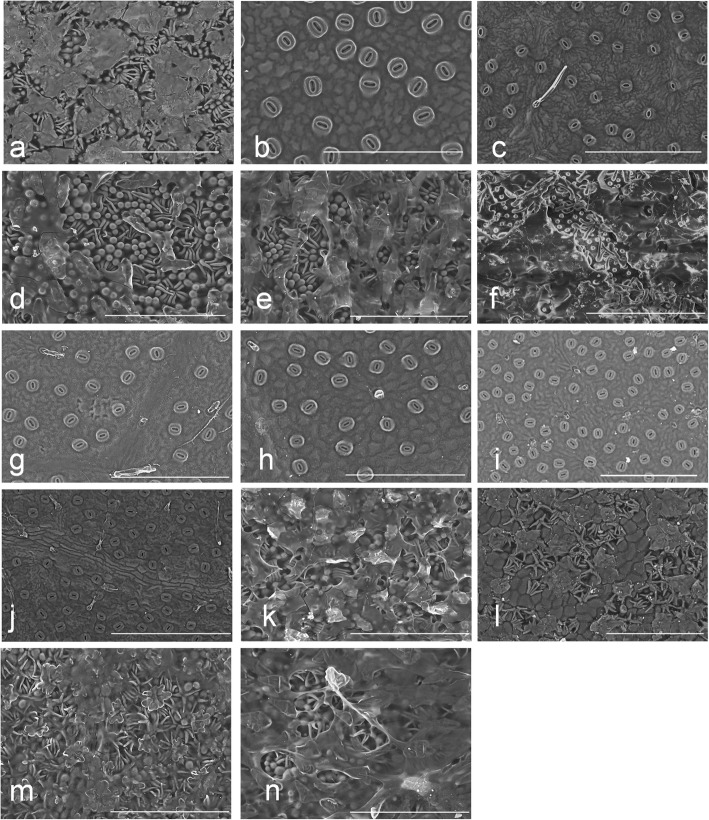
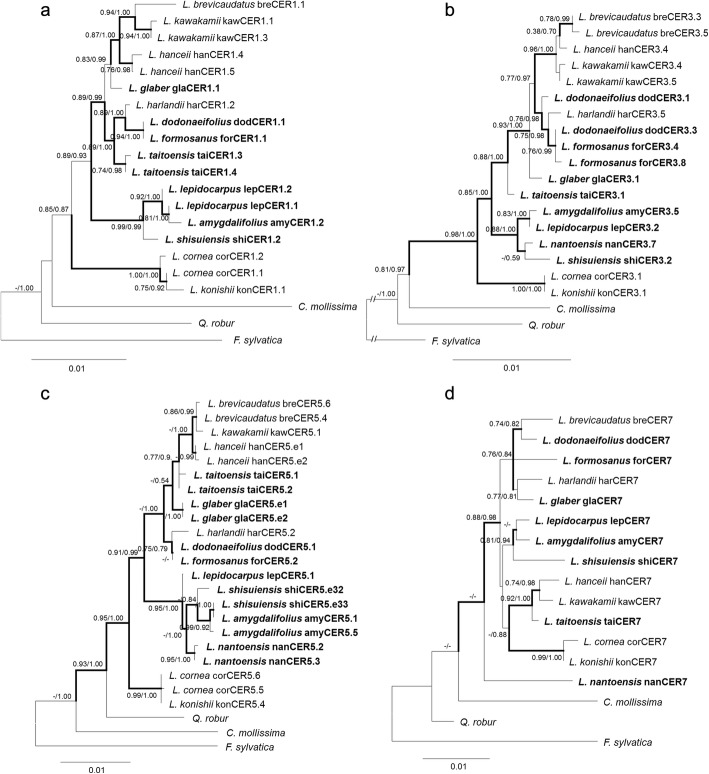
Background: Leaf epicuticular wax is an important functional trait for physiological regulation and pathogen defense. This study tests how selective pressure may have forced the trait of leaf abaxial epicuticular wax crystals (LAEWC) and whether the presence/absence of LAEWC is associated with other ecophysiological traits. Scanning Electron Microscopy was conducted to check for LAEWC in different Lithocarpus species. Four wax biosynthesis related genes, including two wax backbone genes ECERIFERUM 1 (CER1) and CER3, one regulatory gene CER7 and one transport gene CER5, were cloned and sequenced. Ecophysiological measurements of secondary metabolites, photosynthesis, water usage efficiency, and nutrition indices were also determined. Evolutionary hypotheses of leaf wax character transition associated with the evolution of those ecophysiological traits as well as species evolution were tested by maximum likelihood.
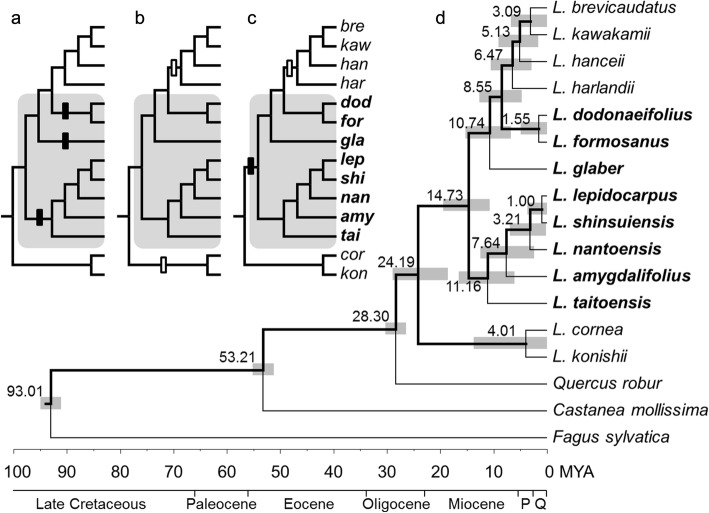
Results: Eight of 14 studied Lithocarpus species have obvious LAEWC appearing with various types of trichomes. Measurements of ecophysiological traits show no direct correlations with the presence/absence of LAEWC. However, the content of phenolic acids is significantly associated with the gene evolution of the wax biosynthetic backbone gene CER1, which was detected to be positively selected when LAEWC was gained during the late-Miocene-to-Pliocene period.
Conclusions: Changes of landmass and vegetation type accelerated the diversification of tropical and subtropical forest trees and certain herbivores during the late Miocene. As phenolic acids were long thought to be associated with defense against herbivories, co-occurrence of LAEWC and phenolic acids may suggest that LAEWC might be an adaptive defensive mechanism in Lithocarpus.
Keywords: Adaptive evolution; Chemical defenses; Leaf epicuticular wax; Lithocarpus; Phylogenetic signal; Physical defenses.
Conflict of interest statement
Ethics approval and consent to participate
Not applicable.
Consent for publication
Not applicable.
Competing interests
The authors declare that there are no conflicts of interest.
Publisher’s Note
Springer Nature remains neutral with regard to jurisdictional claims in published maps and institutional affiliations.
Figures

References
-
- Haworth M, McElwain J. Hot, dry, wet, cold or toxic? Revisiting the ecological significance of leaf and cuticular micromorphology. Palaeogeogr Palaeocl. 2008;262(1–2):79–90. doi: 10.1016/j.palaeo.2008.02.009. - DOI
-
- Hill RS. Fossil evidence for the onset of xeromorphy and scleromorphy in Australian Proteaceae. Aust Syst Bot. 1998;11(3–4):391–400. doi: 10.1071/SB97016. - DOI
-
- Becker M, Kerstiens G, Schonherr J. Water permeability of plant cuticles: permeance, diffusion and partition coefficients. Trees-Struct Funct. 1986;1(1):54–60. doi: 10.1007/BF00197025. - DOI
-
- Richardson A, Franke R, Kerstiens G, Jarvis M, Schreiber L, Fricke W. Cuticular wax deposition in growing barley (Hordeum vulgare) leaves commences in relation to the point of emergence of epidermal cells from the sheaths of older leaves. Planta. 2005;222(3):472–483. doi: 10.1007/s00425-005-1552-2. - DOI - PubMed
MeSH terms
Substances
Grants and funding
LinkOut - more resources
Full Text Sources
Other Literature Sources
Research Materials
