


Deleterious effects of dialysis emergency start, insights from the French REIN registry
- PMID: 30223784
- PMCID: PMC6142323
- DOI: 10.1186/s12882-018-1036-9
Deleterious effects of dialysis emergency start, insights from the French REIN registry
Erratum in
-
Correction to: Deleterious effects of dialysis emergency start, insights from the French REIN registry.BMC Nephrol. 2018 Oct 15;19(1):266. doi: 10.1186/s12882-018-1063-6. BMC Nephrol. 2018. PMID: 30322378 Free PMC article.
Abstract
Background: Emergency start (ES) of dialysis has been associated with worse outcome, but remains poorly documented. This study aims to compare the profile and outcome of a large cohort of patients starting dialysis as an emergency or as a planned step in France.
Methods: Data on all patients aged 18 years or older who started dialysis in mainland France in 2012 or in 2006 were collected from the Renal Epidemiology and Information Network and compared, depending on the dialysis initiation condition: ES or Planned Start (PS). ES was defined as a first dialysis within 24 h after a nephrology visit due to a life-threatening event. Three-year survival were compared, and a multivariate model was performed after multiple imputation of missing data, to determine the parameters independently associated with three-year survival.
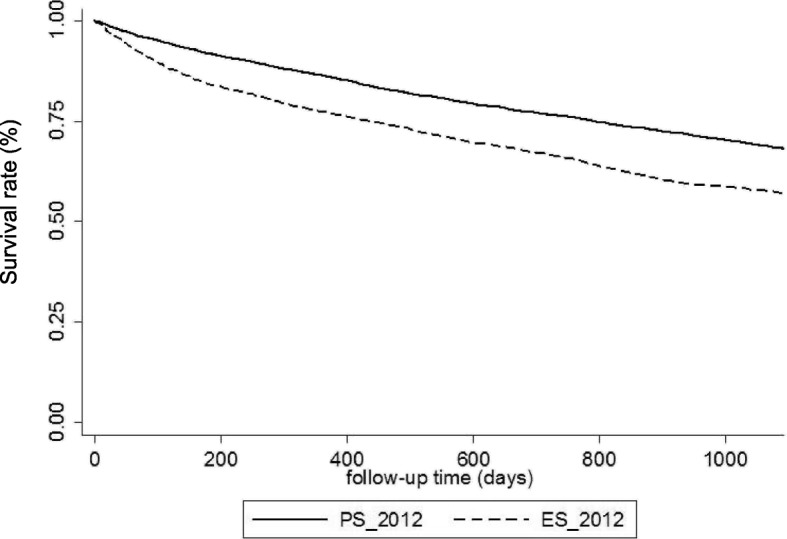
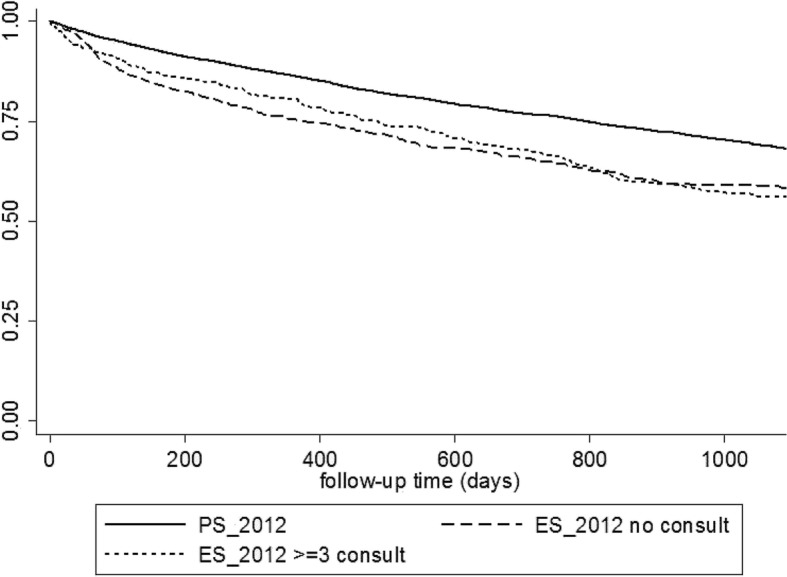
Results: In 2012, 30.3% of all included patients (n = 8839) had ES. Comorbidities were more frequent in the ES than PS group (≥ 2 cardiovascular diseases: 39.2% vs 28.8%, p < 0.001). ES was independently associated with worse three-year survival (57% vs. 68.2%, p = 0.029, HR 1.10, 95% CI 1.01-1.19) in multivariate analysis. Among ES group, a large part had a consistent previous follow-up: 36.4% of them had ≥3 nephrology consultations in the previous year. This subgroup of patients had a particularly high comorbidity burden. ES rate was stable between 2006 and 2012, but some proactive regions succeeded in reducing markedly the ES rate.
Conclusion: ES remains frequent and is independently associated with worse three-year survival, demonstrating that ES deleterious impact is never overcome. This study shows that a large part of patients with ES had a previous follow-up, but high comorbidity burden that could favor acute decompensation with life-threatening conditions before uremic symptoms appearance. This suggests the need of closer end-stage renal disease follow-up or early dialysis initiation in these high-risk patients.
Keywords: Dialysis; ESRD; Emergency start; France; Outcome; Survival.
Conflict of interest statement
Ethics approval and consent to participate
This study used data collected through the french REIN registry, a national database including every french dialysed patient since 2003. This registry has been allowed after CNIL approvement n° 903,188.
URL:
This study didn’t require patient’s specific written or verbal consent as this was use of already collected data. Every French dialyzed patient is included in REIN after information when he initiates chronic dialysis, unless he opposes to his name specific recording, in which case he will be anonymously recorded.
Consent for publication
Not applicable. This manuscript doesn’t contain data from any individual person.
Competing interests
The authors declare that they have no competing interests.
Publisher’s Note
Springer Nature remains neutral with regard to jurisdictional claims in published maps and institutional affiliations.
Figures
References
-
- USRDS 2015 Incidence, prevalence, patient characteristics, and treatment modalities [internet]. Available from: http://www.usrds.org/2015/view/v2_01.aspx [cited 2016 Feb 25].
-
- Pippias Maria, Jager Kitty J., Kramer Anneke, Leivestad Torbjørn, Sánchez Manuel Benítez, Caskey Fergus J., Collart Frederic, Couchoud Cécile, Dekker Friedo W., Finne Patrik, Fouque Denis, Heaf James G., Hemmelder Marc H., Kramar Reinhard, De Meester Johan, Noordzij Marlies, Palsson Runolfur, Pascual Julio, Zurriaga Oscar, Wanner Christoph, Stel Vianda S. The changing trends and outcomes in renal replacement therapy: data from the ERA-EDTA Registry. Nephrology Dialysis Transplantation. 2015;31(5):831–841. doi: 10.1093/ndt/gfv327. - DOI - PubMed
-
- Vigneau Cécile, Kolko Anne, Stengel Bénédicte, Jacquelinet Christian, Landais Paul, Rieu Philippe, Bayat Sahar, Couchoud Cécile. Ten-years trends in renal replacement therapy for end-stage renal disease in mainland France: Lessons from the French Renal Epidemiology and Information Network (REIN) registry. Néphrologie & Thérapeutique. 2017;13(4):228–235. doi: 10.1016/j.nephro.2016.07.453. - DOI - PubMed
-
- Maynard C, Cordonnier D. The late referral of diabetic patients with kidney insufficiency to nephrologists has a high human and financial cost: interdisciplinary communication is urgently needed. Diabetes Metab. 2001;27:517–521. - PubMed
MeSH terms
LinkOut - more resources
Full Text Sources
Other Literature Sources
Medical
