


Haemoglobin A1c and hearing impairment: longitudinal analysis using a large occupational health check-up data of Japan
- PMID: 30224397
- PMCID: PMC6144394
- DOI: 10.1136/bmjopen-2018-023220
Haemoglobin A1c and hearing impairment: longitudinal analysis using a large occupational health check-up data of Japan
Abstract
Objectives: The aim of this study was to determine whether haemoglobin A1c (HbA1c) level is associated with the incidence of hearing impairment accounting for smoking status and diabetic condition at baseline.
Methods: Participants were 131 689 men and 71 286 women aged 30-65 years and free of hearing impairment at baseline (2008) who attended Japanese occupational annual health check-ups from 2008 to 2015. We defined low-frequency hearing impairment at a hearing threshold >30 dB at 1 kHz and high frequency at >40 dB at 4 kHz in the better ear in pure-tone audiometric tests. HbA1c was categorised into seven categories. The association between HbA1c and hearing impairment was assessed using the Cox proportional hazards model.
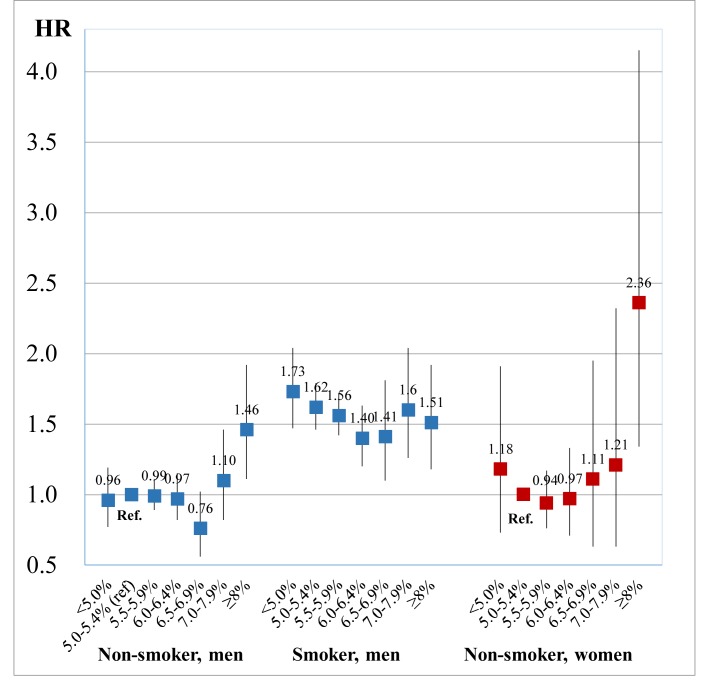
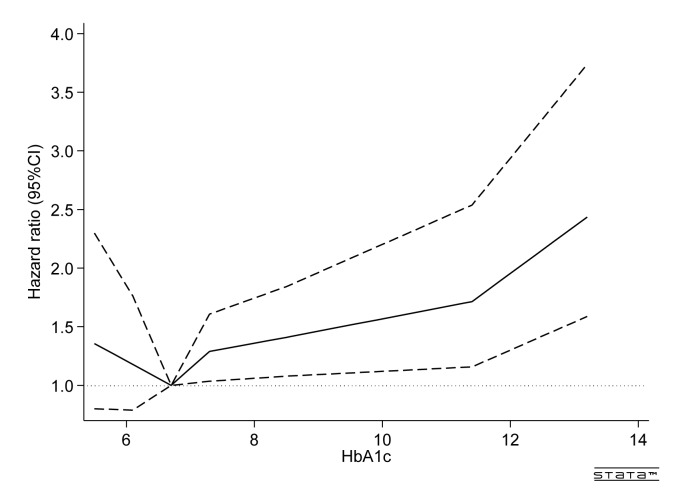
Results: On 5 years mean follow-up, high HbA1c was associated with high-frequency hearing impairment. In non-smokers, HbA1c≥8.0% was associated with high-frequency hearing impairment, with a multivariable HR (95% CI) compared with HbA1c 5.0%-5.4% of 1.46 (1.10 to 1.94) in men and 2.15 (1.13 to 4.10) in women. There was no significant association between HbA1c and hearing impairment in smokers. A J-shaped association between HbA1c and high-frequency hearing impairment was observed for participants with diabetes at baseline. HbA1c was not associated with low-frequency hearing impairment among any participants.
Conclusions: HbA1c ≥8.0% of non-smokers and ≥7.3% of participants with diabetes was associated with high-frequency hearing impairment. These findings indicate that appropriate glycaemic control may prevent diabetic-related hearing impairment.
Keywords: audiology; epidemiology.
© Author(s) (or their employer(s)) 2018. Re-use permitted under CC BY-NC. No commercial re-use. See rights and permissions. Published by BMJ.
Conflict of interest statement
Competing interests: SN is occupational physicians in All Japan Labor Welfare Foundation.
Figures
References
-
- WHO. Deafness and hearing loss. http://www.who.int/mediacentre/factsheets/fs300/en (accessed 11 Jan 2018).
Publication types
MeSH terms
Substances
LinkOut - more resources
Full Text Sources
Other Literature Sources
Medical
Miscellaneous
