Lung-Enriched Mutations in the p53 Tumor Suppressor: A Paradigm for Tissue-Specific Gain of Oncogenic Function
- PMID: 30224539
- PMCID: PMC6729127
- DOI: 10.1158/1541-7786.MCR-18-0357
Lung-Enriched Mutations in the p53 Tumor Suppressor: A Paradigm for Tissue-Specific Gain of Oncogenic Function
Abstract
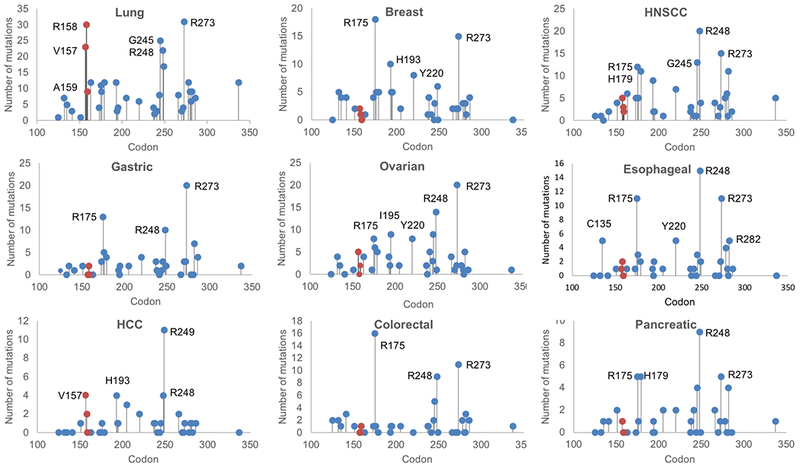
Lung cancer, the leading cause of cancer-related mortality in the United States, occurs primarily due to prolonged exposure to an array of carcinogenic compounds in cigarette smoke. These carcinogens create bulky DNA adducts, inducing alterations including missense mutations in the tumor suppressor gene TP53 TP53 is the most commonly mutated gene in many human cancers, and a specific set of these variants are enriched in lung cancer (at amino acid residues V157, R158, and A159). This perspective postulates that lung-enriched mutations can be explained, in part, by biological selection for oncogenic gain-of-function (GOF) mutant p53 alleles at V157, R158, and A159. This hypothesis explaining tissue-specific TP53 mutations is further supported by mouse model studies of the canonical TP53 hotspots showing that tumor spectra and GOF activities are altered with mutation type. Therefore, although smoking-related lung cancer unequivocally arises due to the mutagenic environment induced by tobacco carcinogens, this perspective provides a rationale for the preferential selection of lung-enriched V157, R158, and A159 mutant p53.
©2018 American Association for Cancer Research.
Conflict of interest statement
Conflict of interest disclosure statement:
The authors have no conflicts of interest to disclose.
Figures
References
-
- Lane DP, Crawford LV. T antigen is bound to a host protein in SV40-transformed cells. Nature 1979;278:261–3 - PubMed
-
- Linzer DI, Levine AJ. Characterization of a 54K dalton cellular SV40 tumor antigen present in SV40-transformed cells and uninfected embryonal carcinoma cells. Cell 1979;17:43–52 - PubMed
Publication types
MeSH terms
Substances
Grants and funding
LinkOut - more resources
Full Text Sources
Other Literature Sources
Medical
Molecular Biology Databases
Research Materials
Miscellaneous