Clinical Usefulness of Unenhanced Computed Tomography in Patients with Acute Pyelonephritis
- PMID: 30224907
- PMCID: PMC6137028
- DOI: 10.3346/jkms.2018.33.e236
Clinical Usefulness of Unenhanced Computed Tomography in Patients with Acute Pyelonephritis
Abstract
Background: Unenhanced computed tomography (UCT) may be useful for evaluating acute pyelonephritis; however, no study has compared UCT with enhanced computed tomography (ECT) as a diagnostic tool. We evaluated a clinical usefulness of UCT versus ECT in acute pyelonephritis (APN).
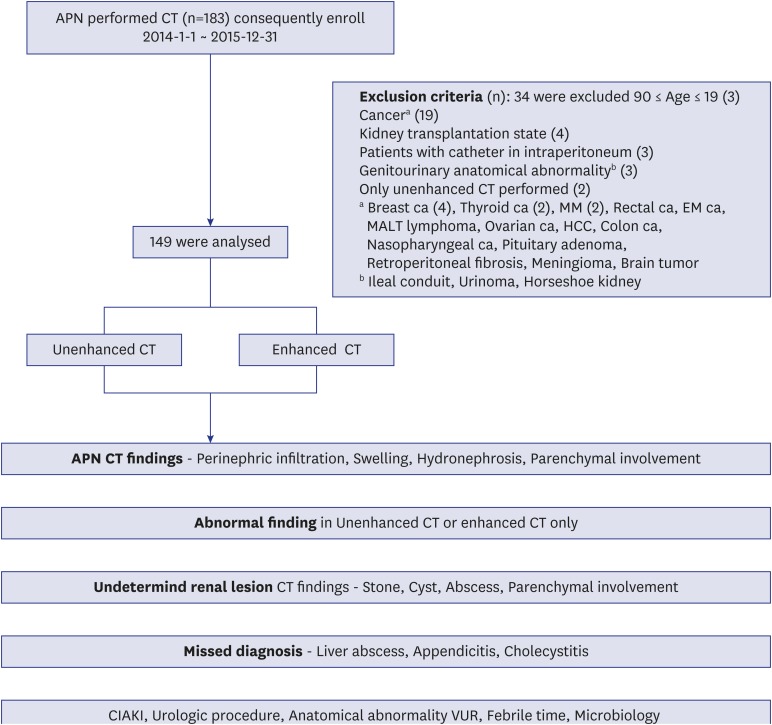
Methods: We reviewed the clinical and radiological data from 183 APN-suspected patients who underwent UCT and ECT simultaneously at emergency room (ER) over a two-year period. Demographic, clinical parameters and computed tomography (CT) parameters of 149 patients were compared.
Results: The average patient age was 61.2 (± 10) years: 31 patients were men. Ninety-nine (66.4%) patients showed stones (18.7%), perinephric infiltration (56%), swelling (21%), and hydronephrosis (6.7%) on UCT. Seventeen patients (11.4%) had an atypical clinical course, requiring additional tests for accurate diagnosis. In 7 patients UCT and ECT results did not differ; in 10 patients, the diagnosis changed on ECT. On ECT, 112/149 (75.2%) patients had stones (16.7%), perinephric infiltrations (57%), swelling (21%), and hydronephrosis (6.7%); 62.5% showed parenchymal involvement: 34 (22.8%) patients had no abnormal ECT findings. APN CT findings are similar on stone, perinephric infiltration, swelling and hydronephrosis on both CTs. Twelve patients (8.0%) had an abnormal ECT finding, i.e., low-grade (1 and 2) parenchymal involvement. Six (4%) patients developed contrast-induced acute kidney injury within 2 days after ECT.
Conclusion: We demonstrate that UCT is not inferior to ECT as an initial tool for evaluating APN for screening nephrolithiasis and hydronephrosis without the risk of contrast-induced acute kidney injury (CIAKI). However, patients with an atypical clinical course may still need ECT.
Keywords: Acute Pyelonephritis; Contrast-induced Nephropathy; Parenchymal Involvement; Perinephric Infiltration; Unenhanced Computed Tomography.
Conflict of interest statement
Disclosure: The authors have no potential conflicts of interest to disclose.
Figures

References
-
- Jung YH, Cho IR, Lee SE, Lee KC, Kim JG, Jeon JS, et al. Comparative analysis of clinical parameters in acute pyelonephritis. Korean J Urol. 2007;48(1):29–34.
-
- Ki M, Park T, Choi B, Foxman B. The epidemiology of acute pyelonephritis in South Korea, 1997–1999. Am J Epidemiol. 2004;160(10):985–993. - PubMed
-
- Johri N, Cooper B, Robertson W, Choong S, Rickards D, Unwin R. An update and practical guide to renal stone management. Nephron Clin Pract. 2010;116(3):c159–71. - PubMed
-
- Goldman SM. Acute and chronic urinary infection: present concepts and controversies. Urol Radiol. 1988;10(1):17–24. - PubMed
-
- Goldman SM, Fishman EK. Upper urinary tract infection: the current role of CT, ultrasound, and MRI. Semin Ultrasound CT MR. 1991;12(4):335–360. - PubMed
MeSH terms
LinkOut - more resources
Full Text Sources
Other Literature Sources
Research Materials
Miscellaneous