Review
. 2018 Aug 26:2018:6726185.
doi: 10.1155/2018/6726185. eCollection 2018.

Current Strategies to Generate Human Mesenchymal Stem Cells In Vitro

Affiliations
Review

Current Strategies to Generate Human Mesenchymal Stem Cells In Vitro

Jennifer Steens et al. Stem Cells Int. .

Abstract

Mesenchymal stem cells (MSCs) are heterogeneous multipotent stem cells that are involved in the development of mesenchyme-derived evolving structures and organs during ontogeny. In the adult organism, reservoirs of MSCs can be found in almost all tissues where MSCs contribute to the maintenance of organ integrity. The use of these different MSCs for cell-based therapies has been extensively studied over the past years, which highlights the use of MSCs as a promising option for the treatment of various diseases including autoimmune and cardiovascular disorders. However, the proportion of MSCs contained in primary isolates of adult tissue biopsies is rather low and, thus, vigorous ex vivo expansion is needed especially for therapies that may require extensive and repetitive cell substitution. Therefore, more easily and accessible sources of MSCs are needed. This review summarizes the current knowledge of the different strategies to generate human MSCs in vitro as an alternative method for their applications in regenerative therapy.


Figures
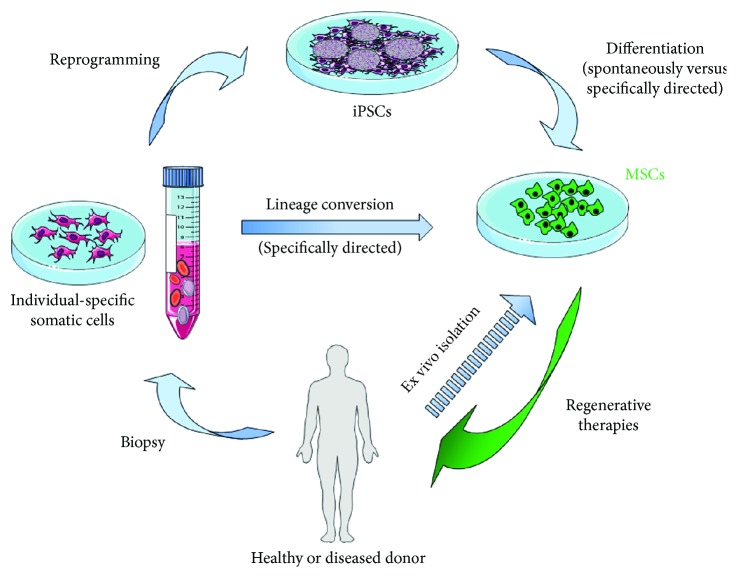
Figure 1
Figure 1
Patient-specific adult MSCs. Somatic cells (e.g., fibroblasts and peripheral blood cells) can be isolated from individual healthy or diseased donors (biopsy) and (i) directly converted into MSCs or (ii) reprogrammed into iPSCs by the introduction of the common transcription (Yamanaka) factors OCT4, SOX2, KLF4, and c-MYC. iPSCs were characterized by indefinite self-renewal and pluripotent differentiation capacities and, thus, represent an attractive source to generate unlimited cell numbers for targeted differentiation into MSCs. For regenerative therapy, only donor cells that have reached a particular differentiation stage could be used, which means that the iPSCs must first be brought to an ordered differentiation path. MSC differentiation of iPSC is initiated either spontaneously (by deprivation of pluripotent signals) or specifically directed by the induction of mesodermal differentiation, followed by treatment with MSC-specific growth factors that allows then the isolation and expansion of the selected MSCs under chemically defined cell culture conditions. As an alternative pathway, patient-specific somatic cells can directly programmed/transdifferentiated to MSCs which would avoid the need for prior reprogramming those cells back the pluripotent stage. Hypothetically, human MSCs could also be obtained by a direct programming approach, by ectopic expression of MSC-specific transcription factors in iPSCs and somatic cells, or by the introduction of cell type-specific microRNA molecules that functions in RNA silencing and posttranscriptional regulation of MSC gene expression. Morphology-based manual selection and/or sorting for cell type-specific cell surface markers using flow cytometry or immunomagnetic separation might further be used to increase purity of generated MSCs. The generation of patient- and disease-specific iPSCs is a valuable tool for regenerative therapies, for example, restoration of function through transplantation of ex vivo manufactured cells.

References

    1. Chidgey A. P., Layton D., Trounson A., Boyd R. L. Tolerance strategies for stem-cell-based therapies. Nature. 2008;453(7193):330–337. doi: 10.1038/nature07041. - DOI - PubMed
    1. Kristjansson B., Honsawek S. Current perspectives in mesenchymal stem cell therapies for osteoarthritis. Stem Cells International. 2014;2014:13. doi: 10.1155/2014/194318.194318 - DOI - PMC - PubMed
    1. Rafii S., Lyden D. Therapeutic stem and progenitor cell transplantation for organ vascularization and regeneration. Nature Medicine. 2003;9(6):702–712. doi: 10.1038/nm0603-702. - DOI - PubMed
    1. Uccelli A., Moretta L., Pistoia V. Mesenchymal stem cells in health and disease. Nature Reviews Immunology. 2008;8(9):726–736. doi: 10.1038/nri2395. - DOI - PubMed
    1. Copland I. B. Mesenchymal stromal cells for cardiovascular disease. Journal of Cardiovascular Disease Research. 2011;2(1):3–13. doi: 10.4103/0975-3583.78581. - DOI - PMC - PubMed

LinkOut - more resources
