Development and Evaluation of a Multiplex Quantitative Real-Time Polymerase Chain Reaction for Hookworm Species in Human Stool
- PMID: 30226132
- PMCID: PMC6221243
- DOI: 10.4269/ajtmh.18-0276
Development and Evaluation of a Multiplex Quantitative Real-Time Polymerase Chain Reaction for Hookworm Species in Human Stool
Abstract
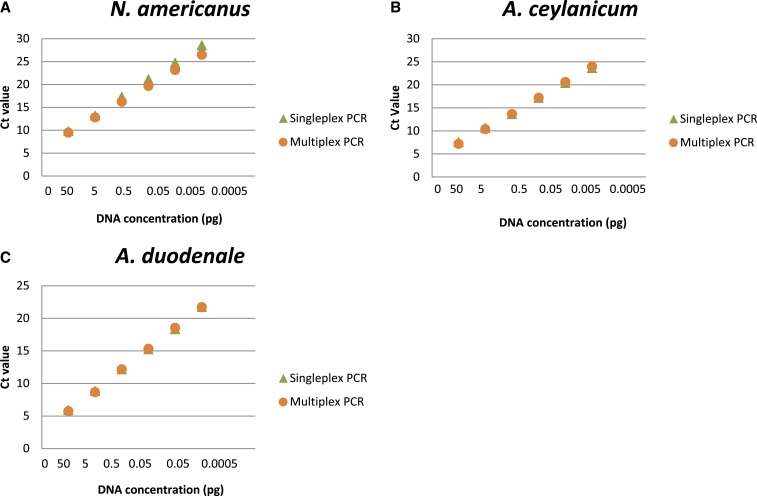
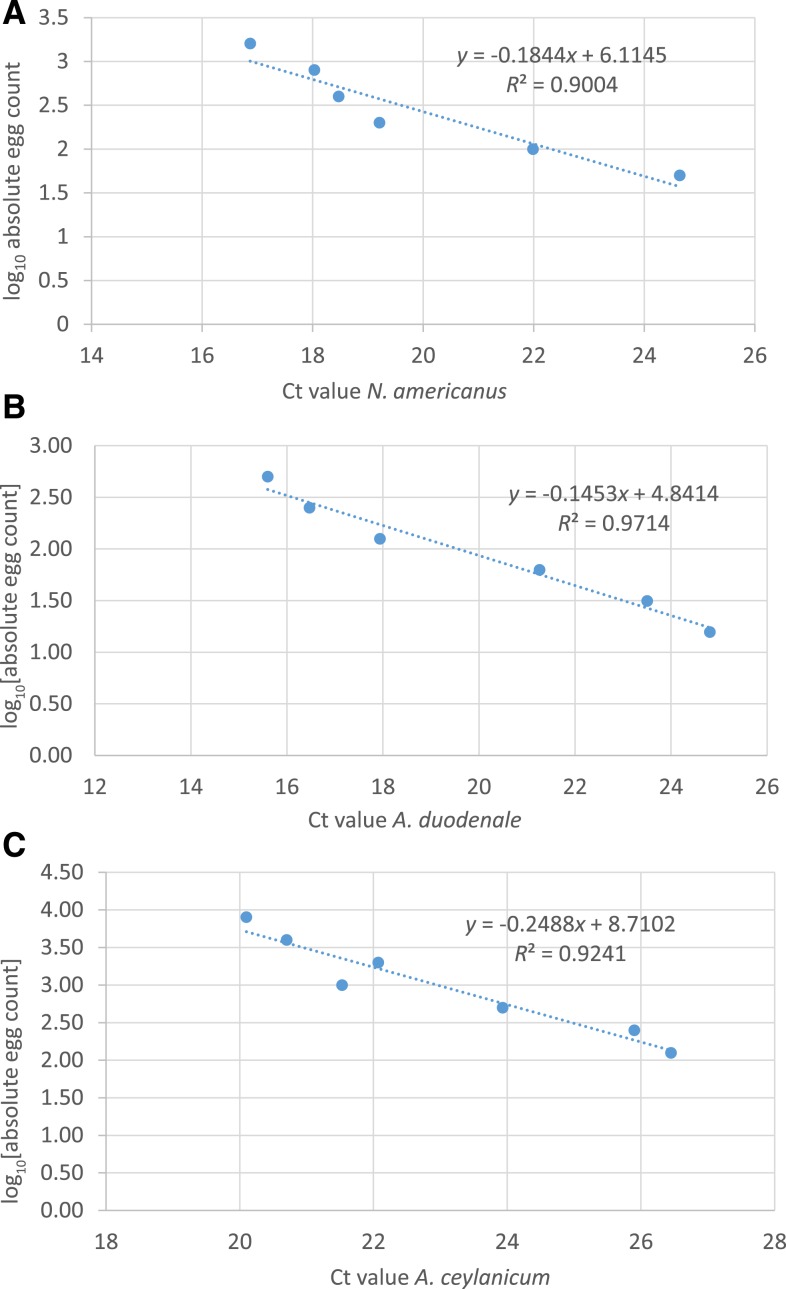
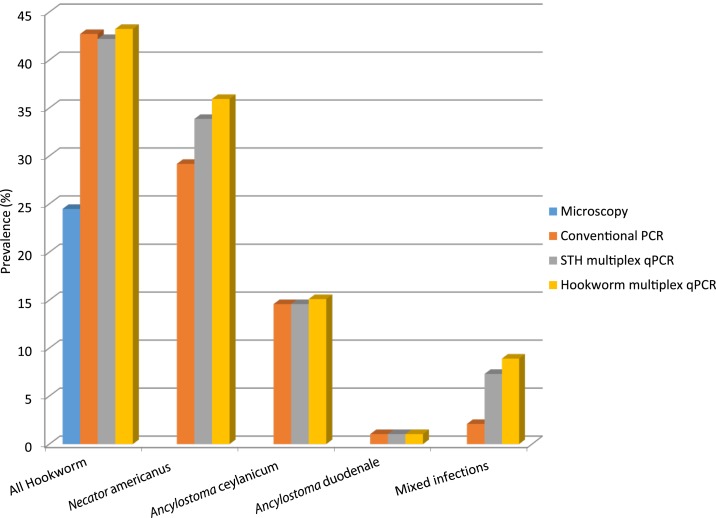
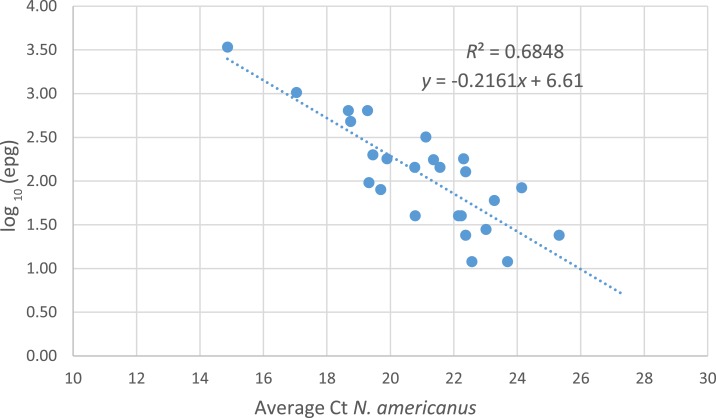
Hookworm disease caused by Necator americanus, Ancylostoma duodenale, and Ancylostoma ceylanicum affects half a billion people worldwide. The prevalence and intensity of infection of individual hookworm species are vital for assessing morbidity and generating targeted intervention programs for their control. The present study aims to evaluate a multiplex real-time quantitative PCR (qPCR) assay to determine the prevalence and egg intensity of all three hookworm species and compare this with standard microscopy and published genus-based conventional and real-time multiplex qPCRs. Performance of the diagnostic assays was evaluated using DNA extracted from 192 fecal samples collected as part of a soil-transmitted helminth (STH) survey in northern Cambodia. The prevalence of hookworms as detected by the multiplex hookworm qPCR of 84/192 (43.8%) was significantly higher than that using microscopy of 49/192 (25.5%). The hookworm multiplex qPCR showed very good agreement for the detection of both N. americanus (Kappa 0.943) and Ancylostoma spp. (Kappa 0.936) with a multiplex STH qPCR. A strong and moderate quantitative correlation between cycle threshold and eggs per gram (EPG) feces was obtained for the hookworm qPCR for seeded DNA egg extracts (R 2 ≥ 0.9004) and naturally egg-infected individuals (R 2 = 0.6848), respectively. The newly developed hookworm quantitative multiplex qPCR has the potential for application in anthelmintic efficacy trials and for monitoring the success of mass deworming programs targeting individual species of anthroponotic and zoonotic hookworms.
Figures
References
-
- Forouzanfar MH, et al. GBD 2013 Risk Factors Collaborators , 2015. Global, regional, and national comparative risk assessment of 79 behavioural, environmental and occupational, and metabolic risks or clusters of risks in 188 countries, 1990–2013: a systematic analysis for the Global Burden of Disease Study 2013. Lancet 386: 2287–2323. - PMC - PubMed
-
- Hotez P, Whitham M, 2014. Helminth infections: a new global women’s health agenda. Obstet Gynecol 123: 155–160. - PubMed
-
- Traub RJ, 2013. Ancylostoma ceylanicum, a re-emerging but neglected parasitic zoonosis. Int J Parasitol 43: 1009–1015. - PubMed
-
- Miller TA, 1979. Hookworm infection in man. Adv Parasitol 17: 315–384. - PubMed
Publication types
MeSH terms
Substances
LinkOut - more resources
Full Text Sources
Other Literature Sources
Medical
Miscellaneous