


Outcomes of Patients with Recurrent and Refractory Lymphoma Undergoing Allogeneic Hematopoietic Cell Transplantation with BEAM Conditioning and Sirolimus- and Tacrolimus-Based GVHD Prophylaxis
- PMID: 30227232
- PMCID: PMC6502508
- DOI: 10.1016/j.bbmt.2018.09.009
Outcomes of Patients with Recurrent and Refractory Lymphoma Undergoing Allogeneic Hematopoietic Cell Transplantation with BEAM Conditioning and Sirolimus- and Tacrolimus-Based GVHD Prophylaxis
Abstract
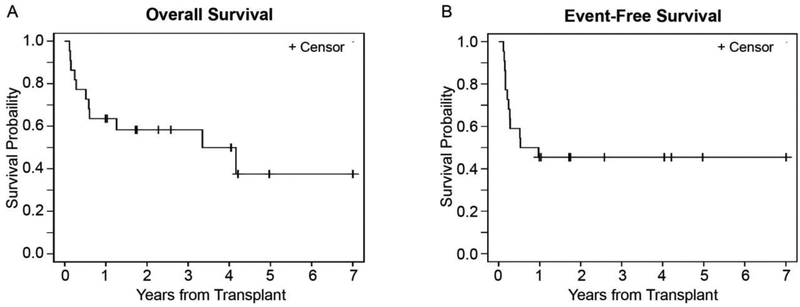
The current standard of care for patients with Hodgkin lymphoma (HL) and non-Hodgkin lymphoma (NHL) is high-dose conditioning followed by autologous stem cell transplantation (ASCT). For some patients (ie, those with highest-risk disease, insufficient stem cell numbers after mobilization, or bone marrow involvement) allogeneic hematopoietic cell transplantation (alloHCT) offers the potential for cure. However, the majority of patients undergoing alloHCT receive reduced-intensity conditioning as a preparative regimen, and studies assessing outcomes of patients after alloHCT with myeloablative conditioning are limited. In this retrospective study, we reviewed outcomes of 22 patients with recurrent and refractory NHL who underwent alloHCT with myeloablative BEAM conditioning and received tacrolimus/sirolimus as graft-versus-host disease (GVHD) prophylaxis at City of Hope between 2005 and 2018. With a median follow-up of 2.6 years (range, 1.0 to 11.2 years), the probabilities of 2-year overall survival and event-free survival were 58.3% (95% confidence interval [CI], 35.0% to 75.8%) and 45.5% (95% CI, 24.4% to 64.3%), respectively. The cumulative incidence of grade II to IV acute GVHD was 45.5% (95% CI, 23.8% to 64.9%), with only 1 patient developing grade IV acute GVHD. However, chronic GVHD was seen in 55% of the patients (n = 12). Of the 22 eligible patients, 2 had undergone previous ASCT and 2 had undergone previous alloHCT. Both patients with previous ASCT developed severe regimen-related toxicity. Patients who underwent alloHCT with chemorefractory disease had lower survival rates, with 1-year OS and EFS of 44.4% and 33.0%, respectively. In conclusion, alloHCT with a BEAM preparative regimen and tacrolimus/sirolimus-based GVHD should be considered as an alternative option for patients with highest-risk lymphoma whose outcomes are expectedly poor after ASCT.
Keywords: BEAM conditioning; allogeneic hematopoietic stem cell transplantation; tacrolimus/sirolimus.
Copyright © 2018. Published by Elsevier Inc.
Figures
References
-
- Philip T, Guglielmi C, Hagenbeek A, et al. Autologous bone marrow transplantation as compared with salvage chemotherapy in relapses of chemotherapy-sensitive non-Hodgkin's lymphoma. N Engl J Med. 1995;333(23):1540–1545. - PubMed
-
- Schmitz N, Pfistner B, Sextro M, et al. Aggressive conventional chemotherapy compared with high-dose chemotherapy with autologous haemopoietic stem-cell transplantation for relapsed chemosensitive Hodgkin’s disease: a randomised trial. Lancet. 2002;359(9323):2065–2071. - PubMed
-
- Sirvent A, Dhedin N, Michallet M, et al. Low nonrelapse mortality and prolonged long-term survival after reduced-intensity allogeneic stem cell transplantation for relapsed or refractory diffuse large B cell lymphoma: report of the Societe Francaise de Greffe de Moelle et de Therapie Cellulaire. Biol Blood Marrow Transplant. 2010;16(1):78–85. - PubMed
Publication types
MeSH terms
Substances
Supplementary concepts
Grants and funding
LinkOut - more resources
Full Text Sources
Other Literature Sources
Medical
