. 2018 Sep 18;16(1):103.
doi: 10.1186/s12915-018-0571-y.

The piRNA pathway responds to environmental signals to establish intergenerational adaptation to stress

Affiliations

The piRNA pathway responds to environmental signals to establish intergenerational adaptation to stress

Tony Belicard et al. BMC Biol. .

Abstract

Background: piRNAs have a constitutive role in genome defence by silencing transposable elements in the germline. In the nematode Caenorhabditis elegans, piRNAs also induce epigenetic silencing of transgenes, which can be maintained for many generations in the absence of the piRNA pathway. The role of multi-generational epigenetic inheritance in adaptation to the environment is unknown.

Results: Here, we show that piRNA biogenesis is downregulated in response to a small increase in temperature. Some effects on gene expression persist into subsequent generations and are associated with a negative fitness cost. We show that simultaneous infection with pathogenic bacteria suppresses downregulation of the piRNA pathway in response to increased temperature. This effect is associated with increased fitness of progeny of infected animals in subsequent generations.

Conclusions: Our results show that the piRNA pathway integrates inputs from the environment to establish intergenerational responses to environmental conditions, with important consequences for the fitness of the subsequent generation.


Conflict of interest statement

Ethics approval and consent to participate

Not applicable.

Competing interests

The authors declare that they have no competing interests.

Publisher’s Note

Springer Nature remains neutral with regard to jurisdictional claims in published maps and institutional affiliations.

Figures
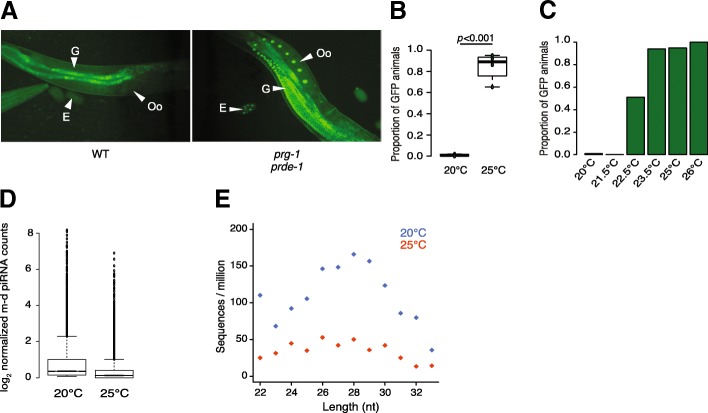
Fig. 1
Fig. 1
Reduction in motif-dependent piRNA biogenesis at increased temperature. a Expression of GFP in nuclei of the gonad (G), oocytes (Oo) and eggs (E) of animals carrying the piRNA sensor at 20 °C in the wild-type strain (WT, left), and in mutants for the piRNA pathway (prg-1 and prde-1, right). b Proportion of wild-type animals expressing GFP at 20 °C and 25 °C. At least 30 worms have been screened for each conditions in each of the 4 replicates (20 °C ntotal = 138, 25 °C ntotal = 208, two-sided Student’s t test). Animals were grown at the tested temperature for their entire developmental cycle (i.e. from fertilisation to adulthood). c Proportion of wild-type animals expressing GFP at 20 °C (n = 75), 21.5 °C (n = 50), 22.5 °C (n = 45), 25 °C (n = 89) and 26 °C (n = 49). d Log2 motif-dependent piRNA counts normalised to the total number small RNAs in the wild-type strain at 20 °C and 25 °C. Animals were grown at the tested temperature from the first larval stage to adulthood. 18,571 piRNA loci with a motif score > 7 according to the algorithm used in Ruby et al. [15] were examined. e Abundance of piRNA precursors (26 to 30 nt) in the wild-type strain at 20 °C and 25 °C. piRNA precursors from any of the 18,571 loci as above were examined
Fig. 2
Fig. 2
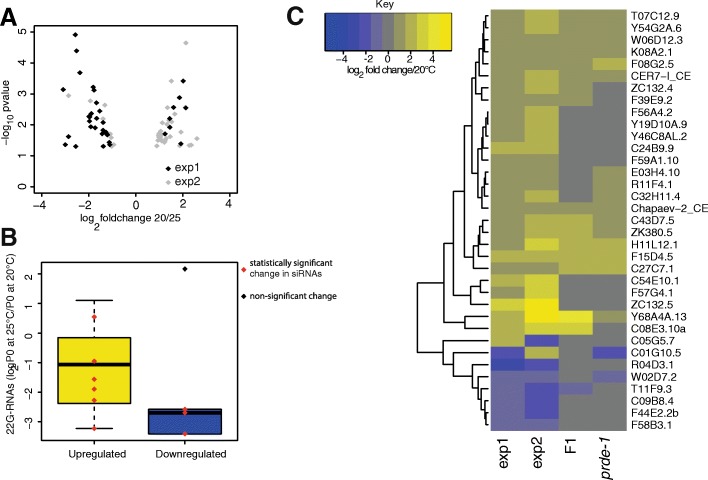
Intergenerational gene expression alterations induced by increased temperature. a Volcano plot presenting the overlap of downregulated genes (Log2 fold change 20 °C/25 °C < 0) and upregulated genes (Log2 fold change 20 °C/25 °C > 0) at 25 °C between adults P0 animals (exp1) and the time course experiment (exp2). b Changes in secondary piRNA production for upregulated genes (yellow) and downregulated genes (blue) at 25 °C compared to 20 °C for the overlapping genes from exp1 and exp2. c Heatmap representing the behaviour of these genes for P0 at 25 °C (exp1), the time course experiment at 25 °C (exp2), F1 grown at 20 °C from P0 grown at 25 °C (F1) and prde-1 mutant animals. Numbers of genes involved are shown in Additional file 4: Figure S3A, B and C
Fig. 3
Fig. 3
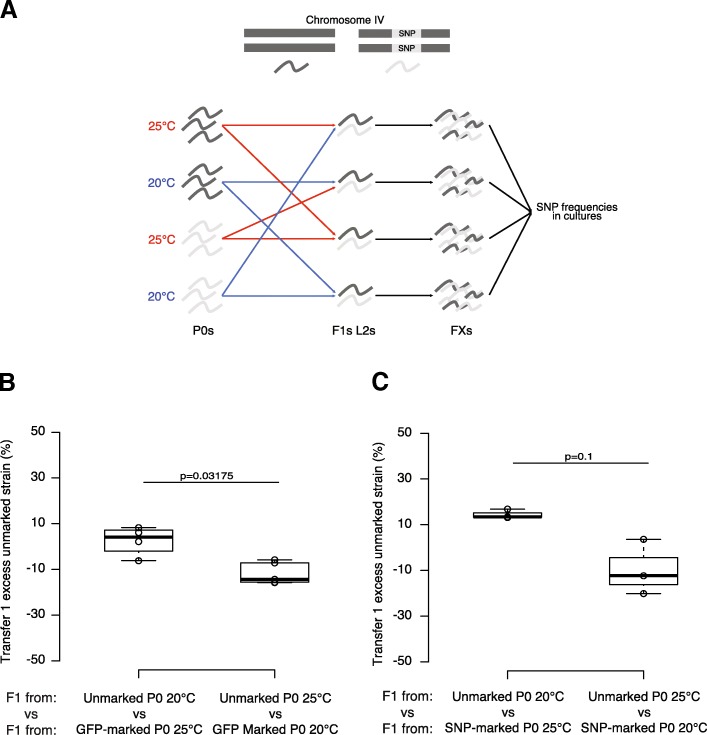
Intergenerational fitness effects of growth at altered temperatures. a Experimental design used for the competition assay. Two strains with either different fluorescence (unmarked or GFP-marked) or different genotypes (N2 or N2 containing introgressed SNPs from JU1580 on Chromosome IV) were grown at 20 °C or 25 °C and then synchronised using sodium hypochlorite treatment (bleaching). Equal number of F1s from two different parental treatments was then put in the same plate. All different combinations have been tested in parallel either in triplicate or in quintuplicate. Before starvation, animals were harvested and the proportions of each of the different strains measured using a fluorescent microscope (GFP-marked animals) or using pyrosequencing (SNP-marked animals). 200 to 400 animals were transferred to a fresh NGM plate and the proportions were measured similarly. b Intergenerational competition at 20 °C between animals derived from (left) unmarked P0 animals grown at 20 °C and GFP-marked P0 animals grown at 25 °C; (right) GFP-marked P0 animals grown at 20 °C and unmarked P0 animals grown at 25 °C. c Competition at 20 °C between animals derived from (left) unmarked P0 animals grown at 20 °C and SNP-marked P0 animals grown at 25 °C; (right) SNP-marked P0 animals grown at 20 °C and unmarked P0 animals grown at 25 °C. Y-axes show the proportion of unmarked animals after 1 transfer for all replicates, corrected for the effect of the SNP or the GFP by subtracting the mean of the proportions of animals grown at 20 °C when both P0 strains were grown at 25 °C. The raw data are available in Additional file 5: Table S2
Fig. 4
Fig. 4
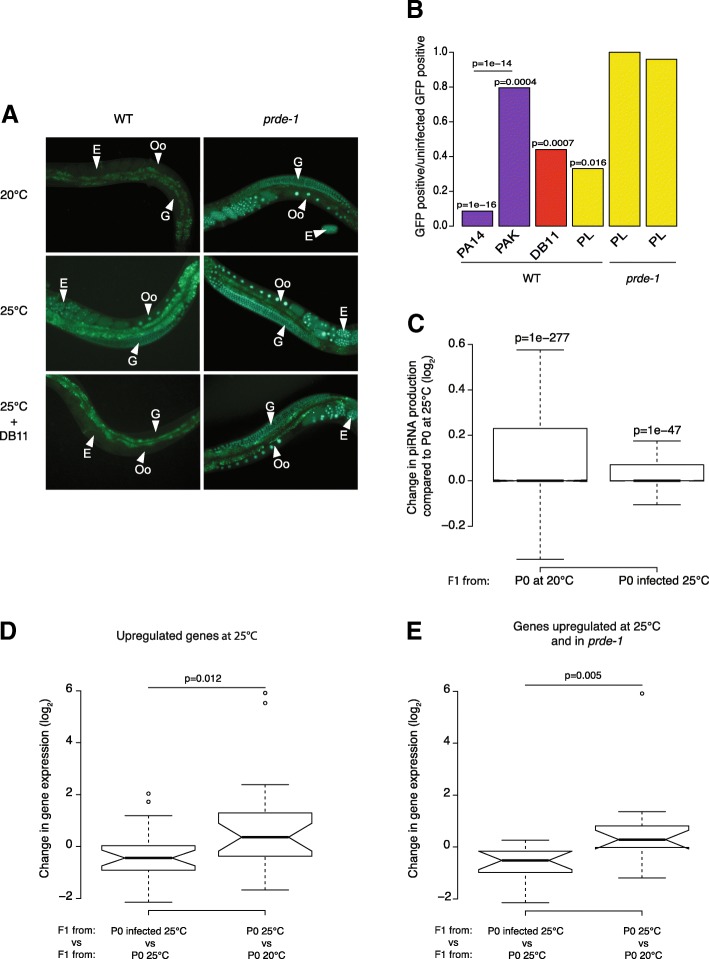
Bacterial infection suppresses reduced piRNA levels at 25 °C. a Expression of GFP in nuclei of the gonad (G), oocytes (Oo) and eggs (E) of animals carrying the piRNA sensor in the wild-type strain (WT, left) and in the prde-1 mutant (prde-1 right) both grown from hatching either at 20 °C or 25 °C on regular bacteria (HB101) or at 25 °C on the pathogenic bacteria Serratia marcescens (DB11). b Proportion of wild-type animals (WT) and prde-1 animals expressing GFP on: P. aeruginosa (purple) PA14 (high toxicity, n = 47) and PAK (low toxicity, n = 73); S. marcescens DB11 (red, n = 106); and P. luminescens (yellow; WT n = 31; prg-1 n = 28; prde-1 n = 46) relative to the proportion of GFP-positive animals grown at 25 °C on regular food (n = 38). Fisher’s exact test was used to evaluate differences between conditions. Raw data are available in Additional file 9: Table S4. c Change (Log2) in mature piRNA levels in F1s from parents grown at 20 °C (P0 at 20 °C) or grown at 25 °C (P0 at 25 °C) in presence of Serratia marcescens compared to F1s from parents grown at 25 °C. d, e Changes (Log2) in gene expression in F1s from infected P0s compared to F1s from P0s grown at 25 °C (left) and F1s from P0s grown at 25 °C compared to F1s from P0s grown at 25 °C (right) for: (d) genes previously identified as intergenerationally upregulated when parents grown at 25 °C; (e) genes intergenerationally upregulated both when parents were grown at 25 °C and in the prde-1 mutant
Fig. 5
Fig. 5
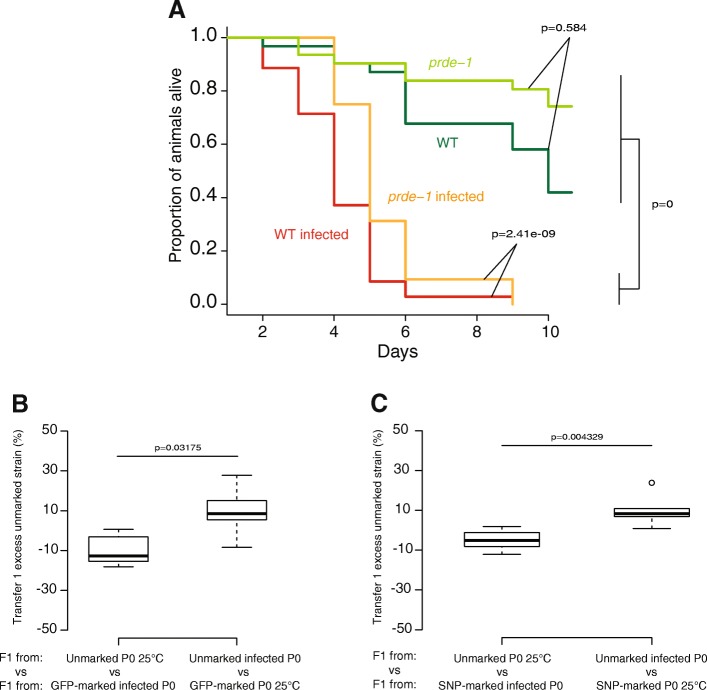
Bacterial infection improves fitness in subsequent generations. a Survival of the wild-type strain (WT) and the prde-1 mutant at 25 °C on regular food (dark green and light green) and on the pathogenic bacteria Serratia marcescens (red and orange). A Mantel-Haenszel Logrank test has been used to assess the significativity between the different treatments. Raw data are available in Additional file 9: Table S4. b Intergenerational competition at 20 °C between animals derived from (left) unmarked P0 animals grown on E. coli at 25 °C and GFP-marked animals grown on S. marcescens at 25 °C; (right) GFP-marked P0 animals grown on E. coli at 25 °C and unmarked animals grown on S. marcescens at 25 °C. c Intergenerational competition at 20 °C between animals derived from (left) unmarked P0 animals grown on E. coli at 25 °C and SNP-marked P0 animals grown on S. marcescens at 25 °C; (right) SNP-marked P0 animals grown on E. coli at 25 °C and unmarked P0 animals grown on S. marcescens at 25 °C. Y-axes for b and c show the percentage of unmarked animals after 2–3 generations (1 transfer, all biological replicates), corrected for the effect of the SNP or GFP marker as in Fig. 3. Raw data are available in Additional file 5: Table S2
Fig. 6
Fig. 6
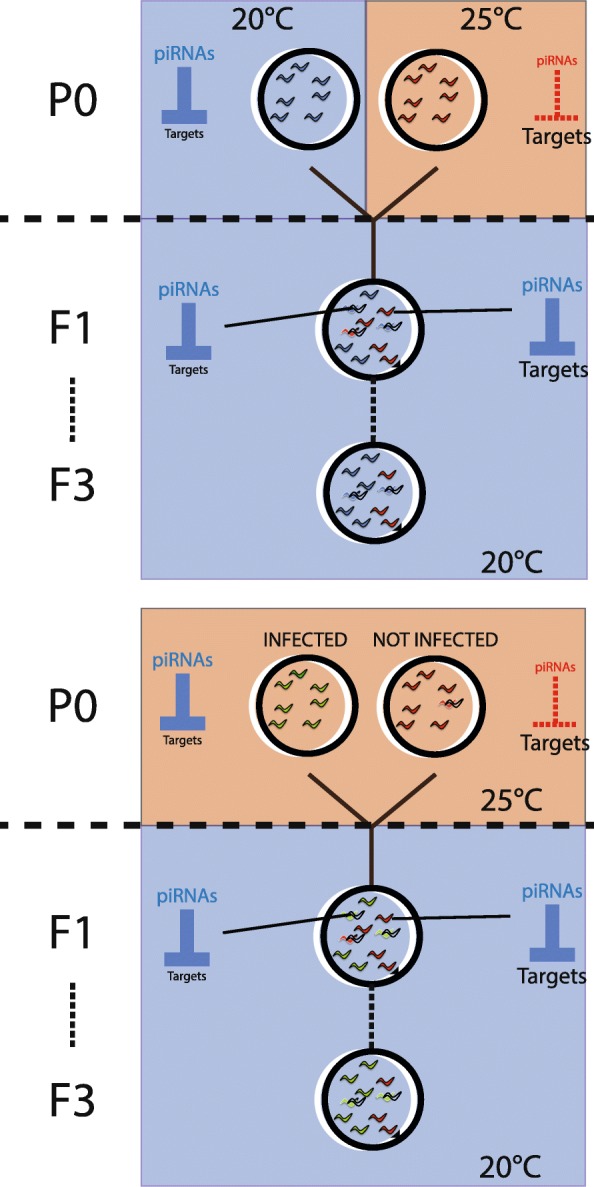
Environmental conditions affect piRNA biogenesis and fitness intergenerationally in C. elegans. PiRNA biogenesis is reduced at 25 °C compared to 20 °C leading to an increase of piRNA targeted genes. The increase of expression of certain genes observed in parental animals grown at 25 °C and resulting from the loss of piRNAs is maintained in the progeny even if grown at 20 °C. Descendants of animals grown at 25 °C display a decrease in fitness at 20 °C compared to descendants of animals grown at 20 °C or animals grown at 25 °C on pathogenic bacteria

References

    1. Heard E, Martienssen RA. Transgenerational epigenetic inheritance: myths and mechanisms. Cell. 2014;157(1):95–109. doi: 10.1016/j.cell.2014.02.045. - DOI - PMC - PubMed
    1. Eggert H., Kurtz J., Diddens-de Buhr M. F. Different effects of paternal trans-generational immune priming on survival and immunity in step and genetic offspring. Proceedings of the Royal Society B: Biological Sciences. 2014;281(1797):20142089–20142089. doi: 10.1098/rspb.2014.2089. - DOI - PMC - PubMed
    1. Radford E. J., Ito M., Shi H., Corish J. A., Yamazawa K., Isganaitis E., Seisenberger S., Hore T. A., Reik W., Erkek S., Peters A. H. F. M., Patti M.-E., Ferguson-Smith A. C. In utero undernourishment perturbs the adult sperm methylome and intergenerational metabolism. Science. 2014;345(6198):1255903–1255903. doi: 10.1126/science.1255903. - DOI - PMC - PubMed
    1. Rechavi O, Houri-Ze’evi L, Anava S, WSS G, Kerk SY, Hannon GJ, et al. Starvation-induced transgenerational inheritance of small RNAs in C. elegans. Cell. 2014;158(2):277–287. doi: 10.1016/j.cell.2014.06.020. - DOI - PMC - PubMed
    1. Schott D, Yanai I, Hunter CP. Natural RNA interference directs a heritable response to the environment. Sci Rep. 2014;4:7387. doi: 10.1038/srep07387. - DOI - PMC - PubMed

Publication types

Substances