. 2019 Jan;13(1):232-236.
doi: 10.1038/s41396-018-0278-7. Epub 2018 Sep 18.

Single-cell genomics uncover Pelagibacter as the putative host of the extremely abundant uncultured 37-F6 viral population in the ocean

Affiliations

Single-cell genomics uncover Pelagibacter as the putative host of the extremely abundant uncultured 37-F6 viral population in the ocean

Francisco Martinez-Hernandez et al. ISME J. 2019 Jan.

Abstract

The identification of relevant virus-host pairs that globally account for a large pool of carbon and nutrients in the ocean is paramount to build accurate ecological models. A previous work using single-virus genomics led to the discovery of the uncultured single-virus vSAG 37-F6, originally sorted from the Mediterranean Sea (Blanes Bay Microbial Observatory), that represents one of the most abundant dsDNA viral population in the marine surface virosphere. Here, from same sampling site, we report that a Pelagibacter single-cell contained a viral member of vSAG 37-F6 population, by means of PCR screening of sorted, genome-amplified single cells with vSAG 37-F6-specific primers and whole-genome sequencing. Furthermore, viruses from this population were also found in three other Pelagibacter single cells from the South Pacific and Atlantic oceans. These new uncultured pelagiphages were genetically different from the previously characterized pelagiphage isolates. Data showed that the uncultured vSAG 37-F6 population represents the Pelagibacter phages that inhabit the sunlit ocean better, and contains a vast unrecognized microdiversity.


Conflict of interest statement

The authors declare that they have no conflict of interest.

Figures

Fig. 1
Fig. 1
Pelagibacter single-amplified genomes (SAGs) analyzed in this study. PCR results and screening of SAGs with vSAG 37-F6-specific primers Seq11 are shown. A PCR band with the expected size was obtained for the Pelagibacter SAG MED40 (lane 2). Lanes 1 and 3 correspond to other SAGs that did not yield positive amplification. Lanes 4 and 5 are negative and positive (DNA template of 37-F6 single-virus MDA product) controls, respectively. Maximum-likelihood phylogeny using a concatenation of 25 conserved proteins from SAGs of this study and from SAR11 representative genomes (see also Supplementary Figure S2). Bootstrap values (%) are indicated at each node (a). Circles indicate geographical location of the different SAGs analyzed in this study (b)
Fig. 2
Fig. 2
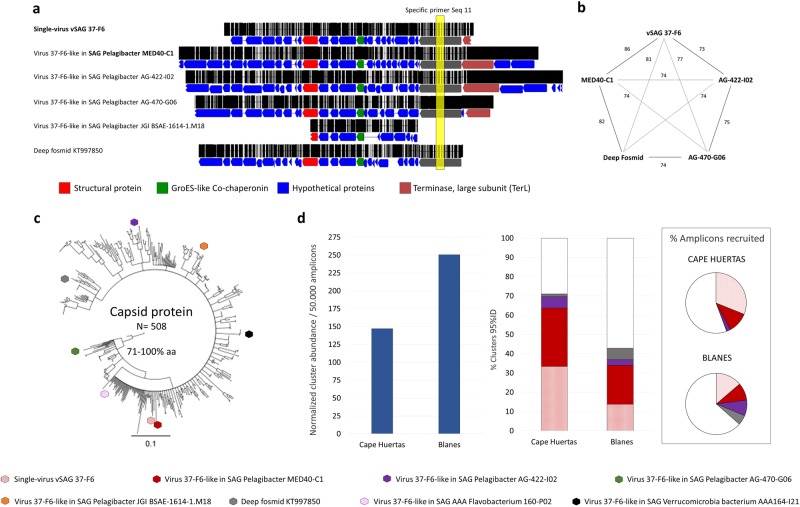
Uncultured pelagiphage population vSAG 37-F6. Genome comparison is shown for the viral members belonging to the uncultured pelagiphage population vSAG 37-F6 recovered by single-cell and single-virus genomics. Black lines in whole-genome alignment denotes homologous genomic regions shared among all viral members. Genomic region (encoding a hypothetical protein) targeted by PCR with the specific viral primer set Seq11 used for SAGs screening is highlighted in yellow (a). Average amino acid similarity was calculated by considering 12 orthologous genes shared and present in all genomes. Higher values indicate a closer relationship between the compared viral pairs (b). Consensus phylogenetic tree based on neighbor-joining (bootstrapping = 1000) of the signature capsid protein found in the uncultured vSAG 37-F6-like viral population. This viral capsid protein has been shown to be the most abundant in viral marine proteomes from Tara expedition. Other homologous proteins (n = 502) have been detected in the viral database released by IMG-VR and have been included in the analyses. Protein names are omitted in branches for convenience, except for those capsid proteins from vSAG 37-F6 viral population that are indicated as colored hexagons. vSAG 37-F6 and the genome variant found in the Pelagibacter SAG MED40 contained nearly identical capsid protein sequences. None of the previously reported pelagiphage isolates have that above mentioned gene encoding a structural capsid protein. Branches with bootstrap values <50% are collapsed. Branches non-collapsed displayed >50% bootstrap value (numbers are omitted for convenience) (c). Illumina sequencing results of PCR amplicons obtained with the specific 37-F6-viral primers Seq11 from two environmental viral samples from the Mediterranean Sea. Data showed a vast microdiversity mostly dominated by the viral members of vSAG 37-F6 and that found in the single cell MED40. Total amplicons and amplicon clusters (cut-off 95% of nucleotide identity for putative species demarcation) were compared to uncultured pelagiphages and assigned to the most similar virus according to the higher bit-score. Bars diagram indicates the percentage of amplicon clusters assigned to each of the uncultured pelagiphages. Circle diagrams represent percentage of the total number of amplicons assigned to each one of the uncultured pelagiphages. White regions denoted unassigned amplicons or amplicons clusters. Viral DNA was obtained from Blanes Bay and Cape Huertas (d)

References

    1. Suttle CA. Marine viruses-major players in the global ecosystem. Nat Rev Microbiol. 2007;5:801–12. doi: 10.1038/nrmicro1750. - DOI - PubMed
    1. Weinbauer M, Chen F, Wilhelm S. Virus-mediated redistribution and partitioning of carbon in the global oceans. Microbial Carbon Pump in the Oceans. Jiao, N., et al. (eds). 2011;54–6.
    1. Lima-Mendez G, Faust K, Henry N, Decelle J, Colin S, Carcillo F, et al. Ocean plankton. Determinants of community structure in the global plankton interactome. Science. 2015;348:1262073. doi: 10.1126/science.1262073. - DOI - PubMed
    1. Roux S, Brum JR, Dutilh BE, Sunagawa S, Duhaime MB, Loy A, et al. Ecogenomics and potential biogeochemical impacts of globally abundant ocean viruses. Nature. 2016;537:689–93. doi: 10.1038/nature19366. - DOI - PubMed
    1. Mizuno CM, Rodriguez-Valera F, Kimes NE, Ghai R. Expanding the marine virosphere using metagenomics. Rocha EPC, editor. PLoS Genet. 2013;9:e1003987. doi: 10.1371/journal.pgen.1003987. - DOI - PMC - PubMed

Publication types