


Meeting the Contraceptive Needs of a Community: Increasing Access to Long-Acting Reversible Contraception
Affiliations
- PMID: 30228573
- PMCID: PMC6140203
Item in Clipboard
Meeting the Contraceptive Needs of a Community: Increasing Access to Long-Acting Reversible Contraception
Mo Med.
2017 May-Jun.
Abstract
To control their reproductive lives, women must have access to all contraceptive methods including the most effective reversible methods, intrauterine devices, and implants. The Contraceptive CHOICE Project, a study of 9,256 women in St. Louis, showed that when barriers to contraception are removed, many women choose intrauterine devices and implants, substantially reducing rates of unintended pregnancy and abortion. This article discusses strategies we learned from the CHOICE Project to improve uptake of the most effective contraceptive methods.
Figures
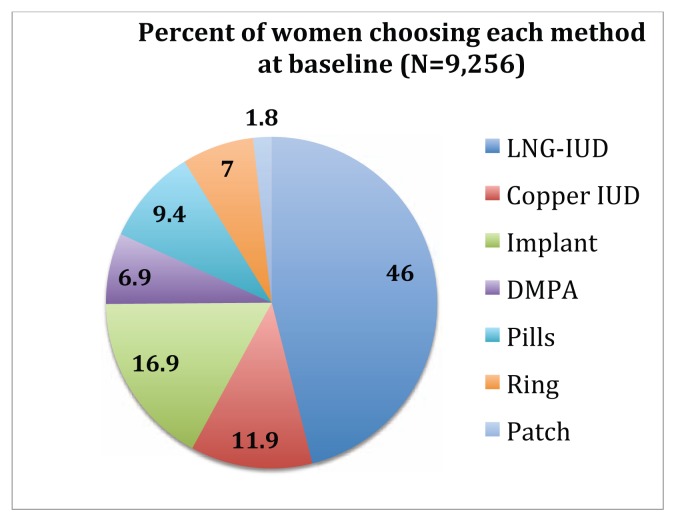
Distribution of Contraceptive Method Choice at Baseline in the Contraceptive CHOICE Project. DMPA, depot medroxyprogesterone acetate injection; IUD, intrauterine device; implant, levonorgestrel implant; pills, oral contraceptive pills; ring, vaginal ring
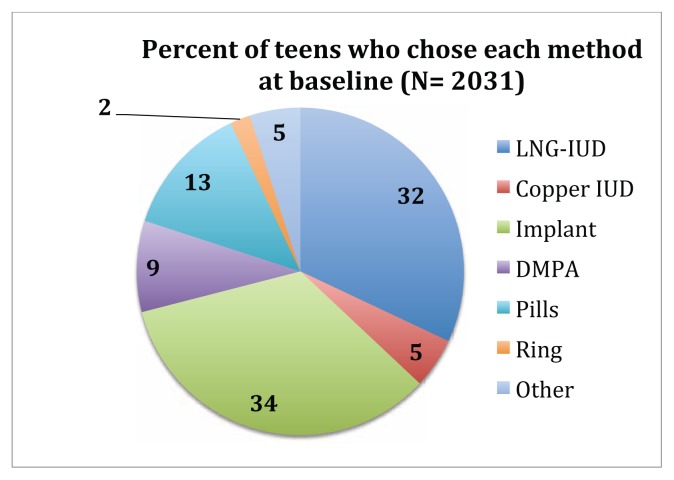
Distribution of Contraceptive Method Choice at Baseline for Teen in the Contraceptive CHOICE Project.


References
-
- Finer LB, Zolna MR. Declines in unintended pregnancy in the United States, 2008–2011. New England Journal of Medicine. 2016;374(9):843–852. http://nejm.org/doi/full/10.1056/NEJMsa1506575. - DOI - PMC - PubMed
-
- Jones RK, Kavanaugh M. Changes in Abortion Rates Between 2000 and 2008 and Lifetime Incidence of Abortion. Obstet Gynecol. 2011;117(6):1358–1366. - PubMed
-
- Kost K, Maddow-Zimet I. U.S. Teenage Pregnancies, Births and Abortions, 2011: State Trends by Age, Race and Ethnicity. New York: Guttmacher Institute; 2016. http://www.guttmacher.org/report/us-teen-pregnancy-state-trends-2011.
-
- Institute TG. Fulfilling the Promise: Public Policy and U.S. Family Planning Clinics. New York: Guttmacher Institute; 2000.
-
- Mayer JP. Unintended childbearing, maternal beliefs, and delay of prenatal care. Birth. 1997;24(4):247–252. - PubMed
MeSH terms
Substances
LinkOut - more resources
Full Text Sources
Medical