. 2018 Jul 23;7(9):e1476817.
doi: 10.1080/2162402X.2018.1476817. eCollection 2018.

Vitamin D deficiency in head and neck cancer patients - prevalence, prognostic value and impact on immune function

Affiliations

Vitamin D deficiency in head and neck cancer patients - prevalence, prognostic value and impact on immune function

Florian Bochen et al. Oncoimmunology. .

Abstract

Vitamin D deficiency is frequently observed in human cancer patients and a prognostic relevance could be shown for some entities. Additionally, it is known that vitamin D can stimulate the patients' antitumor immunity. However, valid epidemiological data for head and neck squamous cell carcinoma (HNSCC) patients are sparse and functional studies on a possible connection between vitamin D and the patients' immune system are missing. 25-OH vitamin D serum levels were analyzed in 231 HNSCC patients and 232 healthy controls and correlated with clinical data and patient survival. Intra- and peritumoral infiltration with T-cell, NK-cell and macrophage populations was analyzed in 102 HNSCC patients by immunohistochemistry. In 11 HNSCC patients, NK-cells were isolated before and after vitamin D substitution and analyzed for their cytotoxic activity directed against a HNSCC cell line. Vitamin D serum levels were significantly lower in HNSCC patients compared with healthy controls. Low vitamin D levels were associated with lymphatic metastasis and a negative HPV status and were a significant predictor of poor overall survival. HNSCC patients with severe vitamin D deficiency showed significantly altered intra- and peritumoral immune cell infiltrate levels. After vitamin D substitution, the patients' NK cells showed a significant rise in cytotoxic activity. Taken together, we could show that Vitamin D deficiency is highly prevalent in HNSCC patients and is a predictor of poor survival. Vitamin D substitution used as an adjuvant in immune therapies such as cetuximab and nivolumab treatment could support antitumorigenic immune responses, thus contributing to the improvement of the patients' prognosis in the context of a multimodal therapy.

Keywords: T cells; head and neck cancer; immunooncology; natural killer cells; vitamin D.


Figures
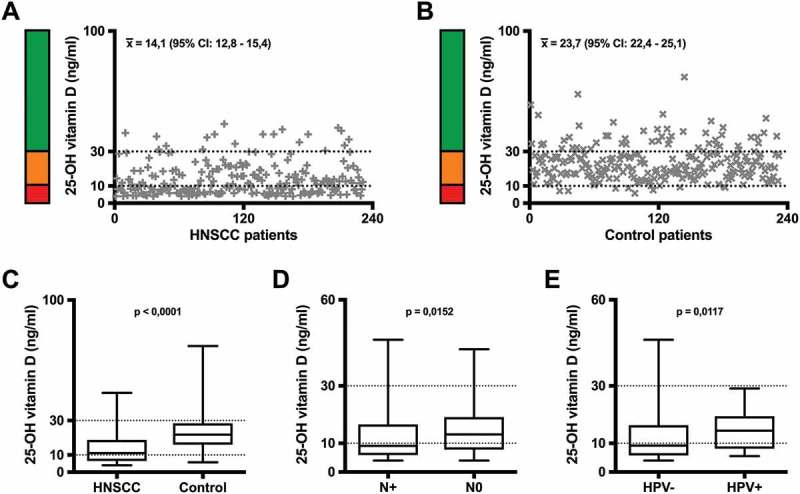
Figure 1.
Figure 1.
25-OH vitamin-D serum levels in (A) 231 HNSCC patients and (B) 232 healthy control patients matched for age and sex. Each individual value is illustrated on the graph. The range of vitamin D deficiency (< 10 ng/ml) is marked by a red bar and a dotted line, the range of insufficient vitamin D levels (10 – 30 ng/ml) by an orange bar and a dotted line, the range of sufficient vitamin D serum levels (> 30 ng/ml) by a green bar. (C) Comparison between 25-OH vitamin D serum levels of HNSCC and control patients. (D) Correlation of 25-OH vitamin D serum level with the lymph node status of HNSCC patients and (E) with the HPV-status of HNSCC patients. In the box and whisker blots in (C) – (E), each box represents the range from the first quartile to the third quartile. The median is indicated by a line inside the box. The whiskers outside the boxes represent the ranges from the minimum to the maximum value of each group. x̅: arithmetic mean; 95% CI: 95% confidence interval of the mean; N+: positive lymph node status; N-: negative lymph node status; HPV+: positive HPV status; HPV-: negative HPV status
Figure 2.
Figure 2.
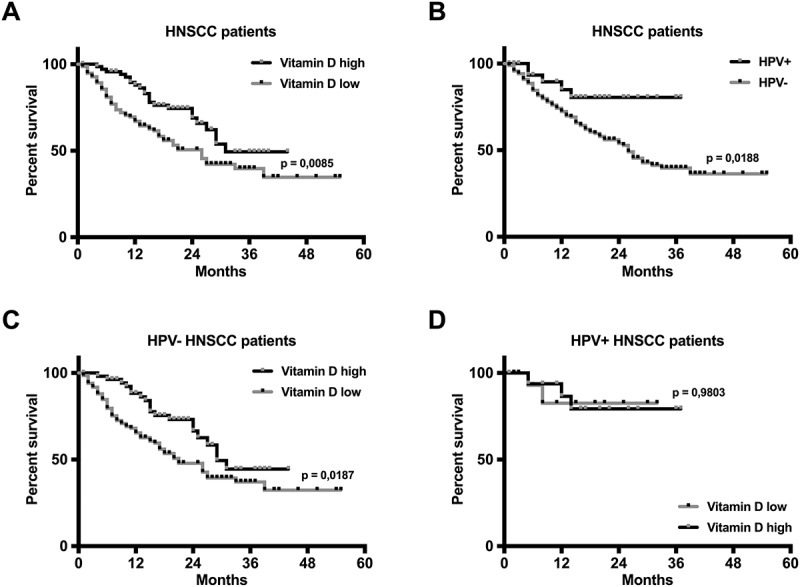
Correlation of 25-OH vitamin D serum level and HPV status in HNSCC patients with overall survival. A Kaplan-Meier analysis is shown in (A) for a vitamin D high group (black line; 25-OH vitamin D ≥ 15 ng/ml; n = 76) and a vitamin D low group (grey line; 25-OH vitamin D < 15 ng/ml; n = 155). It revealed a significantly worse prognosis for vitamin D deficient patients (p = 0,0085; log-rank test). HPV positive tumor status (n = 35) correlated with improved overall survival in the analyzed HNSCC patients (B). Low vitamin D serum levels were a predictor of poor overall survival (OS) in HPV negative patients (C), while vitamin D supply had no influence on the OS in HPV positive HNSCC patients (D). Black or grey dots represent censored data. HPV+: positive HPV status; HPV-: negative HPV status
Figure 3.
Figure 3.
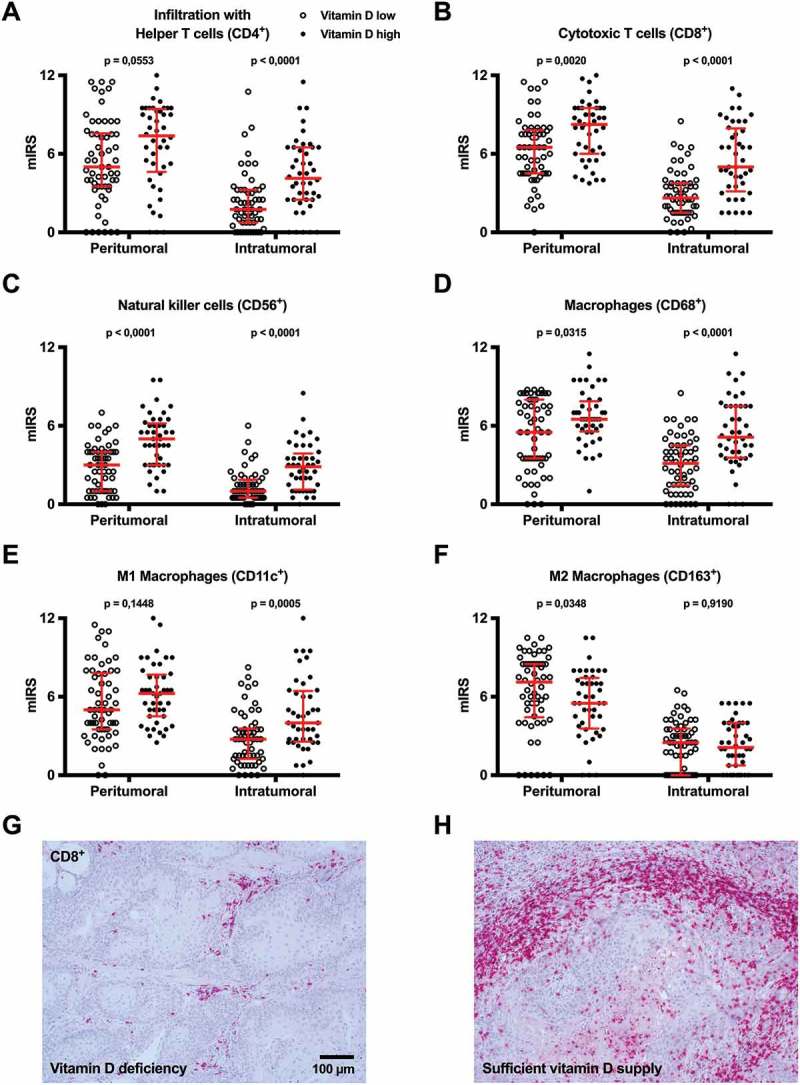
Immunohistochemical analysis of peri- and intratumoral immune cell infiltration in HNSCCs. The immune cell infiltration in the peritumoral stroma and the tumor was analyzed by immunohistochemistry in HNSCC patients with vitamin D deficiency (Vitamin D low; n = 59) and sufficient vitamin D levels (Vitamin D high; n = 43). (A) helper T cells, (B) cytotoxic T cells, (C) NK cells, (D) CD68+ macrophages, (E) M1 macrophages and (F) M2 macrophages were quantified using the mIRS and each individual score is illustrated as dot on the graph. In the plots in (A) – (F) the median is indicated by a red line and the whiskers represent the range from the first quartile to the third quartile. (G & H) Representative images of CD8 immunhistochemical staining in a patient with vitamin D deficiency (G) and sufficient vitamin D supply (H); both are squamous cell carcinomas of the floor of the mouth. mIRS: modified immunoreactive score
Figure 4.
Figure 4.
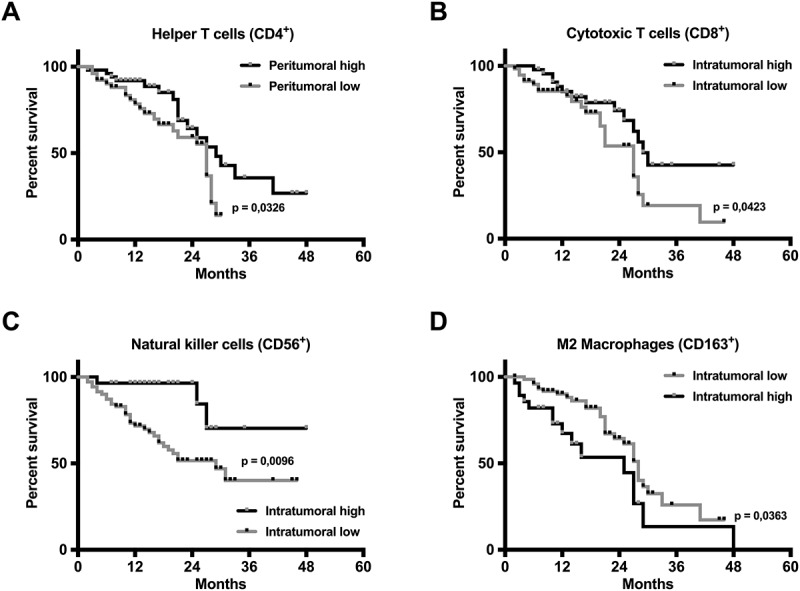
Prognostic relevance of peri- and intratumoral immune cell infiltration in HNSCC patients. The peritumoral infiltration with helper T cells (A) as well as the intratumoral infiltration with (B) cytotoxic T cells, (C) NK cells and (D) M2 macrophages showed a significant correlation with patient overall survival (OS). A higher infiltration of CD4+, CD8+, and CD56+ cells correlated with an improved OS, whereas a higher intratumoral infiltration with CD163+ cells correlated with a poorer OS (log-rank test). In the Kaplan-Meier curves, black or grey dots indicate censored survival data.
Figure 5.
Figure 5.
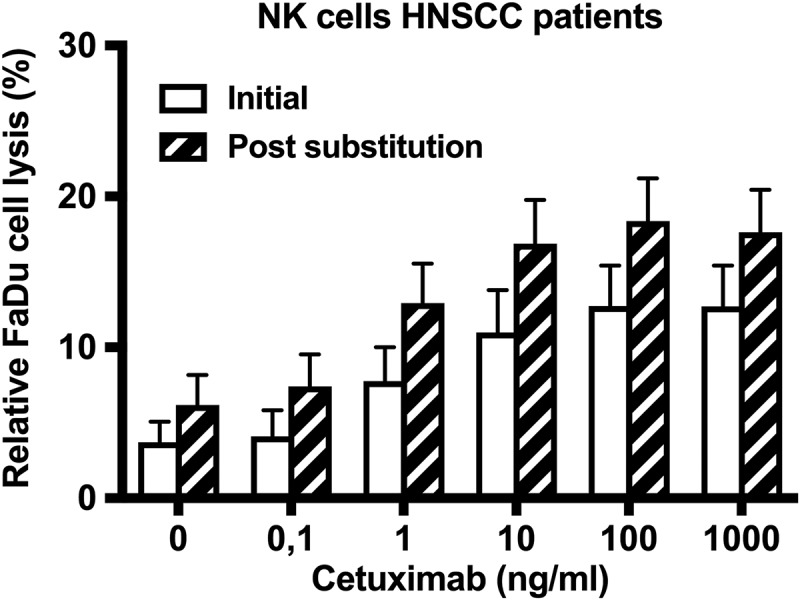
Effect of vitamin D supplementation on antibody-dependent and antibody-independent antitumor NK cell activity. The antitumoral activity of NK cells isolated from HNSCC patients, directed against FaDu cells is shown before and after substitution as relative FaDu cell lysis. Each bar represents the mean value of 9 HNSCC patients with a significant rise in vitamin D serum level (Δ > 10 ng/ml; vitamin D responder). The error bars indicate the standard error of the mean.

References

    1. Barnes L, Eveson JW, Reichart P, Sidransky D.. Pathology and genetics of head and neck tumors. World Health Organization Classification of Tumors. Lyon, France: IARC Press; 2005.
    1. Cooper JS, Porter K, Mallin K, Hoffman HT, Weber RS, Ang KK, Gay EG, Langer CJ. National cancer database report on cancer of the head and neck: 10-year update. Head Neck. 2009;31(6):748–758. doi: 10.1002/hed.v31:6. - DOI - PubMed
    1. Pavlidis N, Pentheroudakis G, Plataniotis G. Cervical lymph node metastases of squamous cell carcinoma from an unknown primary site: a favourable prognosis subset of patients with CUP. Clinical Transl Oncol. 2009;11(6):340–348. doi: 10.1007/s12094-009-0367-1. - DOI - PubMed
    1. Marur S, D’Souza G, Westra WH, Forastiere AA. HPV-associated head and neck cancer: a virus-related cancer epidemic. Lancet Oncol. 2010;11(8):781–789. doi: 10.1016/S1470-2045(10)70017-6. - DOI - PMC - PubMed
    1. D’ Souza G, Kreimer AR, Viscidi R, Pawlita M, Fakhry C, Koch WM, Westra WH, Gillison ML. Case-control study of human papillomavirus and oropharyngeal cancer. N Engl J Med. 2007;356(19):1944–1956. - PubMed

Publication types

LinkOut - more resources