


Combined Intravenous and Intra-Articular Tranexamic Acid in Simultaneous Bilateral Total Knee Arthroplasty without Tourniquet Use
- PMID: 30229212
- PMCID: PMC6132473
- DOI: 10.2106/JBJS.OA.17.00002
Combined Intravenous and Intra-Articular Tranexamic Acid in Simultaneous Bilateral Total Knee Arthroplasty without Tourniquet Use
Abstract
Background: A combined intravenous and intra-articular regimen is one of the most effective administration routes of tranexamic acid (TXA) to reduce perioperative blood loss in unilateral total knee arthroplasty. However, there have been few reports regarding use of the combined regimen for patients undergoing simultaneous bilateral total knee arthroplasty, in which blood-management strategy is more challenging.
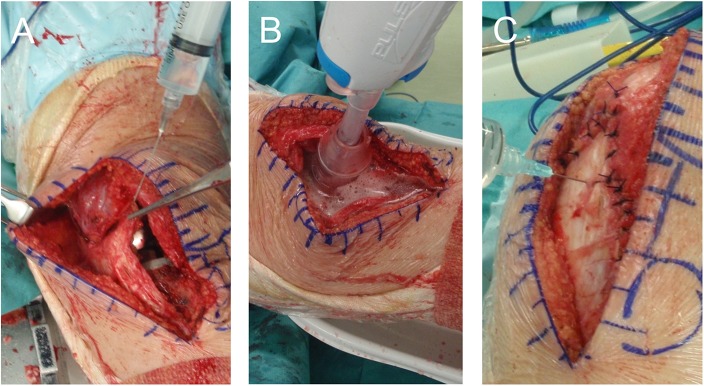
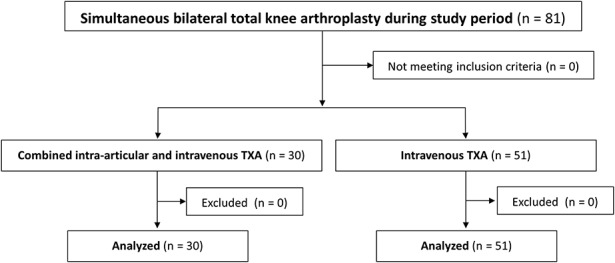
Methods: We compared perioperative blood loss in 30 consecutive patients undergoing simultaneous bilateral total knee arthroplasty who received both 1,000 mg of TXA intravenously and 1,000 mg of intra-articular TXA in each knee (combined TXA group) with that in a consecutive series of 51 patients who only received 1,000 mg of TXA intravenously (intravenous TXA group). Additional intravenous TXA was administered 6 hours after the initial administration in both groups. Except for the intraoperative TXA administration regimen, an identical perioperative blood-management strategy was applied to both groups; this consisted of transfusion of 800 or 400 mL of predeposited autologous blood except for patients with a preoperative hemoglobin level of <11.0 g/dL, who received 4 units of allogenic blood. All surgical procedures were performed with spinal anesthesia and without use of a pneumatic tourniquet. Perioperative blood loss was calculated using the blood volume and change in hemoglobin level from the preoperative measurement to postoperative day 3.
Results: There was significantly less perioperative blood loss in the combined TXA group compared with the intravenous TXA group (mean and standard deviation, 1,201 ± 347 versus 1,638 ± 400 mL, respectively; mean difference, 437 mL; 95% confidence interval, 263 to 613 mL; p < 0.0001). No patient in the combined TXA group and 1 patient (2%) in the intravenous TXA group required additional allogenic blood transfusion. No thrombotic events occurred in either group.
Conclusions: In a nonrandomized comparison, combined intra-articular and intravenous TXA significantly reduced the calculated perioperative blood loss in simultaneous bilateral total knee arthroplasty compared with that found in patients treated only with intravenous TXA.
Level of evidence: Therapeutic Level III. See Instructions for Authors for a complete description of levels of evidence.
Figures
References
-
- Diamond PT, Conaway MR, Mody SH, Bhirangi K. Influence of hemoglobin levels on inpatient rehabilitation outcomes after total knee arthroplasty. J Arthroplasty. 2006. August;21(5):636-41. - PubMed
-
- Hu S, Zhang ZY, Hua YQ, Li J, Cai ZD. A comparison of regional and general anaesthesia for total replacement of the hip or knee: a meta-analysis. J Bone Joint Surg Br. 2009. July;91(7):935-42. - PubMed
-
- Tsukada S, Wakui M, Hoshino A. Postoperative epidural analgesia compared with intraoperative periarticular injection for pain control following total knee arthroplasty under spinal anesthesia: a randomized controlled trial. J Bone Joint Surg Am. 2014. September 03;96(17):1433-8. - PubMed
-
- Su EP, Su S. Strategies for reducing peri-operative blood loss in total knee arthroplasty. Bone Joint J. 2016. January;98-B(1)(Suppl A):98-100. - PubMed
LinkOut - more resources
Full Text Sources
Other Literature Sources
Research Materials