


Progress in achieving quantitative classification of psychopathology
- PMID: 30229571
- PMCID: PMC6172695
- DOI: 10.1002/wps.20566
Progress in achieving quantitative classification of psychopathology
Abstract
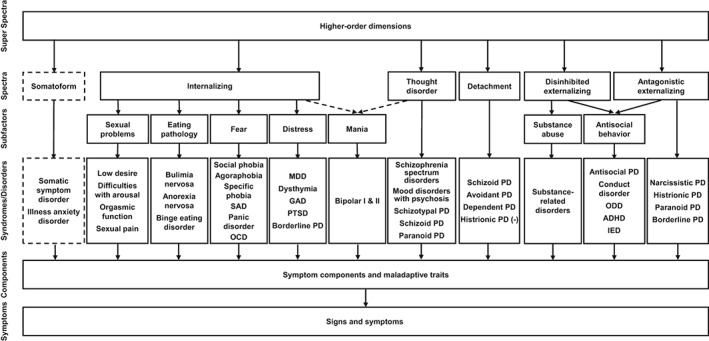
Shortcomings of approaches to classifying psychopathology based on expert consensus have given rise to contemporary efforts to classify psychopathology quantitatively. In this paper, we review progress in achieving a quantitative and empirical classification of psychopathology. A substantial empirical literature indicates that psychopathology is generally more dimensional than categorical. When the discreteness versus continuity of psychopathology is treated as a research question, as opposed to being decided as a matter of tradition, the evidence clearly supports the hypothesis of continuity. In addition, a related body of literature shows how psychopathology dimensions can be arranged in a hierarchy, ranging from very broad "spectrum level" dimensions, to specific and narrow clusters of symptoms. In this way, a quantitative approach solves the "problem of comorbidity" by explicitly modeling patterns of co-occurrence among signs and symptoms within a detailed and variegated hierarchy of dimensional concepts with direct clinical utility. Indeed, extensive evidence pertaining to the dimensional and hierarchical structure of psychopathology has led to the formation of the Hierarchical Taxonomy of Psychopathology (HiTOP) Consortium. This is a group of 70 investigators working together to study empirical classification of psychopathology. In this paper, we describe the aims and current foci of the HiTOP Consortium. These aims pertain to continued research on the empirical organization of psychopathology; the connection between personality and psychopathology; the utility of empirically based psychopathology constructs in both research and the clinic; and the development of novel and comprehensive models and corresponding assessment instruments for psychopathology constructs derived from an empirical approach.
Keywords: DSM; Hierarchical Taxonomy of Psychopathology; ICD; Psychopathology; RDoC; classification; clinical utility; dimensions; mental disorder; nosology; personality.
© 2018 World Psychiatric Association.
Figures
References
-
- Blashfield R. The classification of psychopathology: neo‐kraepelinian and quantitative approaches. Berlin: Springer, 1984.
-
- Regier DA, Narrow WE, Clarke DE et al. DSM‐5 field trials in the United States and Canada, Part II: test‐retest reliability of selected categorical diagnoses. Am J Psychiatry 2013;170:59‐70. - PubMed
-
- Haslam N, Holland E, Kuppens P. Categories versus dimensions in personality and psychopathology: a quantitative review of taxometric research. Psychol Med 2012;42:903‐20. - PubMed
Grants and funding
- L30 MH101760/MH/NIMH NIH HHS/United States
- DA040717/GF/NIH HHS/United States
- R01AG053217/National Institutes of Health
- R21 DA040717/DA/NIDA NIH HHS/United States
- University of Maryland
- 451-13-022/Netherlands Organization for Scientific Research
- Templeton Foundation
- T32 DA037183/DA/NIDA NIH HHS/United States
- L30MH101760/National Institute of Mental Health
- T320A037183/National Institute of Drug Abuse
- R01 MH107444/MH/NIMH NIH HHS/United States
- U19 AG051426/AG/NIA NIH HHS/United States
- R01 AG053217/AG/NIA NIH HHS/United States
- K01 MH109765/MH/NIMH NIH HHS/United States
- U19AG051426/National Institutes of Health
- MH107444/GF/NIH HHS/United States
LinkOut - more resources
Full Text Sources
Other Literature Sources
