


Epidemiological characteristics and influential factors of hand, foot, and mouth disease reinfection in Wuxi, China, 2008-2016
- PMID: 30231857
- PMCID: PMC6146628
- DOI: 10.1186/s12879-018-3385-1
Epidemiological characteristics and influential factors of hand, foot, and mouth disease reinfection in Wuxi, China, 2008-2016
Abstract
Background: Hand, foot, and mouth disease (HFMD) is a viral disease caused by human enteroviruses. Although HFMD reinfection is common, studies investigating this phenomenon are insufficient.
Methods: The present study focused on HFMD reinfection in Wuxi from 2008 to 2016 using surveillance system data.
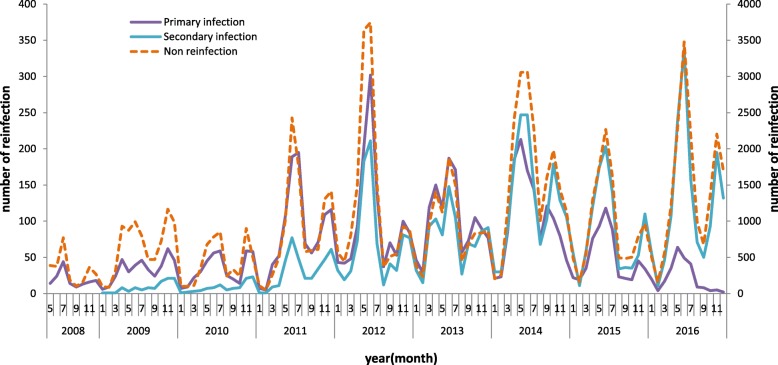
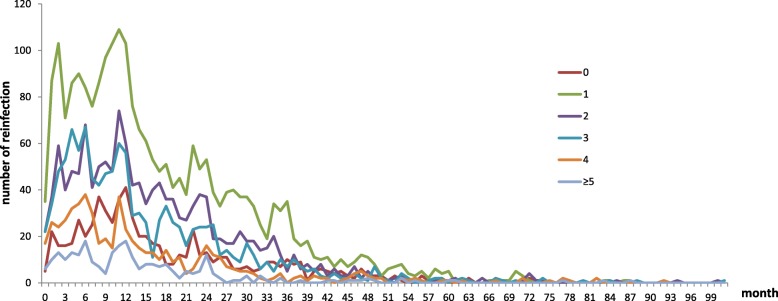
Results: Of 107,677 cases included in the study, 6470 cases were classified as reinfections. The overall reinfection rate was 6.01% (6.37% male and 5.48% female patients), which decreased with increasing age (χ2 = 1125.477, p < 0.001). The rate was 6.17 and 5.79% in urban and rural areas, respectively, and 7.83 and 5.98% of the cases were severe and mild, respectively. Multivariate logistic regression analysis showed that male sex, younger age, residence in an urban area, and severe disease were risk factors for HFMD reinfection. The case-severity rate in secondary infection cases was lower than that in non-reinfection cases (odds ratio 0.675, 95% confidence interval 0.526-0.866).
Conclusions: Boys younger than 4 years of age living in urban areas were more prone to reinfection. Specific health education and intervention should be developed to protect these susceptible populations.
Keywords: And mouth disease; Epidemiology; Foot; Hand; Reinfection.
Conflict of interest statement
Ethics approval and consent to participate
This investigation was conducted by public health agencies as part of their legally authorised mandate and was therefore considered minimal-risk research and was exempted from ethical approval by the Institutional Review Board-Wuxi Center for Disease Control and Prevention.
Consent for publication
Not applicable.
Competing interests
The authors declare that they have no competing interests.
Publisher’s Note
Springer Nature remains neutral with regard to jurisdictional claims in published maps and institutional affiliations.
Figures
Similar articles
-
Epidemiological characteristics and influential factors of hand, foot and mouth disease (HFMD) reinfection in children in Anhui province.Epidemiol Infect. 2016 Jan;144(1):153-60. doi: 10.1017/S0950268815001107. Epub 2015 Jun 1. Epidemiol Infect. 2016. PMID: 26027435 Free PMC article.
-
Short-term effects of extreme meteorological factors on childhood hand, foot, and mouth disease reinfection in Hefei, China: A distributed lag non-linear analysis.Sci Total Environ. 2019 Feb 25;653:839-848. doi: 10.1016/j.scitotenv.2018.10.349. Epub 2018 Oct 28. Sci Total Environ. 2019. PMID: 30759610
-
Reinfection hazard of hand-foot-mouth disease in Wuhan, China, using Cox-proportional hazard model.Epidemiol Infect. 2018 Jul;146(10):1337-1342. doi: 10.1017/S0950268818001322. Epub 2018 May 30. Epidemiol Infect. 2018. PMID: 29843826 Free PMC article.
-
Epidemiological characteristics and influencing factors of hand, foot and mouth disease reinfection cases in Jiulongpo District, Chongqing, China, 2009-2023.Front Public Health. 2025 Mar 19;13:1543450. doi: 10.3389/fpubh.2025.1543450. eCollection 2025. Front Public Health. 2025. PMID: 40270726 Free PMC article.
-
Epidemiological Research on Hand, Foot, and Mouth Disease in Mainland China.Viruses. 2015 Dec 7;7(12):6400-11. doi: 10.3390/v7122947. Viruses. 2015. PMID: 26690202 Free PMC article. Review.
Cited by
-
Epidemiological Characteristics of Hand, Foot and Mouth Disease Reinfection in Guangzhou, Southern China from 2012 to 2017.Iran J Public Health. 2022 Sep;51(9):2078-2088. doi: 10.18502/ijph.v51i9.10563. Iran J Public Health. 2022. PMID: 36743381 Free PMC article.
-
Spatiotemporal cluster patterns of hand, foot, and mouth disease at the province level in mainland China, 2011-2018.PLoS One. 2022 Aug 22;17(8):e0270061. doi: 10.1371/journal.pone.0270061. eCollection 2022. PLoS One. 2022. PMID: 35994464 Free PMC article.
-
Epidemiological and genetic characteristics of enteroviruses associated with hand, foot, and mouth disease in Jiaxing, China from 2019 to 2022.Sci Rep. 2025 Apr 25;15(1):14546. doi: 10.1038/s41598-025-99251-x. Sci Rep. 2025. PMID: 40281098 Free PMC article.
-
Diversity of Human Enterovirus Co-Circulations in Five Kindergartens in Bangkok between July 2019 and January 2020.Viruses. 2023 Jun 20;15(6):1397. doi: 10.3390/v15061397. Viruses. 2023. PMID: 37376696 Free PMC article.
-
Laboratory Indicators for Identifying Hand, Foot, and Mouth Disease Severity: A Systematic Review and Meta-Analysis.Vaccines (Basel). 2022 Oct 29;10(11):1829. doi: 10.3390/vaccines10111829. Vaccines (Basel). 2022. PMID: 36366337 Free PMC article. Review.
References
-
- World Health Organization . WPRO A guide to clinical management and public health response for hand, foot and mouth disease (HFMD) Geneva: WHO Press; 2011.
MeSH terms
Grants and funding
LinkOut - more resources
Full Text Sources
Other Literature Sources
