Review
. 2018 Nov 5;217(11):3785-3795.
doi: 10.1083/jcb.201807037. Epub 2018 Sep 19.

Emerging mechanisms of asymmetric stem cell division

Affiliations
Review

Emerging mechanisms of asymmetric stem cell division

Zsolt G Venkei et al. J Cell Biol. .

Abstract

The asymmetric cell division of stem cells, which produces one stem cell and one differentiating cell, has emerged as a mechanism to balance stem cell self-renewal and differentiation. Elaborate cellular mechanisms that orchestrate the processes required for asymmetric cell divisions are often shared between stem cells and other asymmetrically dividing cells. During asymmetric cell division, cells must establish asymmetry/polarity, which is guided by varying degrees of intrinsic versus extrinsic cues, and use intracellular machineries to divide in a desired orientation in the context of the asymmetry/polarity. Recent studies have expanded our knowledge on the mechanisms of asymmetric cell divisions, revealing the previously unappreciated complexity in setting up the cellular and/or environmental asymmetry, ensuring binary outcomes of the fate determination. In this review, we summarize recent progress in understanding the mechanisms and regulations of asymmetric stem cell division.


Figures

Figure 1.
Figure 1.
Framework of asymmetric cell division. (A and B) Asymmetric cell division dictated by extrinsic (A) or intrinsic (B) fate determinants. (C) Asymmetric division of Drosophila male GSC. The hub cells provide the polarized source of fate determinants (self-renewal ligands Upd and Dpp), which are received by GSC receptor Dome and Tkv, respectively. GSCs are attached to the hub via adherens junctions, ensuring their retention in the niche. The mother centrosome anchors to the adherens junctions via astral MTs, instructing spindle orientation in mitosis. In parallel, the receptor Dome binds to Eb1 to capture MTs to orient the spindle. GSC division creates a gonialblast (GB), the differentiating daughter. (D) Drosophila NBs divide asymmetrically by segregating fate determinants (e.g., Miranda and Prospero) to GMCs (green crescent). Apical polarity complex (e.g., Par3–Par6–aPKC complex and Pins; brown crescent) captures MTs from the activated daughter centrosome to orient the spindle.
Figure 2.
Figure 2.
Breaking symmetry and amplifying asymmetry for binary fate determination. (A) In Drosophila male GSCs, MT-nanotubes and glypican restrict the effective range of niche signaling. MT-nanotubes are extended from the GSC into the hub, where Tkv in the GSC is recruited and engages in signaling with Dpp secreted from the hub. Glypican binds to secreted ligands to maintain their effective concentration near the niche while preventing their diffusion. These mechanisms contribute to limit the niche signaling to GSCs while excluding nonstem cells. (B) Mother–daughter centrosome asymmetry may promote fate asymmetry in apical progenitor cells, the neural stem cells in the ventricle zone of the developing neocortex in mice. Upon mitotic entry, the mother centrosome retains a remnant of ciliary membrane, leading to faster ciliary growth in the next cell cycle. This may break the symmetry of two daughter cells as the cell with the mother centrosome might engage in signaling sooner than its sibling. (C) In Drosophila SOP cells, symmetry breaking on the central spindle leads to biased segregation of SARA endosomes to pIIa cells in addition to asymmetric segregation of cortically localized Numb. These two mechanisms together lead to high Notch activation in pIIa cells, resulting in fate asymmetry.
Figure 3.
Figure 3.
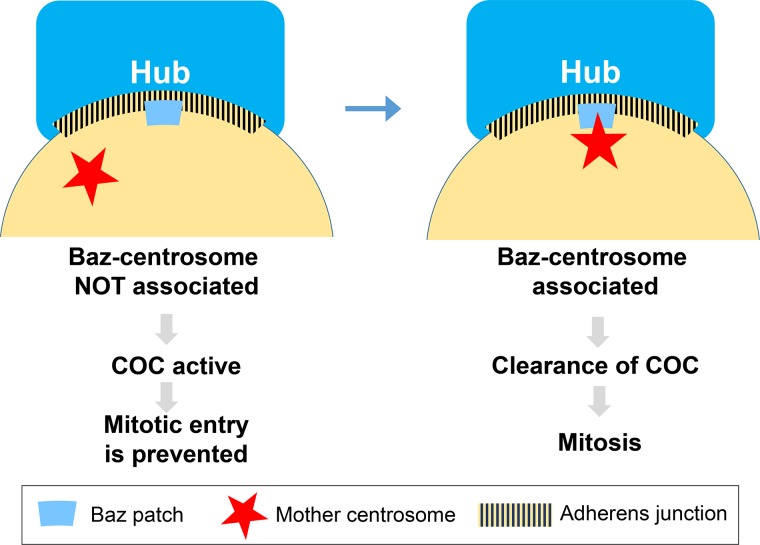
The COC: A safeguard mechanism of spindle orientation in Drosophila male GSCs. In interphase Drosophila male GSCs, the polarity protein Baz (Par3) forms a small structure along the adherens junction (Baz patch), which becomes a docking point for the mother centrosome. GSCs interpret the Baz patch–centrosome interaction as indicating the correct centrosome orientation, permitting mitotic entry. This mechanism ensures that GSCs enter mitosis only when they are ready to orient the mitotic spindle perpendicular to the hub cells.
Figure 4.
Figure 4.
Biased segregation of cellular components during asymmetric stem cell division. (A) In Drosophila male GSCs, sister chromatids of X and Y chromosomes are segregated nonrandomly. Image courtesy of G. Watase (University of Michigan, Ann Arbor, MI; Yadlapalli and Yamashita, 2013). (B) Drosophila male GSCs preferentially retain old histone H3 (green), whereas new histone H3 (red) is preferentially segregated to GBs. Image courtesy of X. Chen (Johns Hopkins University, Baltimore, MD; Tran et al., 2012). (C) An example of asymmetric segregation of protein aggregates. Image adapted from Rujano et al. (2006), published in PLoS Biology under the Creative Commons Attribution License. (D) Old mitochondria labeled by photoactivated Omp25-paGFP are preferentially segregated to the differentiating daughter of human mammary stem-like cells. Image adapted from Katajisto et al. (2015) with the permission from the authors and the American Association for the Advancement of Science.

References

    1. Aguilaniu H., Gustafsson L., Rigoulet M., and Nyström T.. 2003. Asymmetric inheritance of oxidatively damaged proteins during cytokinesis. Science. 299:1751–1753. 10.1126/science.1080418 - DOI - PubMed
    1. Anderson C.T., and Stearns T.. 2009. Centriole age underlies asynchronous primary cilium growth in mammalian cells. Curr. Biol. 19:1498–1502. 10.1016/j.cub.2009.07.034 - DOI - PMC - PubMed
    1. Bentzinger C.F., Wang Y.X., von Maltzahn J., Soleimani V.D., Yin H., and Rudnicki M.A.. 2013. Fibronectin regulates Wnt7a signaling and satellite cell expansion. Cell Stem Cell. 12:75–87. 10.1016/j.stem.2012.09.015 - DOI - PMC - PubMed
    1. Cabernard C., and Doe C.Q.. 2009. Apical/basal spindle orientation is required for neuroblast homeostasis and neuronal differentiation in Drosophila. Dev. Cell. 17:134–141. 10.1016/j.devcel.2009.06.009 - DOI - PubMed
    1. Cabernard C., Prehoda K.E., and Doe C.Q.. 2010. A spindle-independent cleavage furrow positioning pathway. Nature. 467:91–94. 10.1038/nature09334 - DOI - PMC - PubMed

Publication types