. 2018 Sep 7:11:421-429.
doi: 10.2147/CCID.S168621. eCollection 2018.

Effects of dextran sulfate, 4-t-butylcyclohexanol, pongamia oil and hesperidin methyl chalcone on inflammatory and vascular responses implicated in rosacea

Affiliations

Effects of dextran sulfate, 4-t-butylcyclohexanol, pongamia oil and hesperidin methyl chalcone on inflammatory and vascular responses implicated in rosacea

Hélène Hernandez-Pigeon et al. Clin Cosmet Investig Dermatol. .

Abstract

Background: Rosacea is a chronic facial skin disorder characterized by inflammation and vascular abnormalities. The pathophysiology of rosacea involves increased activation of the capsaicin receptor, TRPV1, the vascular endothelial growth factor (VEGF) pathway, and cathelicidin LL-37, MMP-9, and KLKs. We evaluated the activity of four compounds (dextran sulfate, 4-t-butylcyclohexanol [BCH; TRP-regulin®], pongamia oil, and hesperidin methyl chalcone [HMC]) on inflammatory and vascular responses implicated in rosacea.

Materials and methods: The anti-inflammatory activity of dextran sulfate was evaluated on PGE2 production after PMA stimulation of NCTC-2544 keratinocytes, and on normal human epidermal keratinocytes (NHEKs) after proinflammatory stimulation to mimic a rosacea environment. The anti-angiogenic activity of dextran sulfate was measured by analyzing pseudotube formation in co-cultured human microvascular endothelial cells/normal human dermal fibroblasts. HMC modulation of vascular responses and IL-8 cytokine production after SP stimulation was evaluated in human skin explants. We also assessed the effect of BCH on TRPV1 activation, and the effect of combined BCH and pongamia oil on the inflammatory response of NHEKs.

Results: Dextran sulfate strongly and significantly inhibited PMA-induced PGE2 production, inhibited KLK5 and MMP-9 mRNA expression, and IL-8, IL-1α and VEGF production, and displayed a highly significant inhibitory effect on VEGF-induced pseudotube formation. In SP-stimulated human skin explants, HMC significantly decreased the proportion of dilated vessels, total vessel area, and IL-8 production. BCH significantly and dose-dependently inhibited TRPV1 activation, and BCH and pongamia oil inhibited CXCL1 and CXCL6 mRNA expression and IL-8 production in NHEKs. Combined BCH/pongamia oil inhibited IL-8 production synergistically.

Conclusion: These in vitro results showed that dextran sulfate, BCH, pongamia oil and HMC, possess complementary soothing and anti-redness properties, supporting their combination in Avène redness-relief cosmetic products for sensitive skin prone to redness, and for topical adjunctive rosacea treatment.

Keywords: VEGF; inflammation; keratinocyte; redness; rosacea.


Conflict of interest statement

Disclosure All authors are employees of Pierre Fabre Dermo-Cosmétique R&D Center, Toulouse, France. A patent has been deposited (FR 1750059) by Hernandez-Pigeon H and Castex-Rizzi N. The authors report no other conflicts of interest in this work.

Figures
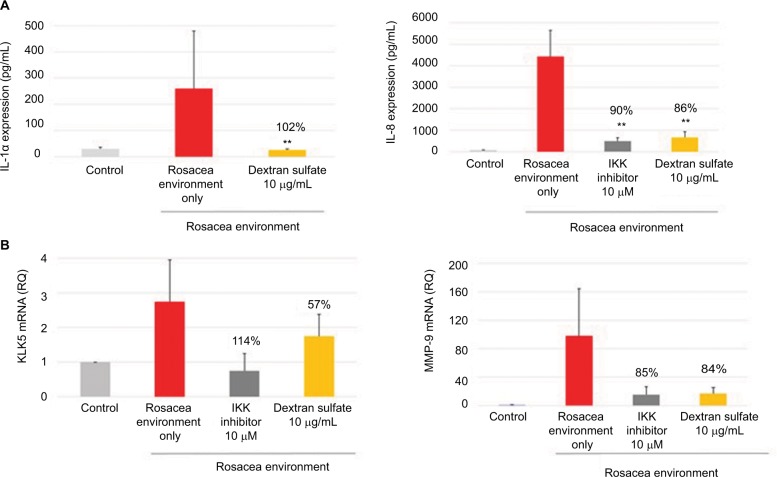
Figure 1
Figure 1
Mean (pg/mL) and percentage inhibition of IL-1α and IL-8 expression (A), and RQ and percentage inhibition of KLK5 and MMP-9 mRNA expression (B) after incubation of NHEK with dextran sulfate for 24 hours in a rosacea environment. IKK inhibitor was used as a positive control. Note: Data shown are the mean of three independent experiments. **P<0.01 vs control cells. Abbreviations: RQ, relative quantity; MMP-9, matrix metalloproteinase 9; NHEK, normal human epidermal keratinocyte; IKK, I kappa B kinase.
Figure 2
Figure 2
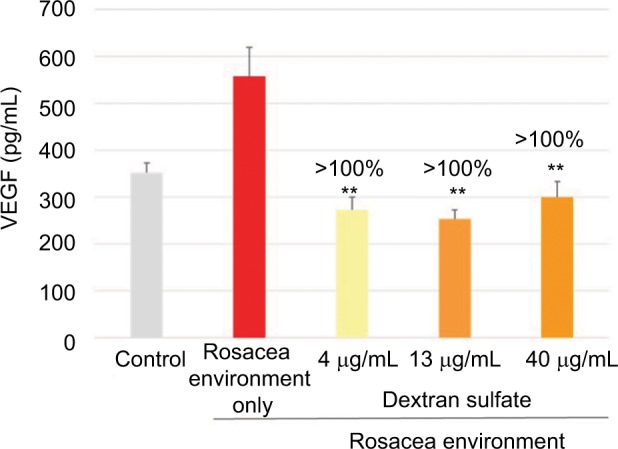
Mean (pg/mL) and percentage inhibition of VEGF expression after incubation of keratinocytes with dextran sulfate for 24 hours in a rosacea environment. Note: Data shown are the mean of three independent experiments. **P<0.01 vs control cells. Abbreviation: VEGF, vascular endothelial growth factor.
Figure 3
Figure 3
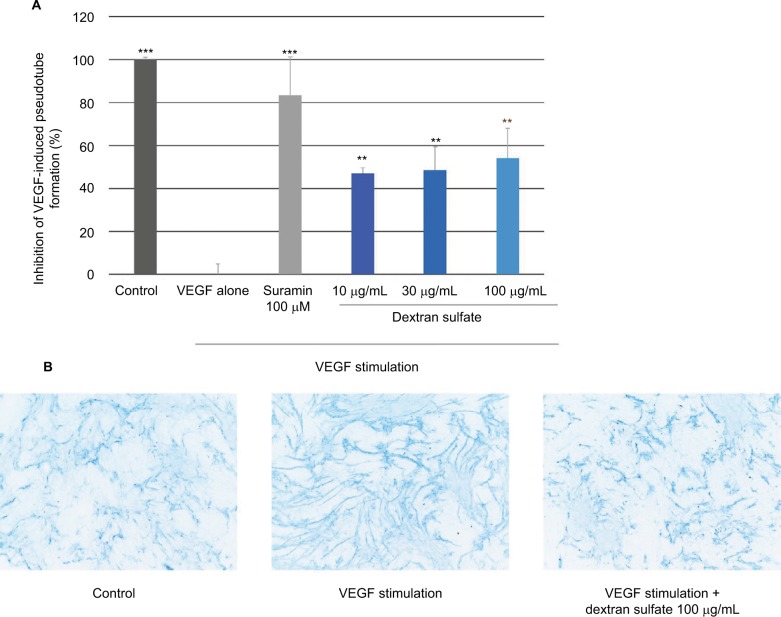
Effect of dextran sulfate on pseudotube formation. Notes: (A) Mean inhibition (%) of VEGF-induced pseudotube formation (mean of three experiments). Suramin 100 µM was used as a positive control. (B) Representative images of the effect of dextran sulfate on VEGF-induced pseudotube formation by endothelial cells. Endothelial cells were labeled with anti-collagen IV antibody-AF568. Magnification ×20. **p<0.01; ***p<0.001. Abbreviation: VEGF, vascular endothelial growth factor.
Figure 4
Figure 4
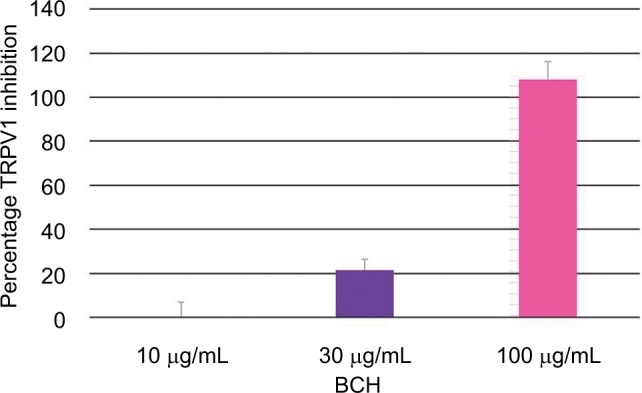
Percentage TRPV1 inhibition after 30 minutes of stimulation by capsaicin and treatment with different concentrations of BCH. Note: Data shown are the mean of three independent experiments. Abbreviations: TRPV1, transient receptor potential vanilloid 1; BCH, 4-t-butylcyclohexanol.
Figure 5
Figure 5
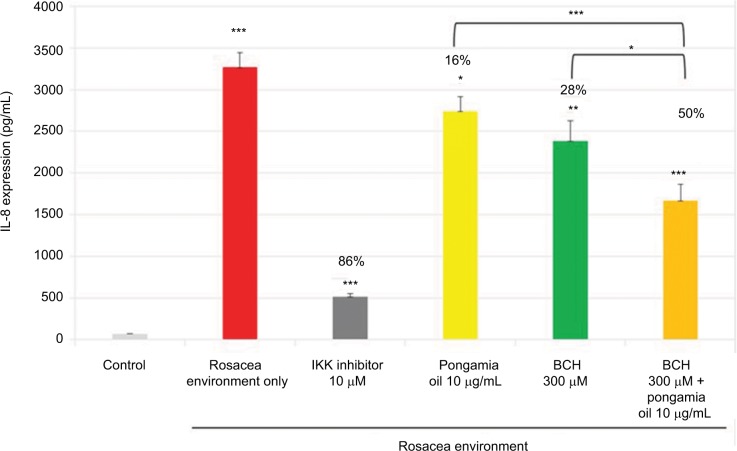
Mean (pg/mL) and percentage inhibition of IL-8 expression after incubation of NHEK with BCH, pongamia oil, or BCH + pongamia oil, for 24 hours in a rosacea environment. IKK inhibitor was used as a positive control. Notes: Data shown are the mean of three independent experiments. *P<0.05, **P<0.01, ***P<0.001 vs control cells. Abbreviations: IKK, I kappa B kinase; BCH, 4-t-butylcyclohexanol; NHEK, normal human epidermal keratinocyte.
Figure 6
Figure 6
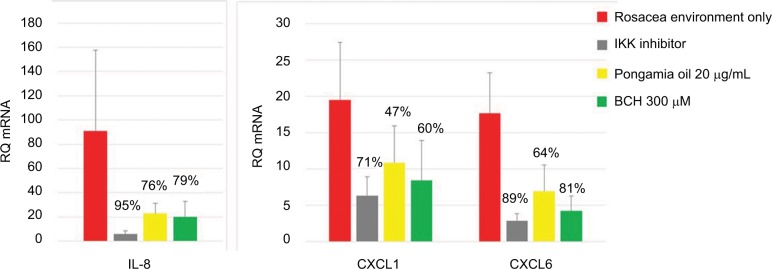
The RQ and percentage inhibition of IL-8, CXCL1, and CXCL6 mRNA expression after incubation of NHEK with BCH or pongamia oil for 24 hours in a rosacea environment. IKK inhibitor was used as a positive control. Note: Data shown are the mean of three independent experiments. Abbreviations: RQ, relative quantity; IKK, I kappa B kinase; BCH, 4-t-butylcyclohexanol; NHEK, normal human epidermal keratinocyte.
Figure 7
Figure 7
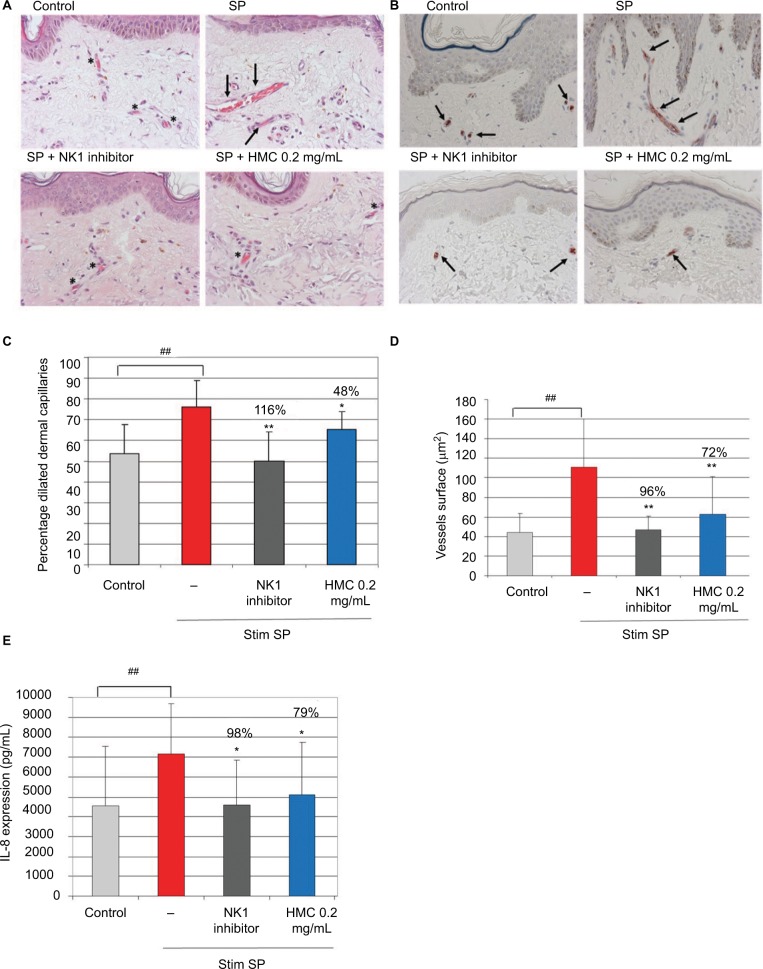
The activity of HMC in modulating vascular responses and IL-8 cytokine production after SP stimulation in human skin explants. Human skin explants were pre-incubated (or not) with HMC and then stimulated with SP for 24 hours. L-703,606 oxalate (10 µM), an NK1 inhibitor, was used as a positive control. Notes: (A) Representative images from H&E coloration of the effect of the test compounds on vessel dilation: normal morphology of capillary vessels is denoted by an asterisk, dilated capillary vessels are marked by an arrow; SP induced a clear dilation of the capillary vessels, while the addition of NK1 inhibitor prevented vascular dilation. HMC prevented SP-induced vessels dilation. (B) CD34+ endothelial cells immunostaining (arrows); CD34-labeling of endothelial cells surrounded by capillary vessels revealed alteration of vessels by SP and normal morphology with both NK1 inhibitor and HMC. Magnification ×40. (C) Proportion of dilated vessel capillaries and percentage inhibition of dilation with the test compounds. (D) Mean (µm2) and percentage inhibition of vessels surface. (E) Mean (pg/mL) and percentage inhibition of IL-8 expression. Data shown are the mean of eight independent experiments. *P<0.05 and **P<0.01 vs SP-stimulated explants. ##P<0.01 vs control explants. Red bar indicates exposure to rosacea environment only. Abbreviations: HMC, hesperidin methyl chalcone; SP, substance P.

References

    1. Sulk M, Seeliger S, Aubert J, et al. Distribution and expression of non-neuronal transient receptor potential (TRPV) ion channels in rosacea. J Invest Dermatol. 2012;132(4):1253–1262. - PMC - PubMed
    1. Kajiya K, Kajiya-Sawane M, Ono T, Sato K. Identification of an epidermal marker for reddened skin: vascular endothelial growth factor A. J Dermatol. 2017;44(7):836–837. - PubMed
    1. Yamasaki K, Gallo RL. Rosacea as a disease of cathelicidins and skin innate immunity. J Investig Dermatol Symp Proc. 2011;15(1):12–15. - PubMed
    1. Reinholz M, Ruzicka T, Schauber J. Cathelicidin LL-37: an antimicrobial peptide with a role in inflammatory skin disease. Ann Dermatol. 2012;24(2):126–135. - PMC - PubMed
    1. Jang YH, Sim JH, Kang HY, Kim YC, Lee ES. Immunohistochemical expression of matrix metalloproteinases in the granulomatous rosacea compared with the non-granulomatous rosacea. J Eur Acad Dermatol Venereol. 2011;25(5):544–548. - PubMed