


High-Fat Feeding Improves Anxiety-Type Behavior Induced by Ovariectomy in Rats
- PMID: 30233288
- PMCID: PMC6129615
- DOI: 10.3389/fnins.2018.00557
High-Fat Feeding Improves Anxiety-Type Behavior Induced by Ovariectomy in Rats
Erratum in
-
Corrigendum: High-Fat Feeding Improves Anxiety-Type Behavior Induced by Ovariectomy in Rats.Front Neurosci. 2018 Oct 12;12:738. doi: 10.3389/fnins.2018.00738. eCollection 2018. Front Neurosci. 2018. PMID: 30349456 Free PMC article.
Abstract
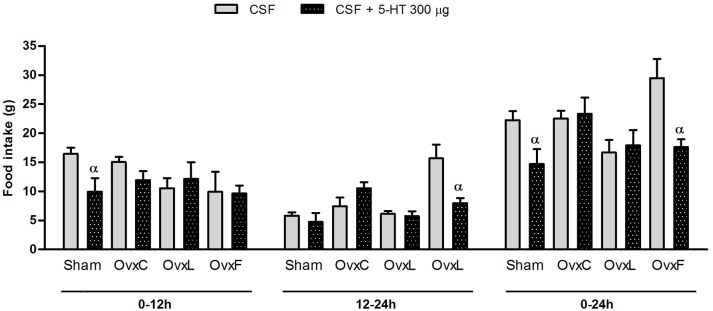
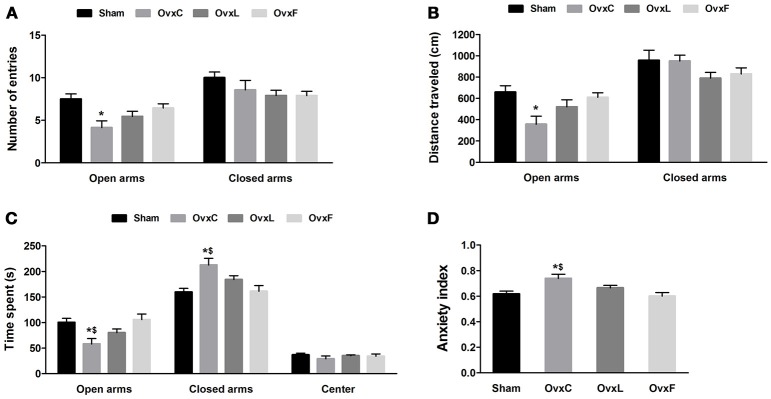
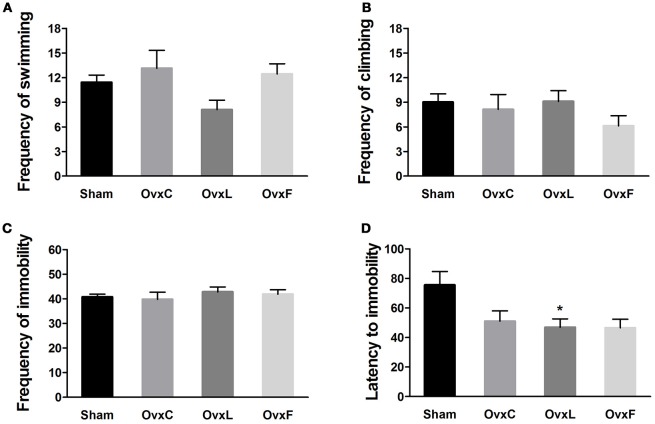
Menopause-induced changes may include increased incidence of both depression/anxiety and obesity. We hypothesized that behavioral changes that may develop after ovarian failure could be related to neurochemical and metabolic aspects affected by this condition and that high-fat intake may influence these associations. The present study investigated in rats the effects of ovariectomy, either alone or combined with high-fat diets enriched with either lard or fish-oil, on metabolic, behavioral and monoaminergic statuses, and on gene expression of neuropeptides and receptors involved in energy balance and mood regulation. Female rats had their ovaries removed and received either standard chow (OvxC) or high-fat diets enriched with either lard (OvxL) or fish-oil (OvxF) for 8 weeks. The Sham group received only chow diet. Ovariectomy increased feed efficiency and body weight gain and impaired glucose homeostasis and serotonin-induced hypophagia, effects either maintained or even accentuated by the lard diet but counteracted by the fish diet. The OvxL group developed obesity and hyperleptinemia. Regarding components of hypothalamic serotonergic system, both ovariectomy alone or combined with the fish diet increased 5-HT2C expression while the lard diet reduced 5-HT1B mRNA. Ovariectomy increased the anxiety index, as derived from the elevated plus maze test, while both high-fat groups showed normalization of this index. In the forced swimming test, ovariectomy allied to high-lard diet, but not to fish-oil diet, reduced the latency to immobility, indicating vulnerability to a depressive-like state. Linear regression analysis showed hippocampal AgRP to be negatively associated with the anxiety index and hypothalamic AgRP to be positively associated with the latency to immobility. These AgRp gene expression associations are indicative of a beneficial involvement of this neuropeptide on both depression and anxiety measures. The present findings demonstrate metabolic, neurochemical and behavioral alterations after ovaries removal and highlight a positive effect of high-fat feeding on the anxiety-like behavior shown by ovariectomized animals. Since the polyunsaturated ômega-3 intake (fish diet), unlike the saturated fat intake (lard diet), failed to induce deleterious metabolic or neurochemical consequences, further studies are needed focusing on the potential of this dietary component as an adjuvant anxiolytic agent after menopause.
Keywords: fish-oil; hippocampus; hypothalamus; lard; neuropeptides; serotonin.
Figures
References
Publication types
LinkOut - more resources
Full Text Sources
Other Literature Sources
