. 2018 Sep 4:9:516.
doi: 10.3389/fendo.2018.00516. eCollection 2018.

Improved Glucose and Lipid Metabolism in the Early Life of Female Offspring by Maternal Dietary Genistein Is Associated With Alterations in the Gut Microbiota

Affiliations

Improved Glucose and Lipid Metabolism in the Early Life of Female Offspring by Maternal Dietary Genistein Is Associated With Alterations in the Gut Microbiota

Liyuan Zhou et al. Front Endocrinol (Lausanne). .

Abstract

Maternal over-nutrition can lead to metabolic disorders in offspring, whereas maternal dietary genistein may have beneficial effects on the metabolic health of offspring. Our objective was to determine whether maternal dietary genistein could attenuate the detrimental effects of a maternal high-fat diet on their offspring's metabolism and to explore the role of the gut microbiota on their offspring's glucose and lipid metabolism. C57BL/6 female mice were fed either a high-fat diet without genistein (HF), high-fat diet with low-dose genistein (0.25 g/kg diet) (HF.LG), high-fat diet with high-dose genistein (0.6 g/kg diet) (HF.HG) or normal control diet (Control) for 3 weeks prior to breeding and throughout gestation and lactation. The female offspring in the HF group had lower birth weights and glucose intolerance and higher serum insulin, triacylglycerol (TG) and total cholesterol (TC) levels at weaning compared with the Control group. Offspring from HF.LG dams had increased birth weight, improved glucose tolerance, and decreased fasting insulin, whereas the serum TG and TC levels were decreased in HF.HG offspring in comparison with HF offspring. The significant enrichment of Bacteroides and Akkermansia in offspring from genistein-fed dams might play vital roles in improving glucose homeostasis and insulin sensitivity, and the significantly increased abundance of Rikenella and Rikenellaceae_RC9_ gut_group in the HF.HG group may be associated with the decreased serum levels of TG and TC. In conclusion, maternal dietary genistein negates the harmful effects of a maternal high-fat diet on glucose and lipid metabolism in female offspring, in which the altered gut microbiota plays crucial roles. The ability of maternal genistein intake to improve offspring metabolism is important since this intervention could fight the transmission of diabetes to subsequent generations.

Keywords: dietary genistein; female offspring; glucose and lipid metabolism; gut microbiota; maternal high-fat diet.


Figures
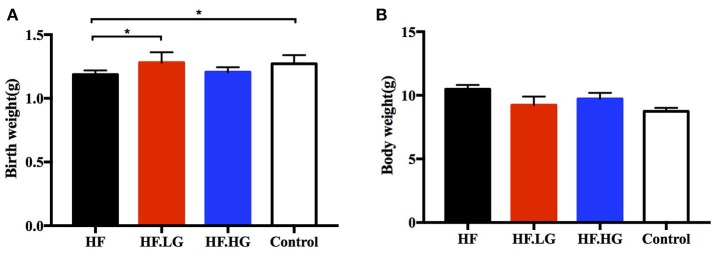
Figure 1
Figure 1
Birth weight and body weight at weaning in offspring. (A) Birth weight, and (B) Body weight of female offspring at weaning. HF, high-fat diet without genistein; HF. LG, high-fat diet with low-dose genistein; HF. HG, high-fat diet with high-dose genistein; Control, normal control diet. Data are expressed as means ± S.E.M. (n = 6–8/group). Mean values were significantly different between other group and the HF group: *p < 0.05.
Figure 2
Figure 2
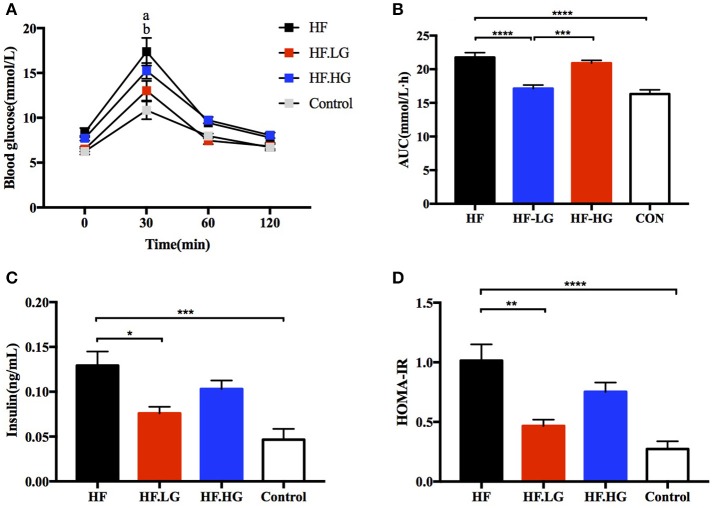
Glucose metabolism of the female offspring at weaning. (A) OGTT; (B) AUC; (C) Serum insulin levels; (D) HOMA-IR. HF, high-fat diet without genistein; HF. LG, high-fat diet with low-dose genistein; HF. HG, high-fat diet with high-dose genistein; Control, normal control diet; OGTT, oral glucose tolerance test; AUC, area under the curve; HOMA-IR, the homeostasis model assessment of insulin resistance. Data are expressed as means ± S.E.M. (n = 6-8/group). Mean values were significantly different between other group and the HF group: *p < 0.05, **p < 0.01, ***p < 0.001, ****p < 0.0001; Mean values were significantly different between Control group and the HF group: ‘a' p < 0.0001; Mean values were significantly different between HF.LG group and the HF group: ‘b' p < 0.001.
Figure 3
Figure 3
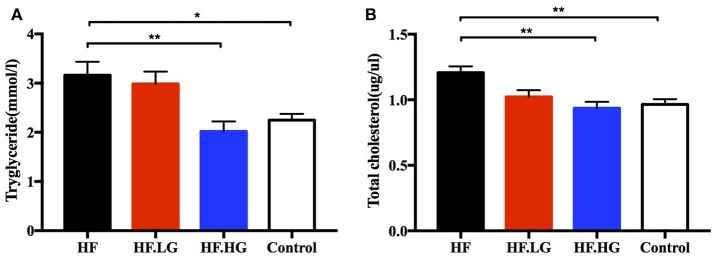
Lipid metabolism of the female offspring at weaning. (A) Serum triacyglycerol; and (B) serum total cholesterol. HF, high-fat diet without genistein; HF. LG, high-fat diet with low-dose genistein; HF. HG, high-fat diet with high-dose genistein; Control, normal control diet. Data are expressed as means ± S.E.M (n = 6-8/group). Mean values were significantly different between other group and the HF group: *p < 0.05, **p < 0.01.
Figure 4
Figure 4
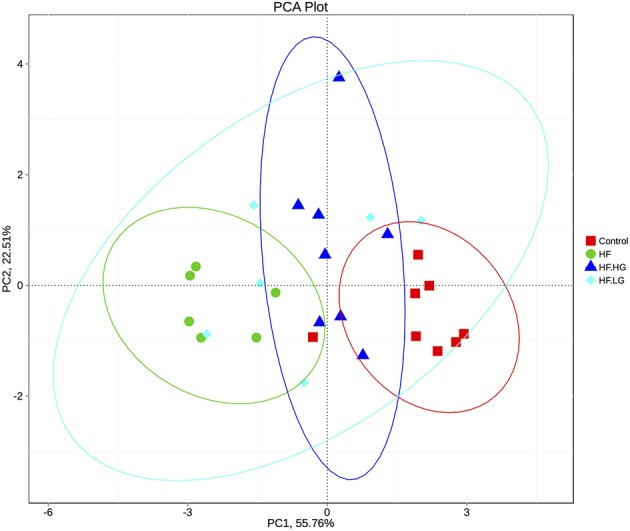
PCA plots of gut communities in the female offspring at weaning (n = 6–8/group). HF, high-fat diet without genistein; HF. LG, high-fat diet with low-dose genistein; HF. HG, high-fat diet with high-dose genistein; Control, normal control diet.
Figure 5
Figure 5
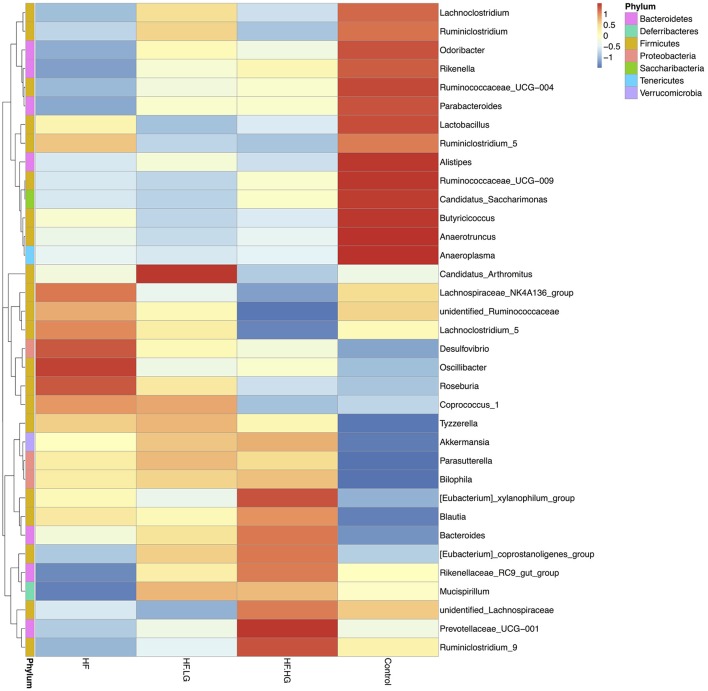
Heat map analyses of abundant genera in each group (n = 6–8/group). HF, high-fat diet without genistein; HF. LG, high-fat diet with low-dose genistein; HF. HG, high-fat diet with high-dose genistein; Control, normal control diet.
Figure 6
Figure 6
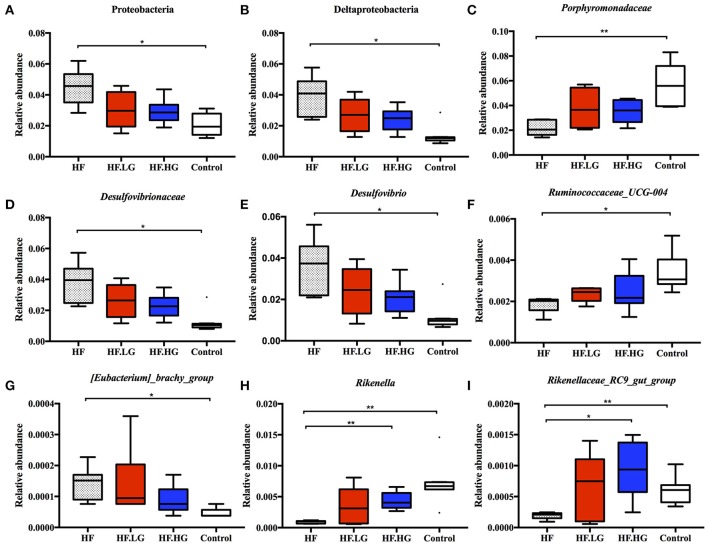
Relative abundance of bacterial taxa at different taxonomic levels in each group. (n = 6–8/group). (A) Proteobacteria; (B) Deltaproteobacteria; (C) Porphyromonadaceae; (D) Desulfovibrionaceae; (E) Desulfovibrio; (F) Ruminococcaceae_UCG-004; (G) [Eubacterium]_brachy_group; (H) Rikenella; and (I) Rikenellaceae_RC9_gut_group. HF, high-fat diet without genistein; HF. LG, high-fat diet with low-dose genistein; HF. HG, high-fat diet with high-dose genistein; Control, normal control diet. Data was analyzed by MetaStat. Mean values were significantly different between other group and the HF group: *q < 0.05, **q < 0.01.
Figure 7
Figure 7
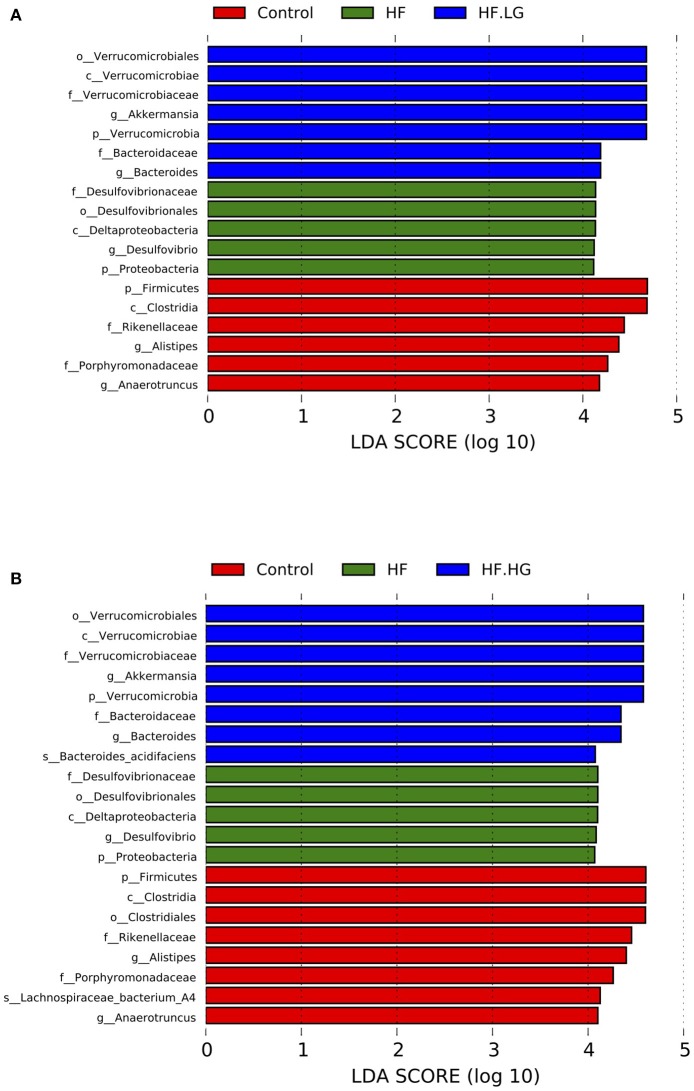
The LEfSe analysis of the different gut microbiota from the phylum level down to the species level (n = 6–8/group). (A) Differently enriched bacteria among the HF-HF.LG-Control group; and (B) Differently enriched bacteria among the HF-HF.HG-Control group. HF, high-fat diet without genistein; HF. LG, high-fat diet with low-dose genistein; HF. HG, high-fat diet with high-dose genistein; Control, normal control diet.

References

    1. Galley JD, Bailey M, Kamp Dush C, Schoppe-Sullivan S, Christian LM. Maternal obesity is associated with alterations in the gut microbiome in toddlers. PLoS ONE (2014) 9:e113026. 10.1371/journal.pone.0113026 - DOI - PMC - PubMed
    1. Jornayvaz FR, Vollenweider P, Bochud M, Mooser V, Waeber G, Marques-Vidal P. Low birth weight leads to obesity, diabetes and increased leptin levels in adults: the CoLaus study. Cardiovasc Diabetol.(2016) 15:73. 10.1186/s12933-016-0389-2 - DOI - PMC - PubMed
    1. Eriksson JG, Sandboge S, Salonen MK, Kajantie E, Osmond C. Long-term consequences of maternal overweight in pregnancy on offspring later health: findings from the Helsinki Birth Cohort Study. Ann Med. (2014) 46:434–8. 10.3109/07853890.2014.919728 - DOI - PubMed
    1. Xiao X, Zhang ZX, Cohen HJ, Wang H, Li W, Wang T, et al. Evidence of a relationship between infant birth weight and later diabetes and impaired glucose regulation in a Chinese population. Diabetes Care. (2008) 31:483–7. 10.2337/dc07-1130 - DOI - PubMed
    1. Ohta T, Toriniwa Y, Ryumon N, Inaba N, Hirao T, Yamanaka S, et al. Maternal high-fat diet promotes onset of diabetes in rat offspring. Anim Sci J. (2017) 88:149–55. 10.1111/asj.12606 - DOI - PubMed