. 2018 Sep 3:9:2001.
doi: 10.3389/fmicb.2018.02001. eCollection 2018.

Assessment of Bacterial Communities Associated With the Skin of Costa Rican Amphibians at La Selva Biological Station

Affiliations

Assessment of Bacterial Communities Associated With the Skin of Costa Rican Amphibians at La Selva Biological Station

Juan G Abarca et al. Front Microbiol. .

Abstract

Amphibian skin is a suitable environment for rich communities of microorganisms, both beneficial and detrimental to the host. The amphibian cutaneous microbiota has been hypothesized to play an important role as symbionts, protecting their hosts against disease. Costa Rica has one of the most diverse assemblages of amphibians in the world and we know very little about the microbiota of these tropical animals. For comparison with other studies, we explore the diversity of the skin bacterial communities employing16S rRNA amplicon sequencing of swab samples from twelve species of frogs at La Selva Biological Station in Sarapiquí, Heredia province. The predominant phylum detected in our studies was Proteobacteria, followed by Bacteroidetes and Actinobacteria, with these three phyla representing 89.9% of the total bacterial taxa. At the family level, Sphingobacteriaceae and Comamonadaceae were highly represented among samples. Our results suggest that host species and host family are significant predictors of the variation in microbiota composition. This study helps set the foundation for future research about microbiota composition and resilience to unfavorable conditions, leading to improvement in managing strategies for endangered amphibian species.

Keywords: Batrachochytrium dendrobatidis; La Selva Biological Station; amphibian; bacterial communities; microbiota.


Figures
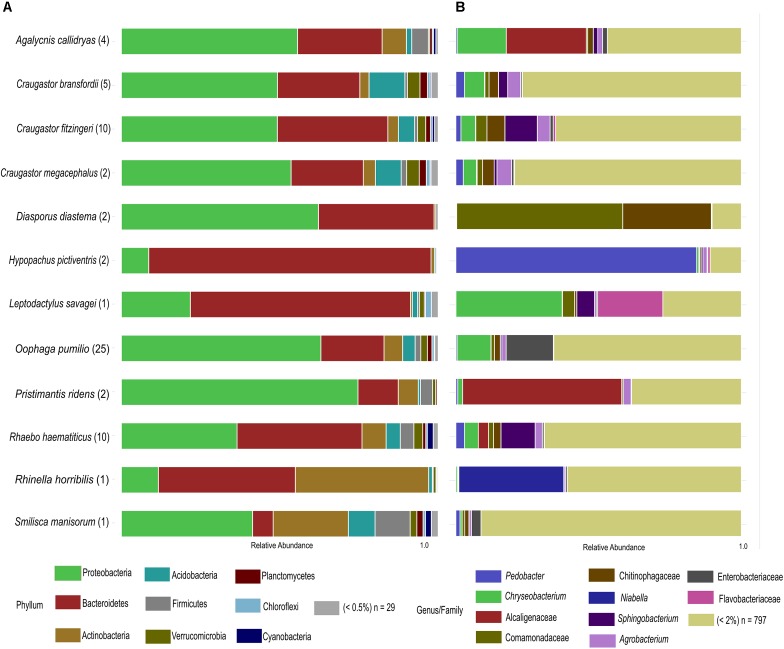
FIGURE 1
FIGURE 1
Taxonomic profile of skin bacterial communities of Costa Rican frogs from La Selva Biological Station. (A) Phylum-level relative abundance profiles of the host-associated skin bacterial communities. OTUs with abundances lower than 0.5% within each Phylum were clustered together. (B) Genus/family level relative abundance profiles of the frog-associated skin bacterial communities. OTUs with percentages lower than 2% of the microbiota composition within species were clustered together. The number of individuals sampled for each species is shown in parenthesis.
FIGURE 2
FIGURE 2
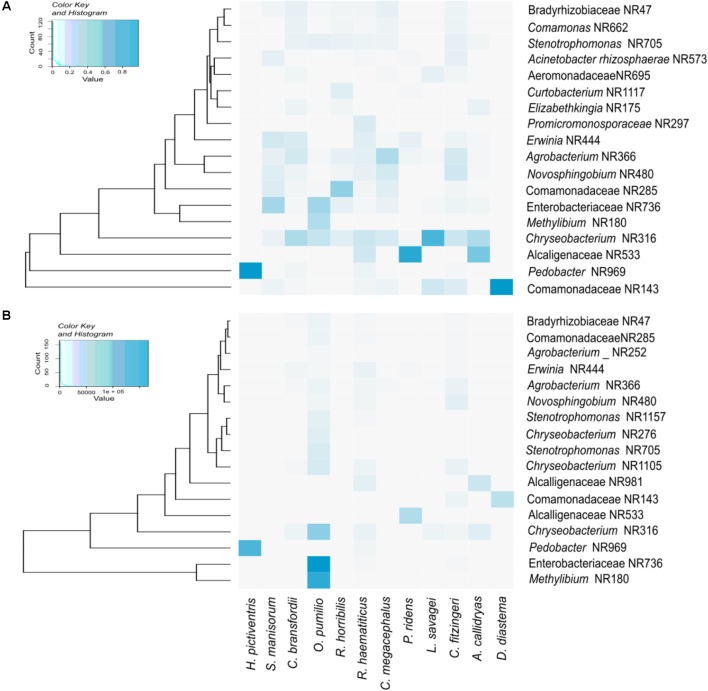
Heatmaps depicting the core skin bacteria present in 90% of samples (A), and the OTUs with higher relative abundance (B).
FIGURE 3
FIGURE 3
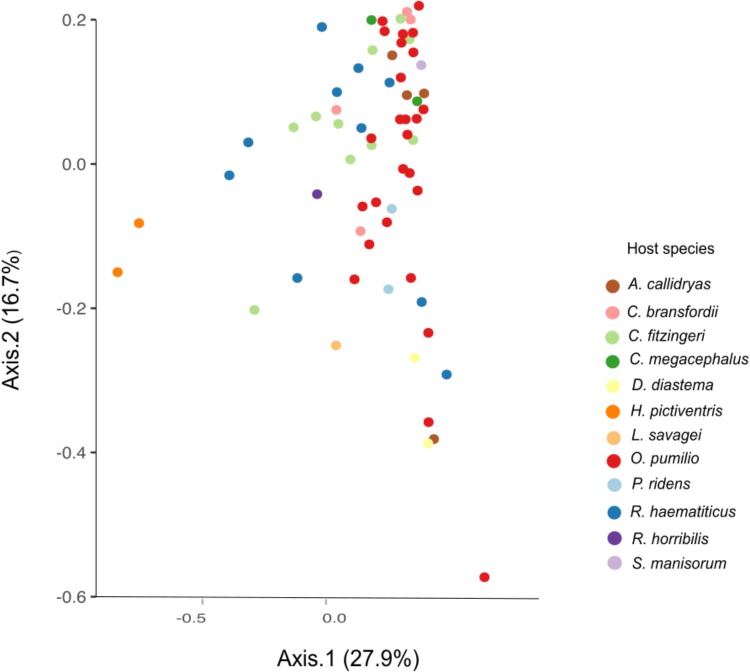
Beta diversity PCoA by weighted UNIFRAC of amphibian skin bacterial communities from La Selva Biological Station. Axes show the major components that explain 44.6% of the differences between samples.
FIGURE 4
FIGURE 4
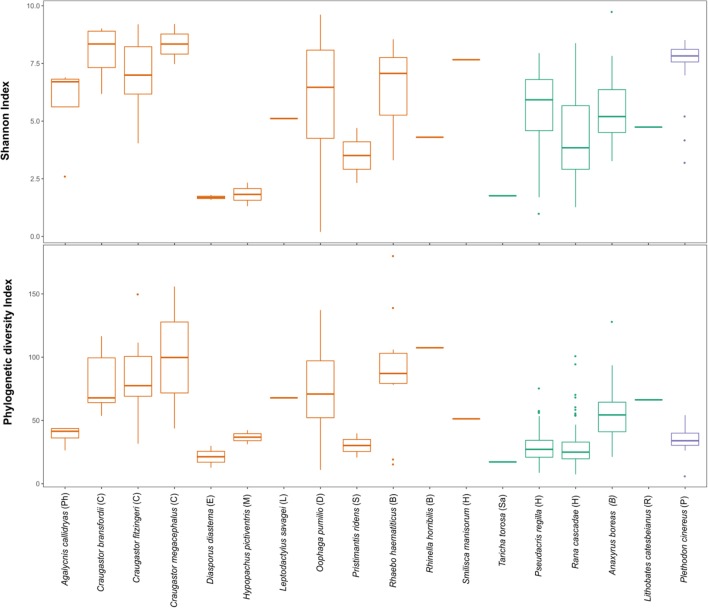
Shannon index and Faith Phylogenetic diversity of amphibian skin bacterial communities from Costa Rica (orange), California (green) and Virginia (purple). Letters in parenthesis represent family: Ph, Phyllomedusidae; C, Craugastoridae; E, Eleutherodactylidae; M, Microhylidae; L, Leptodactylidae; D, Dendrobatidae; S, Strabomantidae; B, Bufonidae; H, Hylidae; Sa, Salamandridae; R, Ranidae; P, Plethodontidae.
FIGURE 5
FIGURE 5
Proportion of putatively anti-Bd bacteria from the Antifungal Isolates Database. Note that 9 of the 12 species are shown after removing species with only one sample. No significant differences were found in proportion of putatively anti-Bd bacteria among species or between arboreal (orange) and terrestrial (green) habitat types.

References

    1. Abarca J. G., Zuniga I., Ortiz-Morales G., Lugo A., Viquez-Cervilla M., Rodriguez-Hernandez N., et al. (2018). Characterization of the skin microbiota of the cane toad rhinella cf. marina in puerto rico and costa rica. Front. Microbiol. 8:2624. 10.3389/fmicb.2017.02624 - DOI - PMC - PubMed
    1. AmphibiaWeb (2018). University of California, Berkeley. Available at: http://amphibiaweb.org [accessed May 2 2018].
    1. Antwis R. E., Harrison X. (2018). Probiotic consortia are not uniformly effective against different amphibian chytrid pathogen isolates. Mol. Ecol. 27 577–589. 10.1111/mec.14456 - DOI - PubMed
    1. Antwis R. E., Preziosi R. F., Harrison X. A., Garner T. W. (2015). Amphibian symbiotic bacteria do not show a universal ability to inhibit growth of the global panzootic lineage of Batrachochytrium dendrobatidis. Appl. Environ. Microbiol. 81 3706–3711. 10.1128/AEM.00010-15 - DOI - PMC - PubMed
    1. Becker M. H., Richards-Zawacki C. L., Gratwicke B., Belden L. K. (2014). The effect of captivity on the cutaneous bacterial community of the critically endangered Panamanian golden frog (Atelopus zeteki). Biol. Cons. 176 199–206. 10.1016/j.biocon.2014.05.029 - DOI

LinkOut - more resources