. 2018 Sep 3;3(4):e000801.
doi: 10.1136/bmjgh-2018-000801. eCollection 2018.

Determining environmental and anthropogenic factors which explain the global distribution of Aedes aegypti and Ae. albopictus

Affiliations

Determining environmental and anthropogenic factors which explain the global distribution of Aedes aegypti and Ae. albopictus

Borame Lee Dickens et al. BMJ Glob Health. .

Abstract

Background: Responsible for considerable global human morbidity and mortality, Aedes aegypti and Ae. albopictus are the primary vectors of several important human diseases, including dengue and yellow fever. Although numerous variables that affect mosquito survival and reproduction have been recorded at the local and regional scales, many remain untested at the global level, potentially confounding mapping efforts to date.

Methods: We develop a modelling ensemble of boosted regression trees and maximum entropy models using sets of variables previously untested at the global level to examine their performance in predicting the global distribution of these two vectors. The results show that accessibility, absolute humidity and annual minimum temperature are consistently the strongest predictors of mosquito presence. Both vectors are similar in their response to accessibility and humidity, but exhibit individual profiles for temperature. Their mapped ranges are therefore similar except at peripheral latitudes, where the range of Ae. albopictus extends further, a finding consistent with ongoing trapping studies. We show that variables previously identified as being relevant, including maximum and mean temperatures, enhanced vegetation index, relative humidity and population density, are comparatively weak performers.

Results: The variables identified represent three key biological mechanisms. Cold tolerance is a critical biological parameter, controlling both species' distribution northwards, and to a lesser degree for Ae. albopictus which has consequent greater inland suitability in North America, Europe and East Asia. Absolute humidity restricts the distribution of both vectors from drier areas, where moisture availability is very low, and increases their suitability in coastal areas. The latter is exacerbated by accessibility with increased likelihood of vector importation due to greater potential for human and trade movement.

Conclusion: Accessibility, absolute humidity and annual minimum temperatures were the strongest and most robust global predictors of Ae. aegypti and Ae. albopictus presence, which should be considered in control efforts and future distribution projections.

Keywords: arboviruses; environmental health; public health.


Conflict of interest statement

Competing interests: None declared.

Figures
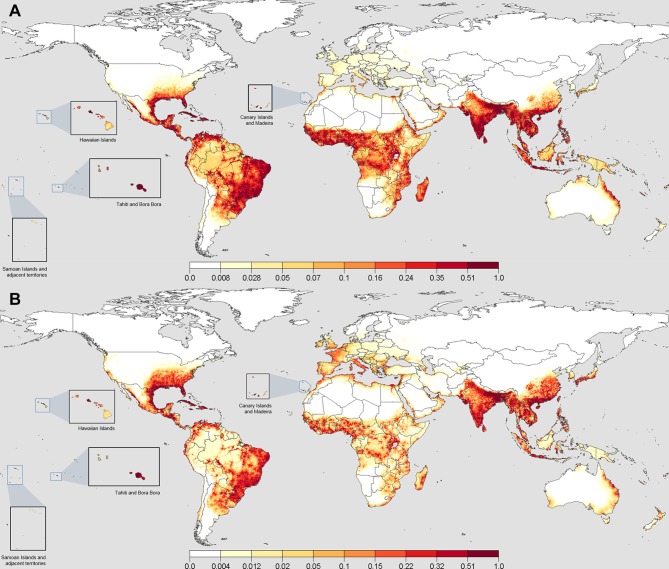
Figure 1
Figure 1
Suitability maps for Aedes aegypti and Ae. albopictus at the 50th percentile from 250 boosted regression trees. When converted to binary presence/absence, values greater than a median threshold of 0.24 for Ae. aegypti and 0.22 for Ae. albopictus indicated the presence across all fits. Panel (A) shows the results for Ae. aegypti, where the Indian subcontinent, South-East Asia, Eastern South America, Mid-Africa, Caribbean and Southern North America have the highest projected suitability. Notably, East Australia, Madagascar and the coastal regions of the Middle East show areas of high suitability. Europe, the heavily forested areas of the Amazon and latitudinal fringes of the distributions show sharp waning to areas of no suitability. Panel (B) shows the results for Ae. albopictus, where considerable similarities exist across the greatest areas of suitability for Ae. aegypti. Greater northward suitability exists in North America, Europe, China and the southern coast of Korea and Japan.
Figure 2
Figure 2
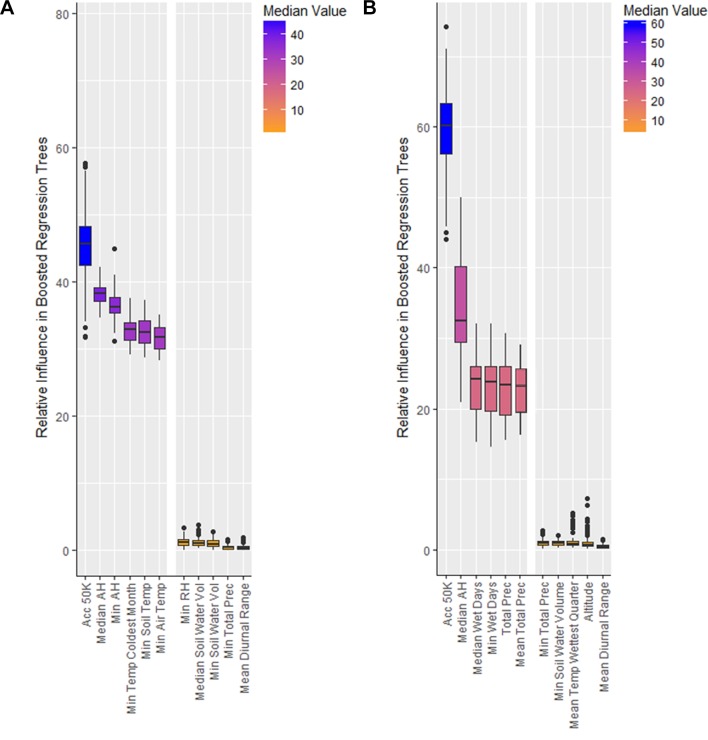
Top-performing and bottom-performing variables in relative influence in boosted regression trees for the prediction of both Aedes aegypti and Ae. albopictus presence. Panel (A) shows the top-performing variables for Ae. aegypti are Socioeconomic Data and Applications Center (SEDAC) accessibility, ERA annual median and minimum absolute humidity, WorldClim (WC) minimum temperature of the coldest month, and ERA annual minimum soil and air temperature. The bottom performers were ERA annual minimum relative humidity, ERA annual median and minimum soil water volume, ERA annual minimum total precipitation, and WC mean diurnal temperatures range. Panel (B) shows a similar trend for Ae. albopictus, where SEDAC accessibility and ERA annual median absolute humidity are the best performers, with ERA annual median and minimum wet days, and WC annual total and mean monthly precipitation also performing well. Annual minimum temperatures still perform as the best temperature constraint for Ae. albopictus, as displayed in the full version of this figure in online supplementary figure 1. The worst performers for Ae. albopictus were ERA annual minimum total precipitation and soil water volume, WC mean temperature of the wettest quarter, altitude, and WC mean diurnal temperature range. AH, absolute humidity; RH relative humidity.
Figure 3
Figure 3
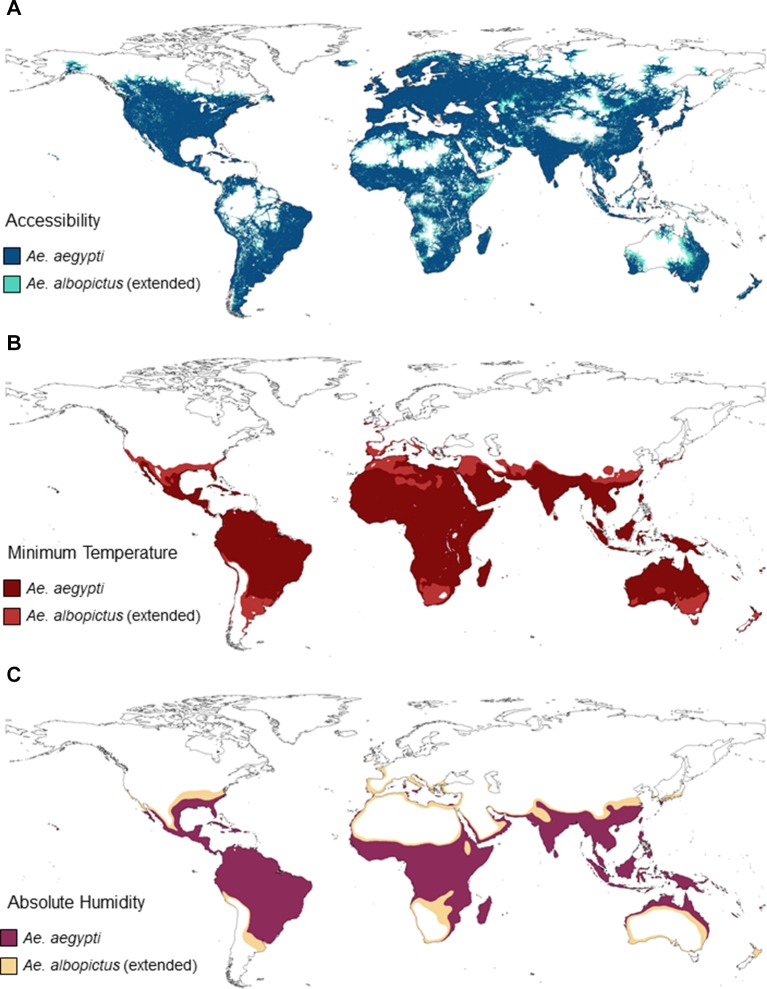
Effects of the three covariates identified in the final models for Aedes aegypti and Ae. albopictus. We used the threshold for the highest sum of sensitivity and specificity as a cut-off for the marginal effect on logit(p) and generated maps indicating areas where, according to that variable, the vector is predicted to be present. Panel (A) shows the effects of accessibility where very inaccessible areas hinder establishment for both species. Ae. albopictus is however able to establish in less accessible areas in comparison with Ae. aegypti, being less anthropophilic. Panel (B) shows the effects of temperature on Ae. aegypti and Ae. albopictus. Ae. albopictus is able to occupy almost the entire range of Ae. aegypti and shows extension beyond these regions into cooler areas. Panel (C) shows that absolute humidity affects Ae. aegypti and Ae. albopictus similarly.

References

    1. Sinka ME, Rubio-Palis Y, Manguin S, et al. . The dominant Anopheles vectors of human malaria in the Americas: occurrence data, distribution maps and bionomic précis. Parasit Vectors 2010;3:72 10.1186/1756-3305-3-72 - DOI - PMC - PubMed
    1. Bhatt S, Gething PW, Brady OJ, et al. . The global distribution and burden of dengue. Nature 2013;496:504–7. 10.1038/nature12060 - DOI - PMC - PubMed
    1. Pigott DM, Bhatt S, Golding N, et al. . Global distribution maps of the leishmaniases. Elife 2014;3 10.7554/eLife.02851 - DOI - PMC - PubMed
    1. Benedict MQ, Levine RS, Hawley WA, et al. . Spread of the tiger: global risk of invasion by the mosquito Aedes albopictus . Vector Borne Zoonotic Dis 2007;7:76–85. 10.1089/vbz.2006.0562 - DOI - PMC - PubMed
    1. Brady OJ, Golding N, Pigott DM, et al. . Global temperature constraints on Aedes aegypti and Ae. albopictus persistence and competence for dengue virus transmission. Parasit Vectors 2014;7:338 10.1186/1756-3305-7-338 - DOI - PMC - PubMed

LinkOut - more resources