


Methane on Mars and Habitability: Challenges and Responses
- PMID: 30234380
- PMCID: PMC6205098
- DOI: 10.1089/ast.2018.1917
Methane on Mars and Habitability: Challenges and Responses
Abstract
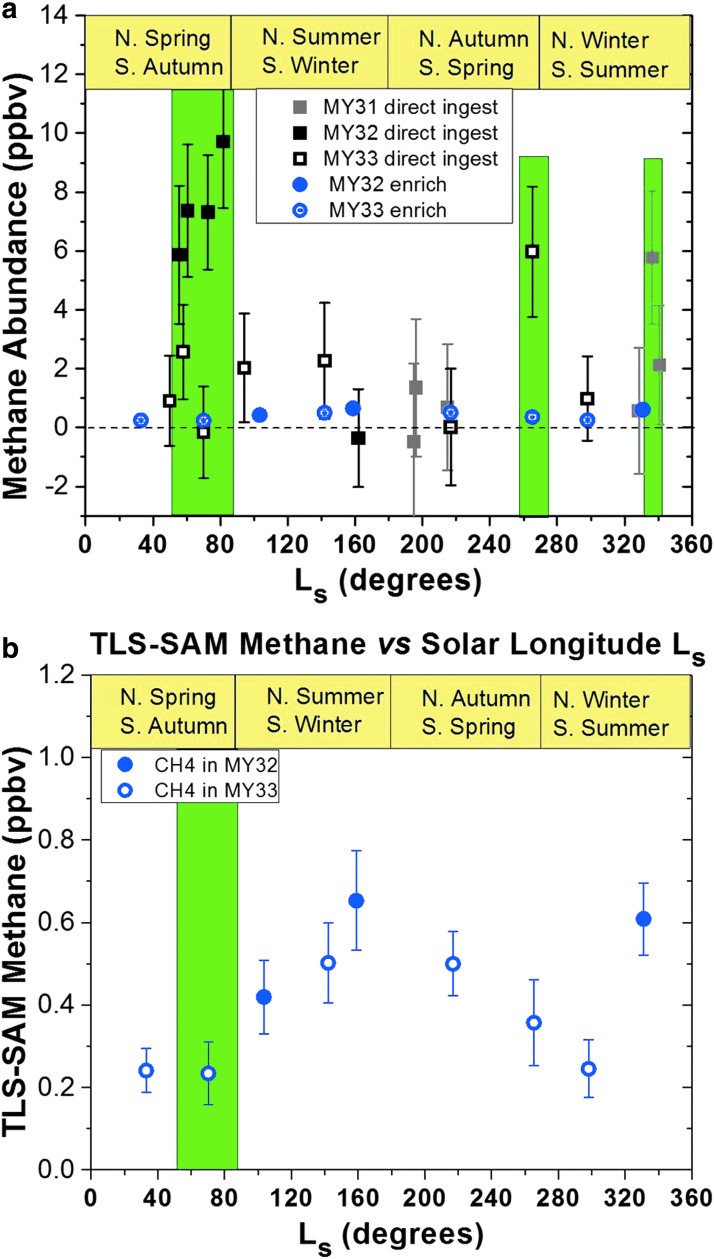
Recent measurements of methane (CH4) by the Mars Science Laboratory (MSL) now confront us with robust data that demand interpretation. Thus far, the MSL data have revealed a baseline level of CH4 (∼0.4 parts per billion by volume [ppbv]), with seasonal variations, as well as greatly enhanced spikes of CH4 with peak abundances of ∼7 ppbv. What do these CH4 revelations with drastically different abundances and temporal signatures represent in terms of interior geochemical processes, or is martian CH4 a biosignature? Discerning how CH4 generation occurs on Mars may shed light on the potential habitability of Mars. There is no evidence of life on the surface of Mars today, but microbes might reside beneath the surface. In this case, the carbon flux represented by CH4 would serve as a link between a putative subterranean biosphere on Mars and what we can measure above the surface. Alternatively, CH4 records modern geochemical activity. Here we ask the fundamental question: how active is Mars, geochemically and/or biologically? In this article, we examine geological, geochemical, and biogeochemical processes related to our overarching question. The martian atmosphere and surface are an overwhelmingly oxidizing environment, and life requires pairing of electron donors and electron acceptors, that is, redox gradients, as an essential source of energy. Therefore, a fundamental and critical question regarding the possibility of life on Mars is, "Where can we find redox gradients as energy sources for life on Mars?" Hence, regardless of the pathway that generates CH4 on Mars, the presence of CH4, a reduced species in an oxidant-rich environment, suggests the possibility of redox gradients supporting life and habitability on Mars. Recent missions such as ExoMars Trace Gas Orbiter may provide mapping of the global distribution of CH4. To discriminate between abiotic and biotic sources of CH4 on Mars, future studies should use a series of diagnostic geochemical analyses, preferably performed below the ground or at the ground/atmosphere interface, including measurements of CH4 isotopes, methane/ethane ratios, H2 gas concentration, and species such as acetic acid. Advances in the fields of Mars exploration and instrumentation will be driven, augmented, and supported by an improved understanding of atmospheric chemistry and dynamics, deep subsurface biogeochemistry, astrobiology, planetary geology, and geophysics. Future Mars exploration programs will have to expand the integration of complementary areas of expertise to generate synergistic and innovative ideas to realize breakthroughs in advancing our understanding of the potential of life and habitable conditions having existed on Mars. In this spirit, we conducted a set of interdisciplinary workshops. From this series has emerged a vision of technological, theoretical, and methodological innovations to explore the martian subsurface and to enhance spatial tracking of key volatiles, such as CH4.
Keywords: CH4; Mars; Mars instrumentation; Subsurface redox conditions.
Conflict of interest statement
No competing financial interests exist.
Figures
References
-
- Abrajano T.A., Sturchio N.C., Kennedy B.M., Lyon G.L., Muehlenbachs K., and Bohlke J.K. (1990) Geochemistry of reduced gas related to serpentinization of the Zambales ophiolite, Philippines. Appl Geochem 5:625–630
-
- Allen M., Sherwood Lollar B., Runnegar B., Oehler D.Z., Lyons J.R., Manning C.E., and Summers M.E. (2006) Is Mars alive? Eos 87:433–439
-
- Anbar A.D., Leu M.T., Nair H.A., and Yung Y.L. (1993) Adsorption of HOx on aerosol surfaces: implications for the atmosphere of Mars. J Geophys Res 98:10933–10940
-
- Astumian R.D. (2006) The unreasonable effectiveness of equilibrium theory for interpreting nonequilibrium experiments. Am J Phys 74:683–688
-
- Atreya S.K., Mahaffy P.R., and Wong A.-S. (2007) Methane and related trace species on Mars: origin, loss, implications for life, and habitability. Planet Space Sci 55:358–369
Publication types
MeSH terms
Substances
LinkOut - more resources
Full Text Sources
Other Literature Sources
Miscellaneous
