


Persistent circulation of genotype D coxsackievirus A2 in mainland of China since 2008
- PMID: 30235342
- PMCID: PMC6147602
- DOI: 10.1371/journal.pone.0204359
Persistent circulation of genotype D coxsackievirus A2 in mainland of China since 2008
Abstract
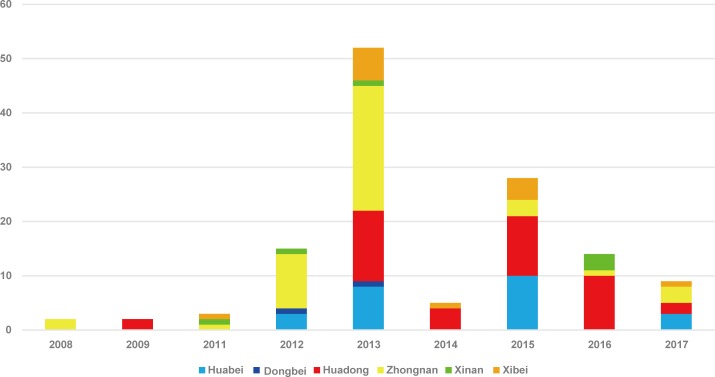
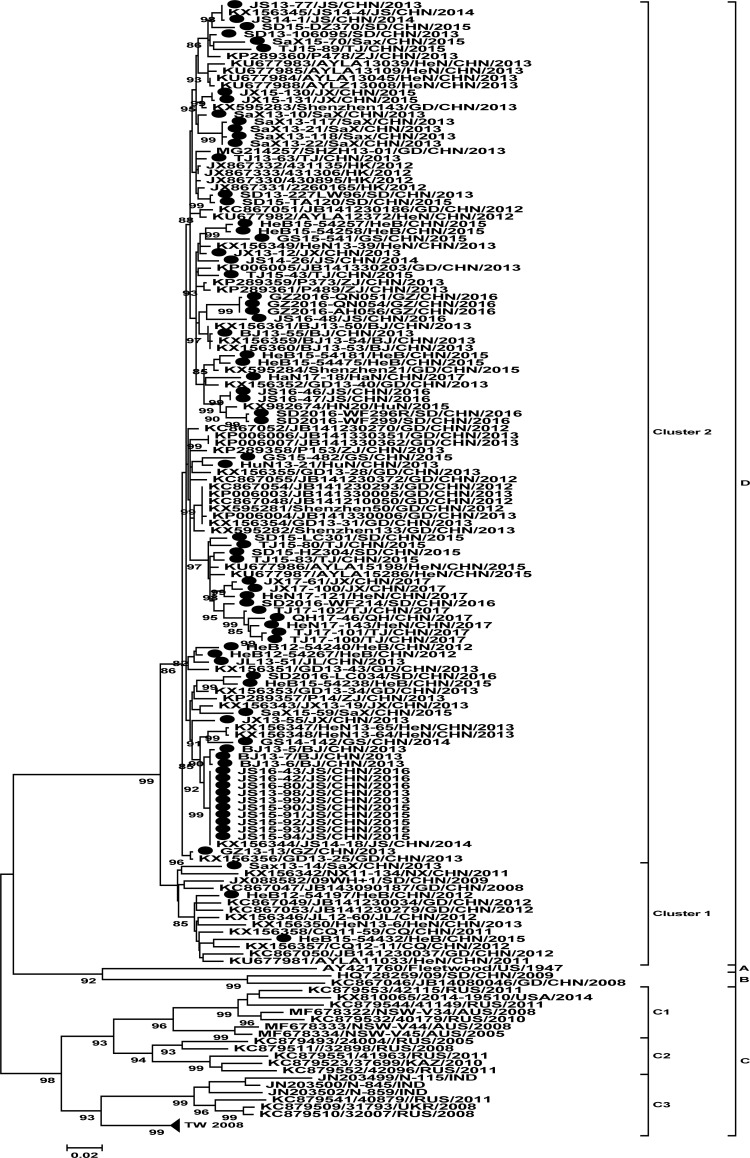
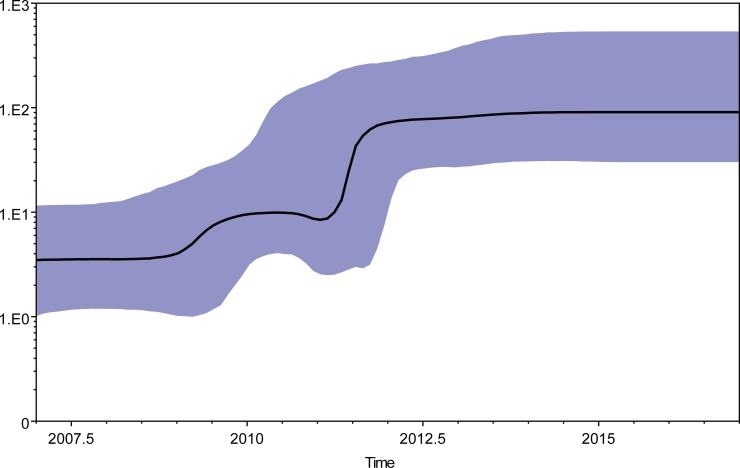
Coxsackievirus A2 (CV-A2) has emerged as an important etiological agent in the hand, foot, and mouth disease and herpangina pathogen spectrum because of its high global prevalence. In the present study, we investigated the evolutionary dynamics of CV-A2 circulating in China. We analyzed a total of 163 entire VP1 sequences of CV-A2, including 74 sequences generated from the present study and 89 sequences collected from the GenBank database. Phylogenetic analysis based on the entire VP1 nucleotide sequences confirmed the persistent circulation of the predominant genotype D in mainland of China since 2008. Cluster analysis grouped the sequences into two distinct clusters, clusters 1 and 2, with most grouped under cluster 2. After 2012, cluster 1 was gradually replaced by cluster 2. Results of Bayesian Markov chain Monte Carlo analysis suggested that multiple lineages of genotype D were transmitted in mainland of China at an estimated evolutionary rate of 6.32×10(-3) substitutions per site per year, which is consistent with the global evolutionary rate of CV-A2 (5.82×10(-3) substitutions per site per year). Continuous transmission and evolution of CV-A2 resulted in the genetic polymorphism.
Conflict of interest statement
The authors have declared that no competing interests exist.
Figures
References
-
- Oberste MS, Peñaranda S, Maher K, Pallansch MA. Complete genome sequences of all members of the species Human enterovirus A. J Gen Virol. 2004;85(6): 1597–1607. - PubMed
-
- Iwai M, Masaki A, Hasegawa S, Obara M, Horimoto E, Nakamura K, et al. Genetic changes of coxsackievirus A16 and enterovirus 71 isolated from hand, foot, and mouth disease patients in Toyama, Japan between 1981 and 2007. Jpn J Infect Dis. 2009;62(4): 254–259. - PubMed
-
- Chen SP, Huang YC, Li WC, Chiu CH, Huang CG, Tsao KC, et al. Comparison of clinical features between coxsackievirus A2 and enterovirus 71 during the enterovirus outbreak in Taiwan, 2008: a children's hospital experience. J Microbiol Immunol Infect. 2010;43(2): 99–104. 10.1016/S1684-1182(10)60016-3 - DOI - PubMed
Publication types
MeSH terms
Substances
LinkOut - more resources
Full Text Sources
Other Literature Sources
