


Evaluation of willingness to pay per quality-adjusted life year for a cure: A contingent valuation method using a scenario-based survey
- PMID: 30235732
- PMCID: PMC6160178
- DOI: 10.1097/MD.0000000000012453
Evaluation of willingness to pay per quality-adjusted life year for a cure: A contingent valuation method using a scenario-based survey
Abstract
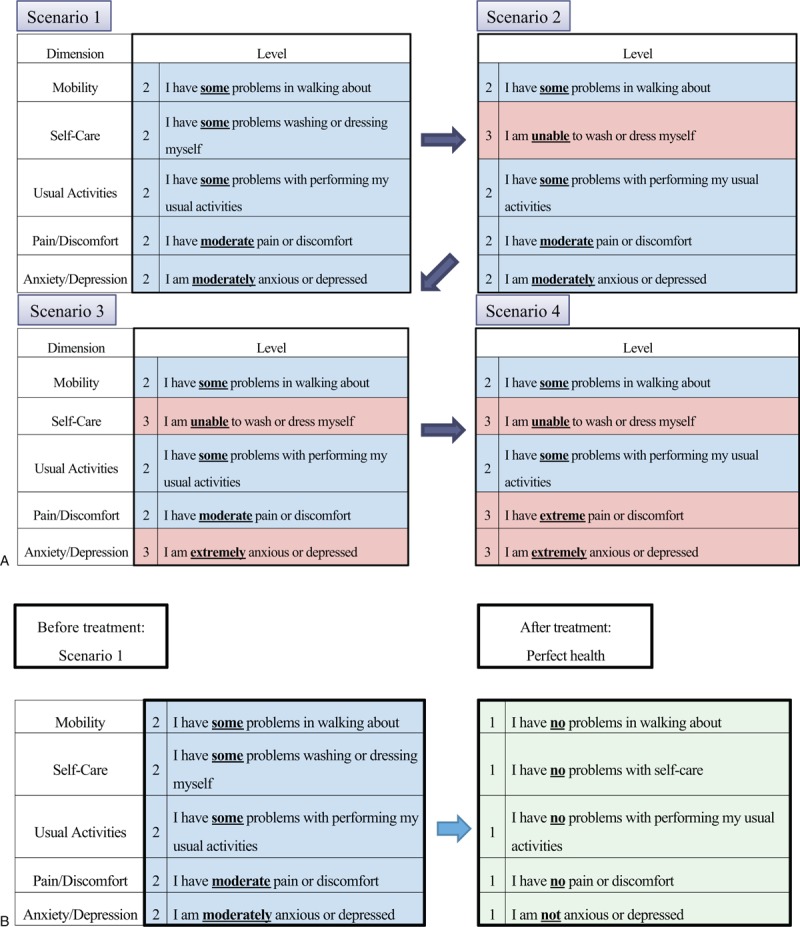
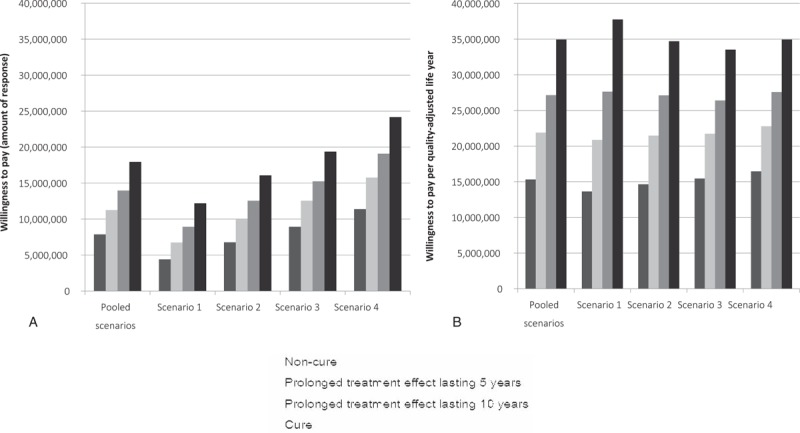
Cost-effectiveness is 1 of the most important factors in medicine reimbursement, and social willingness to pay (WTP) can provide evidence for the threshold of cost-effectiveness analysis. Recently, the concept of curative medicines has been introduced, so it is necessary to study their cost-effectiveness. This study aimed to estimate WTP per quality-adjusted life year (QALY) for a cure in the Korean general population.A total of 507 people from the general population, proportionally assigned by sex, age, and region, participated in face-to-face interviews. The contingent valuation survey was conducted with scenarios involving 4 EuroQol-5 dimensions (EQ-5D) with different health statuses. We assumed a treatment that moved the health status of each scenario to perfect health. WTP for 1 year of treatment was derived using a double-bounded format followed by open-ended answers. In the cure scenario, the post-treatment effect continued for a lifetime; in the non-cure scenario, the effect instantly stopped when treatment was terminated. Additionally, prolonged treatment effects lasting 5 and 10 years were added. To identify the factors influencing WTP, a multi-level analysis was performed.WTP per QALY for the non-cure scenario was KRW 15 million/QALY. For the cure scenario, WTP was 2.3 times higher (KRW 35 million/QALY) than in the non-cure scenario. The results for the prolonged treatment effect scenarios were KRW 22 million/QALY and KRW 27 million/QALY, which are 1.4 and 1.8 times higher than the non-cure scenario, respectively. In all scenarios, the statistically significant factors affecting WTP per QALY were higher education, higher household income, and healthcare provider.This study revealed that WTP for a cure treatment was higher than that for non-cure; this higher WTP should be considered in future decision-making regarding curative treatments.
Conflict of interest statement
The authors have no conflicts of interest to disclose.
Figures
References
-
- Mason C, Dunnill P. A brief definition of regenerative medicine. Regen Med 2008;3:1–5. - PubMed
-
- Faulkner E. What value do we place on a cure? Value demonstration challenges associated with innovator and regenerative therapies in the EU, North America and Asia. Presented at: ISPOR European Congress; Amsterdam, Netherlands; 2014. Available at: https://www.ohe.org/news/ohe-ispor-europe-presentations. Accessed November 21, 2017.
-
- Brennan T, Wilson JM. The special case of gene therapy pricing. Nat Biotechnol 2014;32:874–6. - PubMed
-
- Ahn JH, Kim YH, Shin SJ, et al. Research on methodologies for evidence-based healthcare decision-making process in Korea. 2010; National Evidence-Based Collaborating Agency. Available at: https://www.neca.re.kr/lay1/program/S1T11C145/report/view.do?seq=54. Accessed November 21, 2017.
-
- George B, Harris A, Mitchell A. Cost-effectiveness analysis and the consistency of decision making: evidence from pharmaceutical reimbursement in Australia (1991 to 1996). Pharmacoeconomics 2001;19:1103–9. - PubMed
Publication types
MeSH terms
LinkOut - more resources
Full Text Sources
Other Literature Sources
