


Clinical and radiologic analysis of on-demand use of etanercept for disease flares in patients with rheumatoid arthritis for 2 years: The RESUME study: A case-control study
- PMID: 30235736
- PMCID: PMC6160256
- DOI: 10.1097/MD.0000000000012462
Clinical and radiologic analysis of on-demand use of etanercept for disease flares in patients with rheumatoid arthritis for 2 years: The RESUME study: A case-control study
Abstract
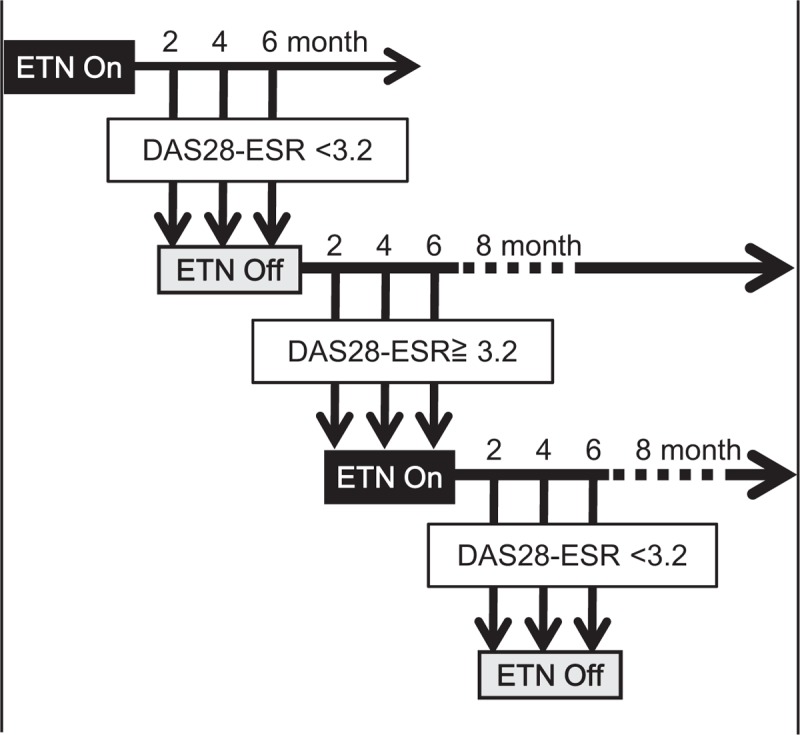
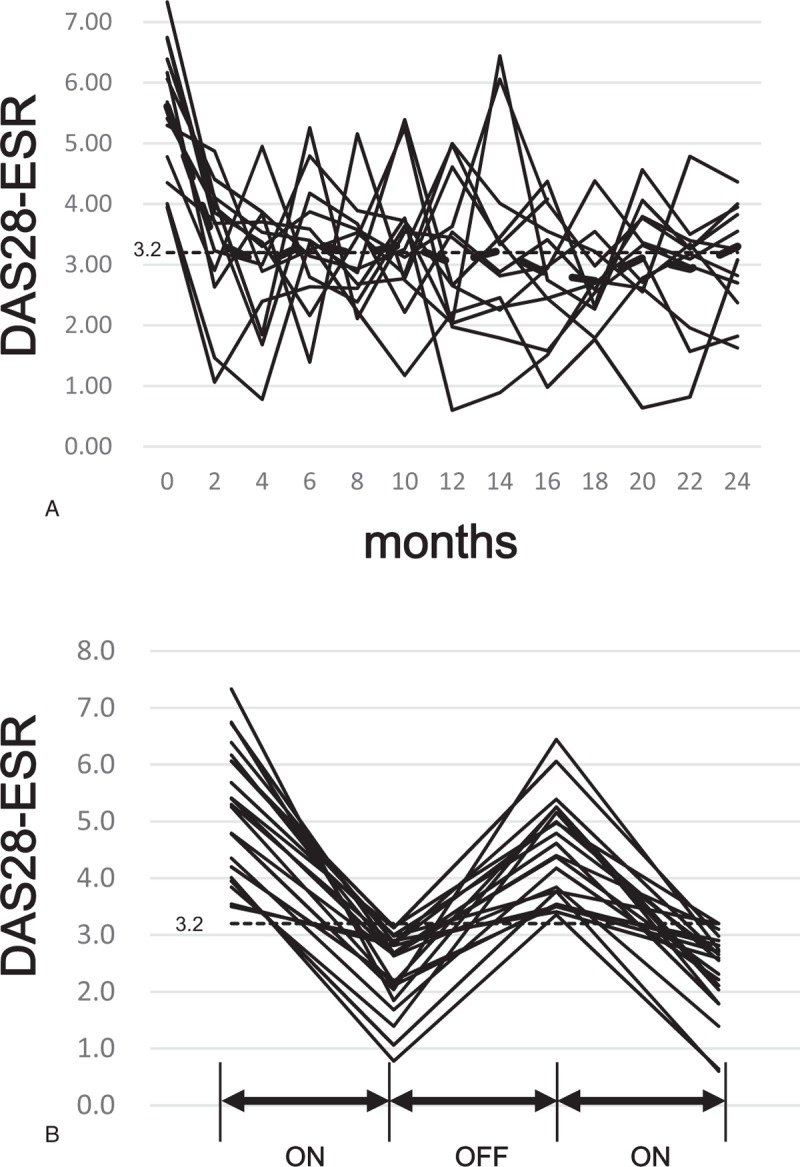
To reduce costs of biological disease-modifying antirheumatic drugs (bDMARDs), we evaluated the efficacy of repeated etanercept (ETN) discontinuation and restarting in rheumatoid arthritis (RA) patients in a case-control study.Thirty-one bDMARD-naive RA patients with moderate to high disease activity received ETN until low disease activity (LDA) was achieved, after which ETN was discontinued. Upon flaring, ETN was readministered with observation every 2 months for 2 years, and radiographically evaluated in comparison with a historical control group treated continuously with ETN. Statistical methods including Fisher exact test, analysis of variance (ANOVA), Kruskal-Wallis test, multiple regression analysis, and Student t test were conducted as appropriate.Thirteen patients with inadequate response to ETN were withdrawn from the study, and 5 had no flare-up after ETN discontinuation. In the remaining 13 patients, ETN was used on-demand to maintain LDA. Multivariate analysis revealed that MTX was significantly correlated with ETN. All 13 patients achieved LDA at final follow-up. Although joint damage progressed in patients using ETN on-demand, structural damage progression in the on-demand group was not significantly different from that in controls.On-demand use of ETN for flaring reduced disease activity but not structural damage in 50% of patients (though not significantly). However, inhibition of joint damage was achieved in 50% of patients after 2 years, supporting on-demand use of ETN as a treatment option for patients with RA who cannot afford bDMARD or targeted synthetic DMARD therapy.
Conflict of interest statement
Conflicts of interest: K.I. has received speakers fee and/or research grant from Chugai Pharmaceutical Co., Ltd, Mitsubishi Tanabe Pharma Co., Astellas Pharma, Inc., Abbvie GK, Eisai Co., Ltd, Takeda Pharmaceutical Co., Ltd, Daiichi Sankyo Co., Ltd, Ono Pharmaceutical Co., Ltd, Janssen Pharmaceutical K.K., Pfizer Japan, Inc., Eisai Co., Ltd, Sanofi K.K., Qol Co., Ltd.
All other authors have declared no conflicts of interest.
Figures
References
-
- Singh JA, Saag KG, Bridges SL, Jr, et al. 2015 American College of Rheumatology Guideline for the Treatment of Rheumatoid Arthritis. Arthritis Care Res (Hoboken) 2016;68:1–25. - PubMed
-
- Smolen JS, Landewe R, Bijlsma J, et al. EULAR recommendations for the management of rheumatoid arthritis with synthetic and biological disease-modifying antirheumatic drugs: 2016 update. Ann Rheum Dis 2017;76:960–77. - PubMed
-
- Michaud K, Messer J, Choi HK, et al. Direct medical costs and their predictors in patients with rheumatoid arthritis: a three-year study of 7,527 patients. Arthritis Rheum 2003;48:2750–62. - PubMed
-
- Sokka T, Haugeberg G, Asikainen J, et al. Similar clinical outcomes in rheumatoid arthritis with more versus less expensive treatment strategies. Observational data from two rheumatology clinics. Clin Exp Rheumatol 2013;31:409–14. - PubMed
Publication types
MeSH terms
Substances
LinkOut - more resources
Full Text Sources
Other Literature Sources
Medical
