Review
. 2018 Sep:35:381-393.
doi: 10.1016/j.ebiom.2018.08.024. Epub 2018 Sep 17.

Cholangiopathies - Towards a molecular understanding

Affiliations
Review

Cholangiopathies - Towards a molecular understanding

Paul K H Tam et al. EBioMedicine. 2018 Sep.

Erratum in

Abstract

Liver diseases constitute an important medical problem, and a number of these diseases, termed cholangiopathies, affect the biliary system of the liver. In this review, we describe the current understanding of the causes of cholangiopathies, which can be genetic, viral or environmental, and the few treatment options that are currently available beyond liver transplantation. We then discuss recent rapid progress in a number of areas relevant for decoding the disease mechanisms for cholangiopathies. This includes novel data from analysis of transgenic mouse models and organoid systems, and we outline how this information can be used for disease modeling and potential development of novel therapy concepts. We also describe recent advances in genomic and transcriptomic analyses and the importance of such studies for improving diagnosis and determining whether certain cholangiopathies should be viewed as distinct or overlapping disease entities.

Keywords: Alagille syndrome; Bile duct; Biliary atresia; Cholangiocyte; Cystic fibrosis; Hepatocyte; Liver; Organoid; Primary biliary cholangitis (PBC); Primary sclerosing cholangitis (PSC); Transplant.


Figures

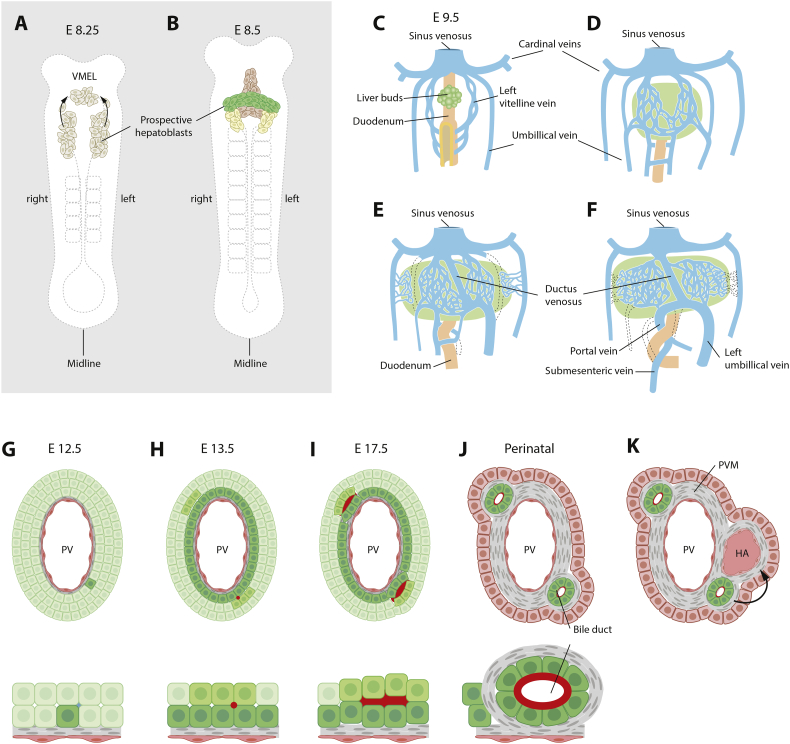
Fig. 1
Fig. 1
Embryonic development of the intrahepatic biliary system. (A,B) At circa embryonic day (E) 8.25 in mouse, cells in the ventral foregut endoderm and ventral midline endodermal lip (VMEL) arise and contribute to the developing liver bud. (C) Next, the liver bud grows to engulf the vitelline veins, which form a vascular plexus that gives rise to hepatic sinusoids. The umbilical veins and cardinal veins also contribute to hepatic sinusoid formation. Portions of the vitelline veins anastomose and establish the portal vein – the scaffold for biliary system formation. (D) Portal vein mesenchyme surrounding the portal veins induces formation of the ductal plate, a layer of cholangiocytes surrounding the portal vein, in a process that initiates near the hilum and progresses towards the periphery. Small lumina form, with cholangiocytes on the portal side and hepatoblast-like cells on the parenchymal side that subsequently differentiate into cholangiocytes. In mice, bile ducts then induce formation of the hepatic artery, while in humans the inductive signal is thought to come from the ductal plate itself.
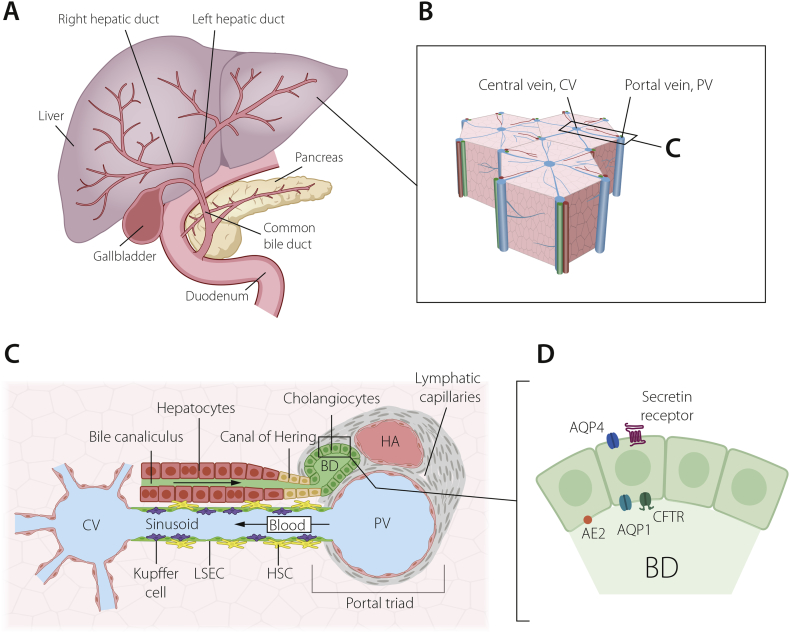
Fig. 2
Fig. 2
The biliary system of the liver. (A) Schematic depiction of the extra- and intra-hepatic bile duct systems and links to the gall bladder. (B) The hexagonal lobular structure of the liver, with a central vein (CV) surrounded by six portal veins (PV), each paired with a bile duct and hepatic artery, a trio known as the portal triad, enlarged in (C). These three structures are embedded in portal vein mesenchyme, which also contains a lymphatic system.Blood flows centripetally from the portal veins and hepatic arteries to the central vein, along sinusoids lined by liver sinusoidal endothelial cells (LSECs), Kupffer cells and hepatic stellate cells (HSCs).Bile flows instead along bile canaliculi formed by hepatocytes, towards the canals of Hering and into the bile ducts. (D) Bile ducts are highly polarized structures, with an apical cilium (not pictured) and apicobasal distribution of channels and receptors, including anion exchange protein 2 (AE2), aquaporin 1 and 4 (AQP1, AQP4), the cystic fibrosis transmembrane receptor (CFTR) and the secretin receptor.

References

    1. Swartley O.M., Foley J.F., Livingston D.P., Cullen J.M., Elmore S.A. Histology atlas of the developing mouse hepatobiliary hemolymphatic vascular system with emphasis on embryonic Days11.5-18.5 and early postnatal development. Toxicol Pathol. 2016;44:705–725. - PMC - PubMed
    1. Ober E.A. Development of the liver: Insights into organ and tissue morphogenesis. J Hepatol. 2018;68:1049–1062. - PubMed
    1. Gérard C., Tys J., Lemaigre F.P. Presented at the seminars in cell & developmental biology. Elsevier; 2017. Gene regulatory networks in differentiation and direct reprogramming of hepatic cells; pp. 43–50. - PubMed
    1. Siebel C., Lendahl U. Notch signaling in development, tissue homeostasis, and disease. Physiol Rev. 2017;97:1235–1294. - PubMed
    1. Hofmann J.J., Zovein A.C., Koh H., Radtke F., Weinmaster G., Iruela-Arispe M.L. Jagged1 in the portal vein mesenchyme regulates intrahepatic bile duct development: insights into Alagille syndrome. Development. 2010;137:4061–4072. - PMC - PubMed