Review
. 2018 Sep 20;9(10):961.
doi: 10.1038/s41419-018-0982-2.

Helicobacter pylori infection and inflammatory bowel disease: a crosstalk between upper and lower digestive tract

Affiliations
Review

Helicobacter pylori infection and inflammatory bowel disease: a crosstalk between upper and lower digestive tract

Yang Yu et al. Cell Death Dis. .

Abstract

Helicobacter pylori has coexisted with humans for approximately 60,000 years and greater than 50% of the global population is infected with H. pylori. H. pylori was successfully cultured in vitro in 1983 and studies of H. pylori have achieved substantial advances over the last 35 years. Since then, H. pylori has been characterized as the primary pathogenic factor for chronic gastritis, peptic ulcer, and gastric malignancy. Numerous patients have received H. pylori eradication treatment, but only 1-2% of H. pylori-infected individuals ultimately develop gastric cancer. Recently, numerous epidemiological and basic experimental studies suggested a role for chronic H. pylori infection in protecting against inflammatory bowel disease (IBD) by inducing systematic immune tolerance and suppressing inflammatory responses. Here we summarize the current research progress on the association between H. pylori and IBD, and further describe the detailed molecular mechanism underlying H. pylori-induced dendritic cells (DCs) with the tolerogenic phenotype and immunosuppressive regulatory T cells (Tregs). Based on the potential protective role of H. pylori infection on IBD, we suggest that the interaction between H. pylori and the host is complicated, and H. pylori eradication treatment should be administered with caution, especially for children and young adults.


Conflict of interest statement

The authors declare that they have no conflict of interest.

Figures
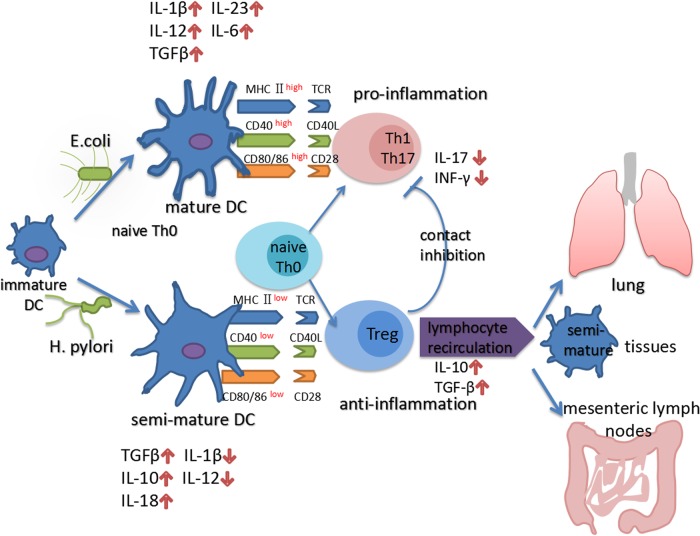
Fig. 1
Fig. 1. H. pylori infection induce tolerogenic DCs and immunosuppressive Tregs.
E. coli efficiently promotes the transformation of DCs into mature DCs expressing high levels of MHC II CD80, CD86, and CD40that produce numerous of proinflammatory factors, such as IL-12, IL-1β, IL-6, and IL-23. In contrast, H. pylori-stimulated DCs retain a semi-mature phenotype with low MHC II CD80, CD86, and CD40 expression and low proinflammatory factor secretion. Semi-mature DCs secrete increased levels of IL-10, TGF-β, and IL-18, a process that is required for the differentiation of immunosuppressive Tregs, rather than Th1 or Th17 cells from naive Th0 cells. Through lymphocyte recirculation mechanisms, CD4 + CD25 + FoxP3 + Tregs produced in the gastric mucosa travel to other lymphoid tissues in distant organs to exert a systematic immunoregulatory effect that influences the pathogenesis of various autoimmune and allergic diseases, such as IBD and asthma. Moreover, Tregs inhibit the transformation of Th0 cells to Th1 and Th17 cells, and maintain DCs in a semi-mature status by direct contact and IL-10 and TGF-β secretion
Fig. 2
Fig. 2. The molecular mechanism underlying the protective effect of H. pylori on IBD.
The uncommon structure and weak biological activation of H. pylori LPS leads to the inefficient activation of NF-κB and production of low levels of proinflammatory molecules. On the other hand, H. pylori activates NOD2 and ATG16L1 to activate autophagy, and the process of autophagosome formation results in the endocytosis of MHC II and inhibition of NF-κB. The disequilibrium between inflammation and autophagy (the latter is relatively enhanced by H. pylori infection) may have a key role in the formation of tolerogenic semi-mature DCs. Moreover, NOD2 forms trimers with p38 and hnRNP-A1, and the latter subsequently enters the nucleus to stimulate IL-10 transcription. IL-10 and TGF-β are required for the activation of the Smad signaling pathway and downstream protective mechanisms, including the inhibition of TLR expression and the NK-κB signaling pathway and the induction of CDX2 production and MUC2 transcription. In addition, NLRP3 and IL-18 are indispensable for the protective effect of H. pylori on experimental colitis. Due to the NF-κB-independent production mechanism, pro-IL-18 is stably expressed in the cytoplasm and is effectively produced by activated NLRP3 and caspase-1 after H. pylori infection

References

    1. Baumgart DC, Sandborn WJ. Crohn’s disease. Lancet. 2012;380:1590–1605. doi: 10.1016/S0140-6736(12)60026-9. - DOI - PubMed
    1. Ordã sI, Eckmann L, Talamini M, Baumgart DC, Sandborn WJ. Ulcerative colitis. Lancet. 2012;380:1606–1619. doi: 10.1016/S0140-6736(12)60150-0. - DOI - PubMed
    1. Manichanh C, Borruel N, Casellas F, Guarner F. The gut microbiota in IBD. Nat. Rev. Gastroenterol. Hepatol. 2012;9:599–608. doi: 10.1038/nrgastro.2012.152. - DOI - PubMed
    1. Jostins L, et al. Host-microbe interactions have shaped the genetic architecture of inflammatory bowel disease. Nature. 2012;491:119–124. doi: 10.1038/nature11582. - DOI - PMC - PubMed
    1. Fujino S, et al. Increased expression of interleukin 17 in inflammatory bowel disease. Gut. 2003;52:65. doi: 10.1136/gut.52.1.65. - DOI - PMC - PubMed

Publication types

MeSH terms
