. 2018 Sep 20;9(1):3832.
doi: 10.1038/s41467-018-06319-6.

Vegetation response to exceptional global warmth during Oceanic Anoxic Event 2

Affiliations

Vegetation response to exceptional global warmth during Oceanic Anoxic Event 2

Ulrich Heimhofer et al. Nat Commun. .

Abstract

The Cenomanian-Turonian Oceanic Anoxic Event (OAE2; ~94.5 million years ago) represents an episode of global-scale marine anoxia and biotic turnover, which corresponds to one of the warmest time intervals in the Phanerozoic. Despite its global significance, information on continental ecosystem response to this greenhouse episode is lacking. Here we present a terrestrial palynological record combined with marine-derived temperature data (TEX86) across an expanded OAE2 section from the Southern Provençal Basin, France. Despite high TEX86-derived temperature estimates reaching up to 38 °C, the continental hinterland did support a diverse vegetation, adapted to persist under elevated temperatures. A transient phase of climatic instability and cooling during OAE2 known as Plenus Cold Event (PCE) is marked by the proliferation of open, savanna-type vegetation rich in angiosperms at the expanse of conifer-dominated forest ecosystems. A rise in early representatives of Normapolles-type pollen during the PCE marks the initial radiation of this important angiosperm group.


Conflict of interest statement

The authors declare no competing interests

Figures
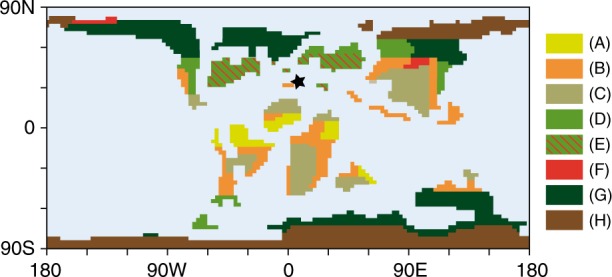
Fig. 1
Fig. 1
Palaeogeographic map illustrating Cenomanian–Turonian biome distribution. Palaeo-map is modified after ref. and includes the extent of the Normapolles palynofloral province. Color code representing (A) tropical moist, open canopy mixed forest with shrub understory; (B) savanna-type dry low understory with sparse trees; (C) deciduous dry/warm shrubland; (D) mid-latitude evergreen closed canopy conifer forest; (E) Normapolles province; (F) evergreen wet/cool shrubland; (G) high-latitude moist, open canopy forest with shrub understory; (H) boreal closed canopy conifer forest. Asterisk marks approximate location of the Southern Provençal Basin
Fig. 2
Fig. 2
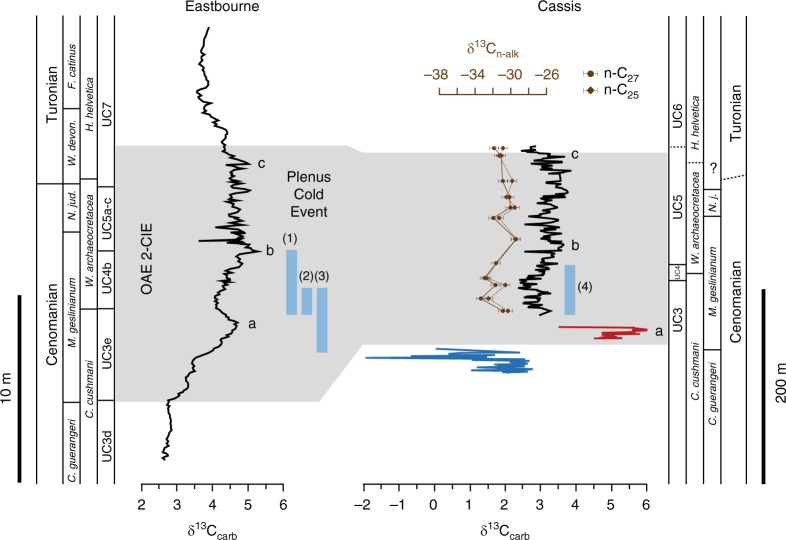
Bio- and chemostratigraphic correlation. Carbon isotope trend from Cassis, S’ France is compared with the European reference section at Eastbourne, Sussex, UK,. Calcareous nannofossil zonation of Eastbourne after ref. . Planktic foraminiferal biozonation of Eastbourne after ref. . Lowercase letters correspond to principal carbon-isotope peaks identified in the Eastbourne record. Stratigraphic positions of the Plenus Cold Event (PCE) according to (1), (2), (3) with (4) representing supposed PCE position at Cassis. Color-code of the Cassis carbon-isotope record corresponds to lithostratigraphic formations, with blue = Grès de l’Anse Sainte Magdeleine Fm., orange = Calcaires du Corton Fm., black = Marnes de l’Anse de l’Arène Fm. Carbon-isotope stratigraphic trend of plant-derived leaf-wax n-alkanes (n-C25; n-C27) is restricted to the Marnes de l’Anse de l’Arène Fm. δ13C values of individual n-alkanes are the means of duplicate runs (σ = ±0.5‰) expressed versus VPDB. Gray area represents the stratigraphic interval covered by the OAE2 carbon isotope excursion,. Note the expanded thickness of the OAE2 in the Cassis record
Fig. 3
Fig. 3
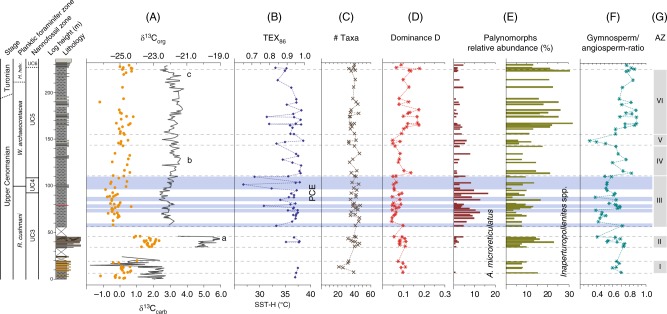
Terrestrial palynomorph and TEX86 data across OAE2. Stratigraphic trends in δ13Ccarb, δ13Corg, TEX86-derived sea-surface temperatures (SSTs) and evolution of palynofloral diversity and composition across OAE2 at Cassis, S’ France. Biostratigraphy and lithological log of Cassis section to the left. (A) Carbon-isotope stratigraphy based on bulk rock carbonate and organic matter; (B) TEX86 and SST reconstruction based on TEX86H calibration; (C) species richness; (D) dominance index; (E) stratigraphic distribution of selected pollen including the Normapolles-type angiosperm pollen Atlantopollis reticulatus and the conifer pollen Inaperturopollenites spp.; (F) ratio of gymnosperm versus angiosperm taxa; (G) assemblage zones (AZs) based on characteristic spore-pollen associations. PCE = Plenus Cold Event. Blue horizontal bands represent individual SST cooling episodes during the PCE
Fig. 4
Fig. 4
Tentative changes in mid-latitude vegetation patterns during OAE2. During OAE mode A (e.g. represented by AZ II, IV and VI), the prevailing climate was characterized by exceptional warmth and high moisture availability, giving way to conifer-dominated forests with moderate angiosperm contribution. During OAE mode B (AZ III and V), climatic conditions were cooler and less humid resulting in an open, savanna-type vegetation community with increased abundances of Normapolles-producing angiosperms. (a) Araucariaceae, (b) other conifers incl. Cheirolepidiaceae, (c) Cupressaceae, (d) angiosperms incl. Normapolles-producing forms, (e) ferns

References

    1. Jaramillo C, et al. Effects of rapid global warming at the Paleocene–Eocene boundary on neotropical vegetation. Science. 2010;330:957–961. doi: 10.1126/science.1193833. - DOI - PubMed
    1. McElwain J, Wade-Murphy J, Hesselbo SP. Changes in carbon dioxide during an oceanic anoxic event linked to intrusion into Gondwana coals. Nature. 2005;435:479–482. doi: 10.1038/nature03618. - DOI - PubMed
    1. Hochuli PA, Sanson-Barrera A, Schneebeli-Hermann E, Bucher H. Severest crisis overlooked - Worst disruption of terrestrial environments postdates the Permian–Triassic mass extinction. Sci. Rep. 2016;6:1–7. doi: 10.1038/srep28372. - DOI - PMC - PubMed
    1. Norris RD, Bice KL, Magno EA, Wilson PA. Jiggling the tropical thermostat in the Cretaceous hothouse. Geology. 2002;30:299–302. doi: 10.1130/0091-7613(2002)030<0299:JTTTIT>2.0.CO;2. - DOI
    1. Forster A, Schouten S, Moriya K, Wilson PA, Sinninghe Damsté JS. Tropical warming and intermittent cooling during the Cenomanian/Turonian Oceanic Anoxic Event 2: Sea surface temperature records from the equatorial Atlantic. Paleoceanography. 2007;22:PA1219. doi: 10.1029/2006PA001349. - DOI

Publication types