. 2018 Sep 20;8(1):14122.
doi: 10.1038/s41598-018-32266-9.

Transcriptional profiling of Zygosaccharomyces bailii early response to acetic acid or copper stress mediated by ZbHaa1

Affiliations

Transcriptional profiling of Zygosaccharomyces bailii early response to acetic acid or copper stress mediated by ZbHaa1

Miguel Antunes et al. Sci Rep. .

Abstract

The non-conventional yeast species Zygosaccharomyces bailii is remarkably tolerant to acetic acid, a highly important microbial inhibitory compound in Food Industry and Biotechnology. ZbHaa1 is the functional homologue of S. cerevisiae Haa1 and a bifunctional transcription factor able to modulate Z. bailii adaptive response to acetic acid and copper stress. In this study, RNA-Seq was used to investigate genomic transcription changes in Z. bailii during early response to sublethal concentrations of acetic acid (140 mM, pH 4.0) or copper (0.08 mM) and uncover the regulatory network activated by these stresses under ZbHaa1 control. Differentially expressed genes in response to acetic acid exposure (297) are mainly related with the tricarboxylic acid cycle, protein folding and stabilization and modulation of plasma membrane composition and cell wall architecture, 17 of which, directly or indirectly, ZbHaa1-dependent. Copper stress induced the differential expression of 190 genes mainly involved in the response to oxidative stress, 15 ZbHaa1-dependent. This study provides valuable mechanistic insights regarding Z. bailii adaptation to acetic acid or copper stress, as well as useful information on transcription regulatory networks in pre-whole genome duplication (WGD) (Z. bailii) and post-WGD (S. cerevisiae) yeast species, contributing to the understanding of transcriptional networks' evolution in yeasts.


Conflict of interest statement

The authors declare no competing interests.

Figures
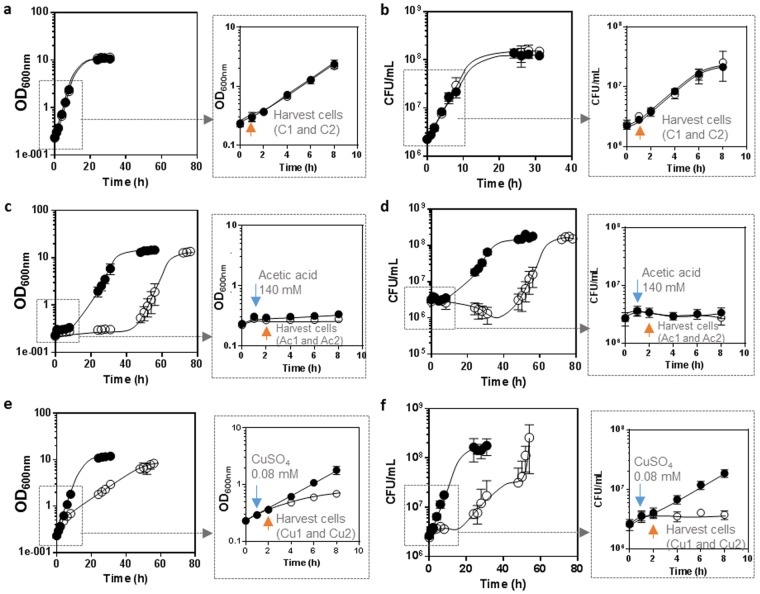
Figure 1
Figure 1
Growth curves of Z. bailii IST302 (●) and derived deletion mutant Zbhaa1∆ (○) based on culture optical density (OD 600 nm) (a,c and e) and on the viable cell concentration (CFU/mL) (b,d and f). Yeast cells were cultivated in MM medium at pH 4.0 (a and b) or in the same medium supplemented with acetic acid (c and d) or CuSO4 (e and f). Acetic acid or CuSO4 were added after 1 hour of cultivation of exponential cells grown under standardized conditions in MM medium to a final concentration of 140 mM or 0.08 mM, respectively. A detailed view of the first eight hours of cultivation is shown on the right of each graph. Cells were harvested for mRNA-Seq analysis before acetic acid or copper supplementation and 1 hour after acetic acid or copper addition.
Figure 2
Figure 2
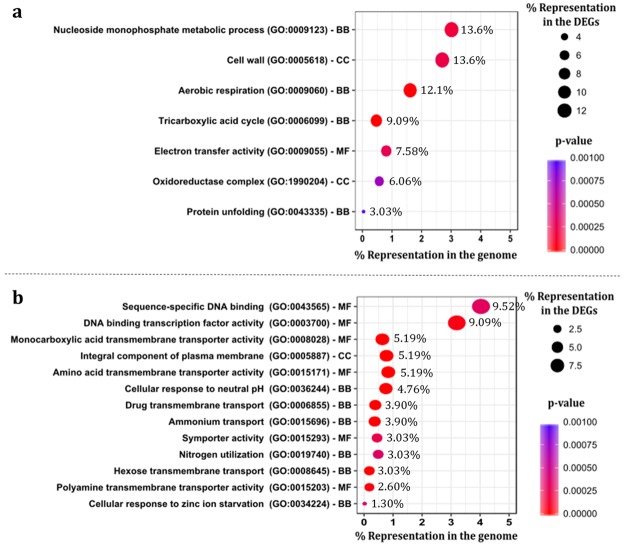
Enriched GO terms associated with the differently expressed genes in the early response to acetic acid stress. Dot plots displaying the percentage of differently expressed genes (DEGs) attributed to a GO term. (a) Upregulated genes in Z. bailii IST302 during exposure to acetic acid stress. (b) Downregulated genes in Z. bailii IST302 during exposure to acetic acid stress. The GO terms are sorted by molecular function (MF), cellular component (CC) and biological process (BP). The numeral percentages of DEGs assigned to each GO term were calculated based on the total number of upregulated (66) or downregulated (231) genes during exposure to acetic acid stress.
Figure 3
Figure 3
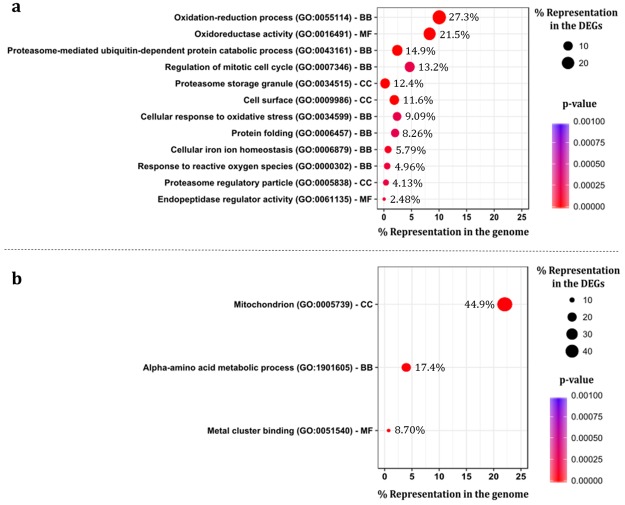
Enriched GO terms associated with the differently expressed genes in the early response to copper stress. Dot plots displaying the percentage of differently expressed genes (DEGs) attributed to a GO term. (a) Upregulated genes in Z. bailii IST302 during exposure to copper stress. (b) Downregulated genes in Z. bailii IST302 during exposure to copper stress. The GO terms are sorted by molecular function (MF), cellular component (CC) and biological process (BP). The numeral percentages of DEGs assigned to each GO were calculated based on the total number of upregulated (121) or downregulated (69) genes during exposure to copper stress.
Figure 4
Figure 4
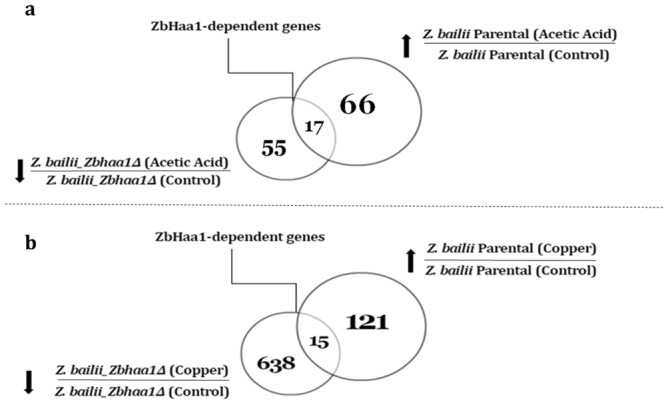
Number of ZbHaa1-dependent genes activated in Z. bailii IST302 during exposure to acetic acid or copper stress. (a) Venn diagram depicting the number of upregulated genes (up arrow) in the parental strain, downregulated genes (down arrow) in the deletion mutant Zbhaa1 during exposure to acetic acid stress, and the common differently expressed genes (DEGs) between them (ZbHaa1-dependent genes). (b) Venn diagram depicting the number of upregulated genes (up arrow) in the parental strain, downregulated genes (down arrow) in the deletion mutant Zbhaa1 during exposure to copper stress, and the common DEGs between them (ZbHaa1-dependent genes).
Figure 5
Figure 5
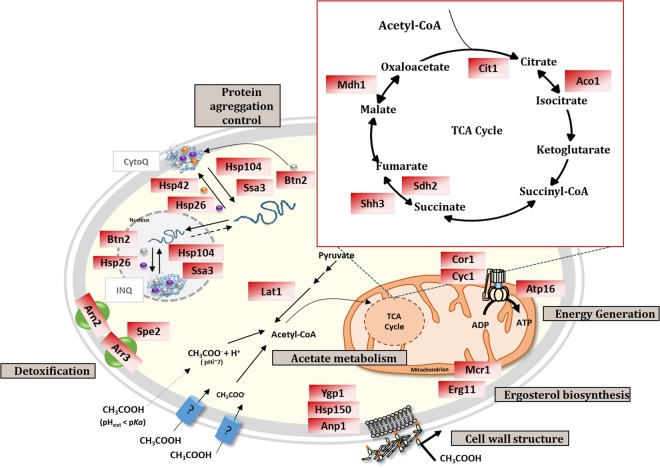
Model representing the mechanisms proposed to underlie Z. bailii IST302 response to acetic acid in a growth medium with glucose and acetic acid. The suggested Z. bailii response mechanisms to acetic acid stress include the metabolization of acetate in the presence of glucose through the TCA cycle, energy generation mechanisms, control of protein folding and stabilization and modulation of the cell wall architecture. Red boxes indicate the proteins whose encoding genes were found in this study to be upregulated in Z. bailii cells grown in a glucose medium supplemented with acetic acid. Details on the proteins’ function and their putative involvement in the adaptive process are described in the text.
Figure 6
Figure 6
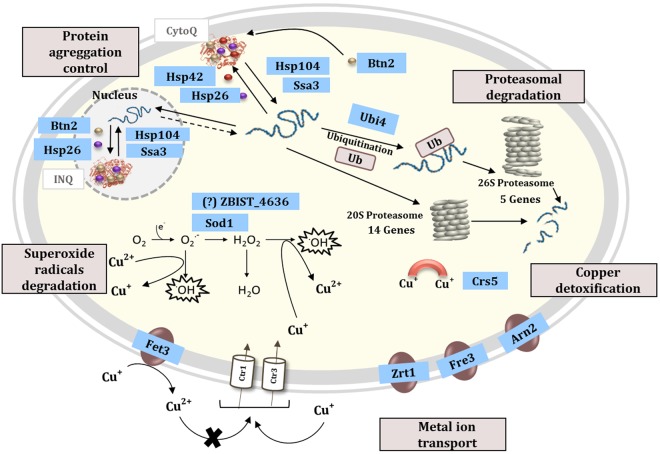
Model representing the mechanisms proposed to underlie Z. bailii IST302 response to copper. The suggested Z. bailii response mechanisms to copper stress include mechanisms of detoxification from superoxide radicals, scavenging of copper ions, control of the protein folding and stabilization and proteasomal proteolysis in response to oxidative stress. Blue boxes indicate the proteins whose encoding genes were found in this study to be upregulated in Z. bailii cells grown in a glucose medium supplemented with copper. Details on the proteins’ function and their putative involvement in the adaptive process are described in the text.
Figure 7
Figure 7
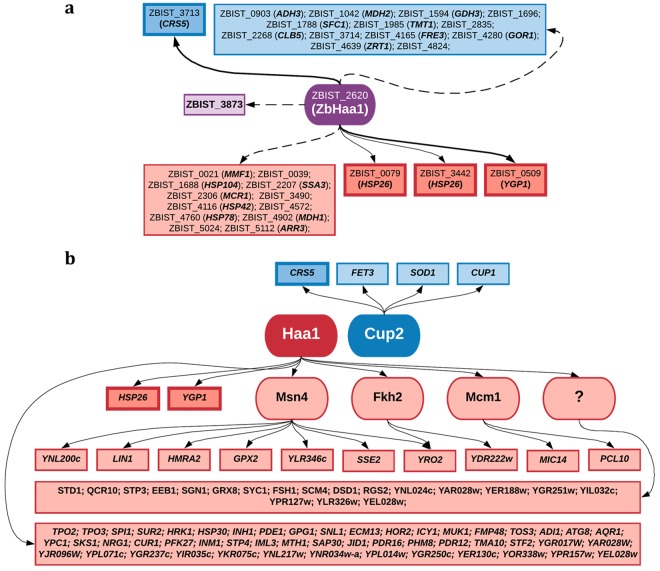
Putative regulatory networks underlying ZbHaa1-dependent gene activation in response to acetic acid or copper stress in Z bailii, and Haa1 and Cup2 gene activation in S. cerevisiae during acetic acid or copper stress, respectively. (a) ZbHaa1-dependent putative regulatory network. The model was assembled based on the RNA-Seq results obtained in this study and previous gene transcription studies in Z. bailii. The displayed regulatory associations are based on the described regulatory networks of S. cerevisiae transcription factors Haa1 and Cup2 activated during acetic acid and copper stress responses, respectively. Represented inside boxes are the genes found to be activated in response to acetic acid (red) or copper (blue) stress in a ZbHaa1-dependent manner. S. cerevisiae homologous genes are shown inside brackets. Genes proposed to be transcriptionally activated under the dependence of ZbHaa1 and whose homologue in S. cerevisiae was described to be directly activated by Haa1 are represented inside darker boxes surrounded by thicker lines. Genes considered to be activated in a ZbHaa1-dependent manner in response to both stresses are represented inside purple boxes. Previously described regulatory associations in S. cerevisiae are represented by an arrow (→). Z bailii genes found to have stress-induced-altered transcription levels herein and in previous studies are represented by a bold arrow (→). Novel transcriptional associations are represented by a dashed arrow (→). (b) Haa1 and Cup2 putative regulatory networks. These networks were assembled based on documented proposed associations of Haa1 under acetic acid stress in S. cerevisiae (represented in red) and known targets of Cup2 under copper stress in S. cerevisiae (represented in blue). Genes proposed to be transcriptionally activated under the dependence of ZbHaa1 and whose homologue in S. cerevisiae was described to be directly activated by Haa1 are represented inside darker boxes surrounded by thicker lines. Other transcription factors presumably regulated by Haa1 and documented to regulate acetic acid-induced genes are represented inside rounded boxes. Genes identified as putative Haa1 indirect targets and whose activation is presumably dependent on unidentified transcription factors are shown associated with the transcription factor designated “?”.

References

    1. Sá-Correia, I., Guerreiro, J. F., Loureiro-Dias, M. C., Leão, C. & Côrte-Real, M. In Encyclopedia of Food Microbiology (eds Batt, C. A. & Tortorello, M. L.) 849–855 (Elsevier Ltd, Academic Press, 2014).
    1. Stratford M, et al. Extreme resistance to weak-acid preservatives in the spoilage yeast Zygosaccharomyces bailii. Int. J. Food Microbiol. 2013;166:126–134. doi: 10.1016/j.ijfoodmicro.2013.06.025. - DOI - PMC - PubMed
    1. Palma M, Guerreiro JF, Sá-Correia I. Adaptive Response and Tolerance to Acetic Acid in Saccharomyces cerevisiae and Zygosaccharomyces bailii: A Physiological GenomicsPerspective. Front. Microbiol. 2018;9:274. doi: 10.3389/fmicb.2018.00274. - DOI - PMC - PubMed
    1. Galeote V, Bigey F, Devillers H, Neuvéglise C, Dequin S. Genome Sequence of the Food Spoilage Yeast Zygosaccharomyces bailii CLIB 213T. Genome Announc. 2013;1:e00606–13. doi: 10.1128/genomeA.00606-13. - DOI - PMC - PubMed
    1. Palma, M., Münsterkötter, M., Peça, J., Güldener, U. & Sá-Correia, I. Genome sequence of the highly weak-acid-tolerant Zygosaccharomyces bailii IST302, amenable to genetic manipulations and physiological studies. FEMS Yeast Res.17 (2017). - PMC - PubMed

Publication types

MeSH terms