


Effects of a specially designed aerobic dance routine on mild cognitive impairment
- PMID: 30237705
- PMCID: PMC6138969
- DOI: 10.2147/CIA.S163067
Effects of a specially designed aerobic dance routine on mild cognitive impairment
Abstract
Background: Mild cognitive impairment (MCI) is known as a transitional stage or phase between normal aging and dementia. In addition, it is associated with an increased risk of dementia. Research has shown that moderate-intensity exercise is associated with a decreased risk of cognitive impairment. Two recent studies demonstrated that dance interventions are associated with improved cognitive function in the elderly with MCI.
Purpose: We evaluated the effect of a moderate-intensity aerobic dance routine on the cognitive function in patients with MCI.
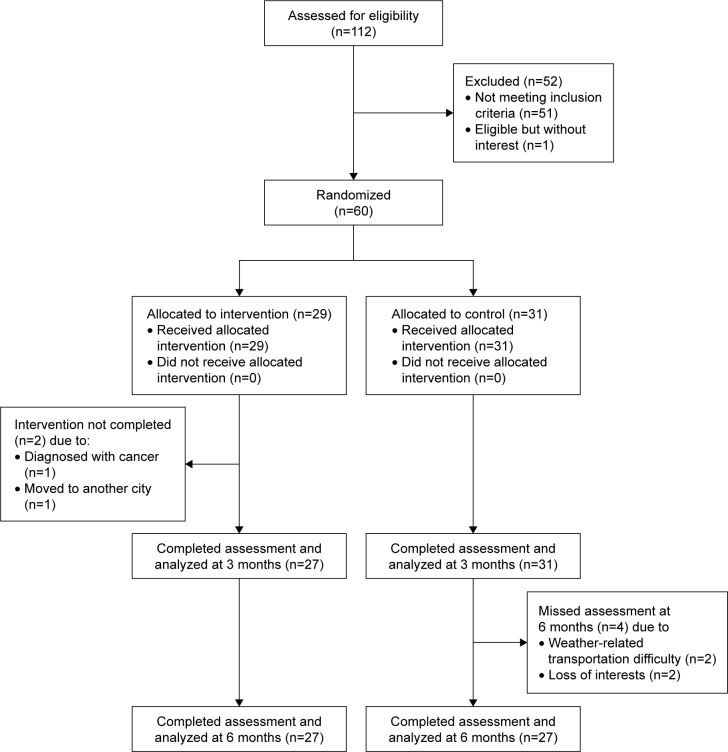
Patients and methods: This is a single-blind randomized controlled trial. Sixty MCI patients were randomized to receive either treatment (aerobic dance routine + usual care) or control (usual care only) for 3 months. All patients received usual care for an additional 3 months thereafter. The aerobic dance routine was a specially designed dance routine which involved cognitive effort for patients to memorize the complex movements. Wechsler memory scale-revised logical memory (WMS-R LM) and event-related evoked potentials (ERPs) P300 latency were used to assess patients' cognitive function at baseline, 3 months, and 6 months.
Results: Twenty-nine patients received exercise therapy and 31 patients received usual care. Patients in the treatment group showed a greater improvement in memory (difference in WMS-R LM changes over 3 months 4.6; 95% CI 2.2, 7.0; p<0.001) and processing speed (difference in P300 latency changes over 6 months -20.0; 95% CI=-39.5, -0.4; p<0.05) compared to control.
Conclusion: This dance routine improves cognitive function, especially episodic memory and processing speed, in MCI patients and merits promotion in communities.
Keywords: cognitive function; dance; memory; mild cognitive impairment.
Conflict of interest statement
Disclosure The authors report no conflicts of interest in this work.
Figures
References
-
- Petersen RC, Smith GE, Waring SC, Ivnik RJ, Tangalos EG, Kokmen E. Mild cognitive impairment: clinical characterization and outcome. Arch Neurol. 1999;56(3):303–308. - PubMed
-
- Winblad B, Palmer K, Kivipelto M, et al. Mild cognitive impairment – beyond controversies, towards a consensus: report of the International Working Group on Mild Cognitive Impairment. J Intern Med. 2004;256(3):240–246. - PubMed
-
- Albert MS, DeKosky ST, Dickson D, et al. The diagnosis of mild cognitive impairment due to Alzheimer’s disease: recommendations from the National Institute on Aging-Alzheimer’s Association workgroups on diagnostic guidelines for Alzheimer’s disease. Alzheimers Dement. 2011;7(3):270–279. - PMC - PubMed
Publication types
MeSH terms
LinkOut - more resources
Full Text Sources
Other Literature Sources
Medical
Miscellaneous
