


Literature review to characterize the empirical basis for response scale selection in pediatric populations
- PMID: 30238084
- PMCID: PMC6127069
- DOI: 10.1186/s41687-018-0051-8
Literature review to characterize the empirical basis for response scale selection in pediatric populations
Abstract
Background: Despite the importance of response option selection for patient-reported outcome measures, there seems to be little empirical evidence for the selected scale type. This article provides an overview of the published research on response scale types and empirical support within pediatric populations.
Methods: A comprehensive review of the scientific literature was conducted to identify response scale option types appropriate for use in pediatric populations and to review and summarize the available empirical evidence for each scale type.
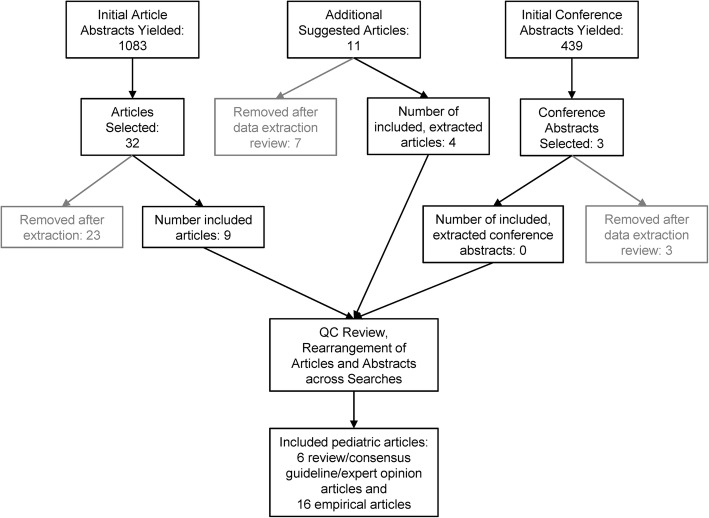
Results: Eleven review/consensus guideline/expert opinion articles and 20 empirical articles that provided guidance or evidence regarding pediatric response scale selection were identified. There was general consensus that 5-point verbal rating scales, including Likert scales, were appropriate for children aged 7 or 8 and older, while graphical or faces scales are often used in pediatric studies with children of younger ages.
Conclusion: In general, the verbal rating scale, numeric rating scale, visual analogue scale, and graphical scales have each demonstrated to be reliable and valid response option formats in specific contexts among pediatric populations; however, their appropriateness is dependent upon sample age. When selecting response scales, it is important to consider target population and context of use during the development of patient-reported outcome measures, especially with respect to tense, recall period, attribution, number of options, etc. In addition to age, cognitive development is an important aspect to consider for optimizing pediatric self-reported measures. More research is needed to determine clinically relevant changes and differences within pediatric research, which includes different response scale options.
Keywords: Children; Patient-reported outcome; Pediatric; Rating scale; Response option; Response scales.
Conflict of interest statement
This article does not contain any studies with human participants or animals performed by any of the authors.Not applicable.Mabel Crescioni and Mira Patel report no employment in a pharmaceutical company nor do they hold stocks, shares, or stock options in a pharmaceutical company. Katherine Gries reports she is a current employee at Janssen but reports no stocks, shares, nor options. Anna Rydén is an employee and shareholder of AstraZeneca. Jennifer T. Hanlon is a salaried employee who owns stocks, shares, and stock options at Ironwood Pharmaceuticals. April N. Naegeli is a salaried employee who owns stocks, shares, and stock options at Eli Lilly and Company. Shima Safikhani and Margaret Vernon are employees of Evidera, a research and consulting firm to the biopharma industry and, as such, are not allowed to accept remuneration from any Evidera clients. None of these authors report any other arrangements that could be perceived as conflicts of interest.Springer Nature remains neutral with regard to jurisdictional claims in published maps and institutional affiliations.
References
-
- Lukas A, Niederecker T, Gunther I, Mayer B, Nikolaus T. Self- and proxy report for the assessment of pain in patients with and without cognitive impairment: Experiences gained in a geriatric hospital. Zeitschrift für Gerontologie und Geriatrie. 2013;46(3):214–221. doi: 10.1007/s00391-013-0475-y. - DOI - PubMed
-
- Matza LS, Patrick DL, Riley AW, Alexander JJ, Rajmil L, Pleil AM, Bullinger M. Pediatric patient-reported outcome instruments for research to support medical product labeling: Report of the ispor pro good research practices for the assessment of children and adolescents task force. Value in Health. 2013;16(4):461–479. doi: 10.1016/j.jval.2013.04.004. - DOI - PubMed
-
- Eiser C, Mohay H, Morse R. The measurement of quality of life in young children. Child: Care, Health and Development. 2000;26(5):401–414. - PubMed
-
- Center for Drug Evaluation and Research (CDER), in cooperation with the Center for Biologics Evaluation and Research (CBER), and the Center for Devices and Radiological Health (CDRH), at the Food and Drug Administration (FDA), Guidance for industry . Patient-reported outcome measures: Use in medical product development to support labeling claims. Silver Spring: Food and Drug Administration; 2009.
Grants and funding
LinkOut - more resources
Full Text Sources
Other Literature Sources
