


Response scale selection in adult pain measures: results from a literature review
- PMID: 30238085
- PMCID: PMC6127068
- DOI: 10.1186/s41687-018-0053-6
Response scale selection in adult pain measures: results from a literature review
Abstract
Background: The purpose of this literature review was to examine the existing patient-reported outcome measurement literature to understand the empirical evidence supporting response scale selection in pain measurement for the adult population.
Methods: The search strategy involved a comprehensive, structured, literature review with multiple search objectives and search terms.
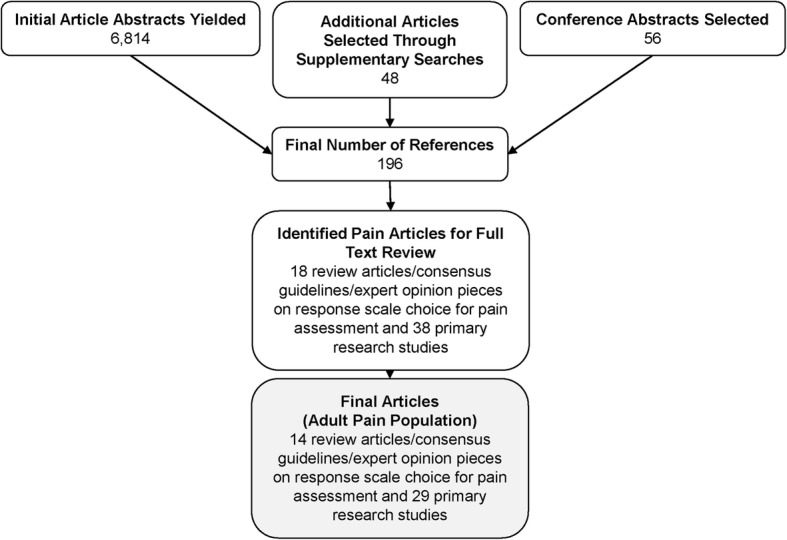
Results: The searched yielded 6918 abstracts which were reviewed against study criteria for eligibility across the adult pain objective. The review included 42 review articles, consensus guidelines, expert opinion pieces, and primary research articles providing insights into optimal response scale selection for pain assessment in the adult population. Based on the extensive and varied literature on pain assessments, the adult pain studies typically use simple response scales with single-item measures of pain-a numeric rating scale, visual analog scale, or verbal rating scale. Across 42 review articles, consensus guidelines, expert opinion pieces, and primary research articles, the NRS response scale was most often recommended in these guidance documents. When reviewing the empirical basis for these recommendations, we found that the NRS had slightly superior measurement properties (e.g., reliability, validity, responsiveness) across a wide variety of contexts of use as compared to other response scales.
Conclusions: Both empirical studies and review articles provide evidence that the 11-point NRS is likely the optimal response scale to evaluate pain among adult patients without cognitive impairment.
Keywords: Outcome measurement; Pain; Rating scales; Response options; Response scales.
Conflict of interest statement
This article does not contain any studies with human participants or animals performed by any of the authors.Not applicable.SJC reports no employment in a pharmaceutical company nor does he hold stocks, shares, or stock options in a pharmaceutical company. LA is an employee and owns stocks, shares, and stock options for Pfizer Ltd. KG reports she is a current employee at Janssen but reports no stocks, shares, nor options. ENB works for Eli Lilly & Company and holds stocks or shares there, but no stock options. JTH and DSR are salaried employees and own stocks, shares, and stock options at Ironwood Pharmaceuticals. KR is an employee of Shire and owns stock options there. JT is a current employee at Janssen but reports no stocks, shares, nor options. SS and MV are employees of Evidera, a research and consulting firm to the biopharma industry and, as such, are not allowed to accept remuneration from any Evidera clients. None of these authors report any other arrangements that could be perceived as conflicts of interest.Springer Nature remains neutral with regard to jurisdictional claims in published maps and institutional affiliations.
Figures
References
-
- Food and Drug Administration Guidance for industry. Patient-reported outcome measures: Use in medical product development to support labeling claims. Federal Register. 2009;74(235):65132–65133.
-
- Patrick DL, Burke LB, Gwaltney CJ, Leidy NK, Martin ML, Molsen E, Ring L. Content validity-establishing and reporting the evidence in newly developed patient-reported outcomes (pro) instruments for medical product evaluation: Ispor pro good research practices task force report: Part 1-eliciting concepts for a new pro instrument. Value in Health. 2011;14(8):967–977. doi: 10.1016/j.jval.2011.06.014. - DOI - PubMed
-
- Patrick DL, Burke LB, Gwaltney CJ, Leidy NK, Martin ML, Molsen E, Ring L. Content validity-establishing and reporting the evidence in newly developed patient-reported outcomes (pro) instruments for medical product evaluation: Ispor pro good research practices task force report: Part 2-assessing respondent understanding. Value in Health. 2011;14(8):978–988. doi: 10.1016/j.jval.2011.06.013. - DOI - PubMed
Publication types
Grants and funding
LinkOut - more resources
Full Text Sources
Other Literature Sources
Medical
