


Immediate versus delayed exercise in men initiating androgen deprivation: effects on bone density and soft tissue composition
- PMID: 30239116
- PMCID: PMC6635752
- DOI: 10.1111/bju.14505
Immediate versus delayed exercise in men initiating androgen deprivation: effects on bone density and soft tissue composition
Abstract
Objectives: To examine whether it is more efficacious to commence exercise medicine in men with prostate cancer at the onset of androgen-deprivation therapy (ADT) rather than later on during treatment to preserve bone and soft-tissue composition, as ADT results in adverse effects including: reduced bone mineral density (BMD), loss of muscle mass, and increased fat mass (FM).
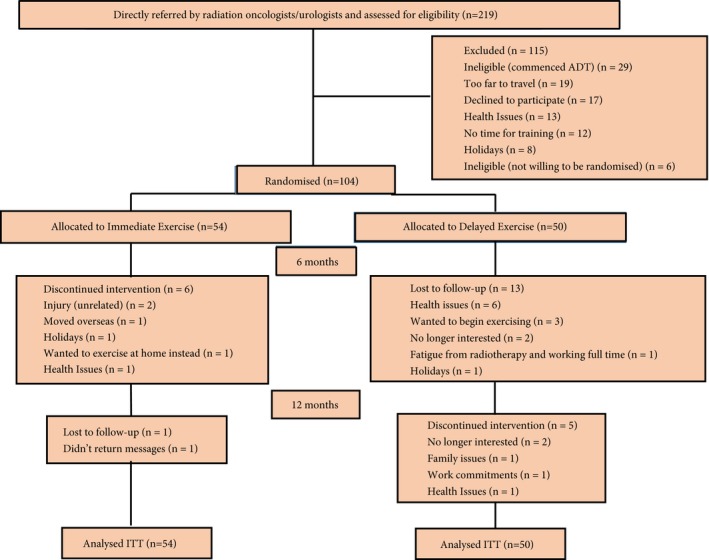
Patients and methods: In all, 104 patients with prostate cancer, aged 48-84 years initiating ADT, were randomised to immediate exercise (IMEX, n = 54) or delayed exercise (DEL, n = 50) conditions. The former consisted of 6 months of supervised resistance/aerobic/impact exercise and the latter comprised 6 months of usual care followed by 6 months of the identical exercise programme. Regional and whole body BMD, lean mass (LM), whole body FM and trunk FM, and appendicular skeletal muscle (ASM) were assessed by dual X-ray absorptiometry, and muscle density by peripheral quantitative computed tomography at baseline, and at 6 and 12 months.
Results: There was a significant time effect (P < 0.001) for whole body, spine and hip BMD with a progressive loss in the IMEX and DEL groups, although lumbar spine BMD was largely preserved in the IMEX group at 6 months compared with the DEL group (-0.4% vs -1.6%). LM, ASM, and muscle density were preserved in the IMEX group at 6 months, declined in the DEL group at 6 months (-1.4% to -2.5%) and then recovered at 12 months after training. FM and trunk FM increased (P < 0.001) over the 12-month period in the IMEX (7.8% and 4.5%, respectively) and DEL groups (6.5% and 4.3%, respectively).
Conclusions: Commencing exercise at the onset of ADT preserves lumbar spine BMD, muscle mass, and muscle density. To avoid treatment-related adverse musculoskeletal effects, exercise medicine should be prescribed and commenced at the onset of ADT.
Keywords: #PCSM; #ProstateCancer; androgen-deprivation therapy; exercise.
© 2018 The Authors BJU International Published by John Wiley & Sons Ltd on behalf of BJU International.
Conflict of interest statement
The authors have no conflict of interests to disclose.
Figures
References
-
- Nguyen PL, Alibhai SM, Basaria S et al. Adverse effects of androgen deprivation therapy and strategies to mitigate them. Eur Urol 2015; 67: 825–36 - PubMed
-
- Spry NA, Kristjanson L, Hooton B et al. Adverse effects to quality of life arising from treatment can recover with intermittent androgen suppression in men with prostate cancer. Eur J Cancer 2006; 42: 1083–92 - PubMed
-
- Galvão DA, Spry NA, Taaffe DR et al. Changes in muscle, fat and bone mass after 36 weeks of maximal androgen blockade for prostate cancer. BJU Int 2008; 102: 44–7 - PubMed
-
- Shahinian VB, Kuo YF, Freeman JL, Goodwin JS. Risk of fracture after androgen deprivation for prostate cancer. N Engl J Med 2005; 352: 154–64 - PubMed
Publication types
MeSH terms
Substances
Associated data
LinkOut - more resources
Full Text Sources
Other Literature Sources
Medical
