


A Prospective Study of Dairy-Food Intake and Early Menopause
- PMID: 30239575
- PMCID: PMC6321800
- DOI: 10.1093/aje/kwy212
A Prospective Study of Dairy-Food Intake and Early Menopause
Abstract
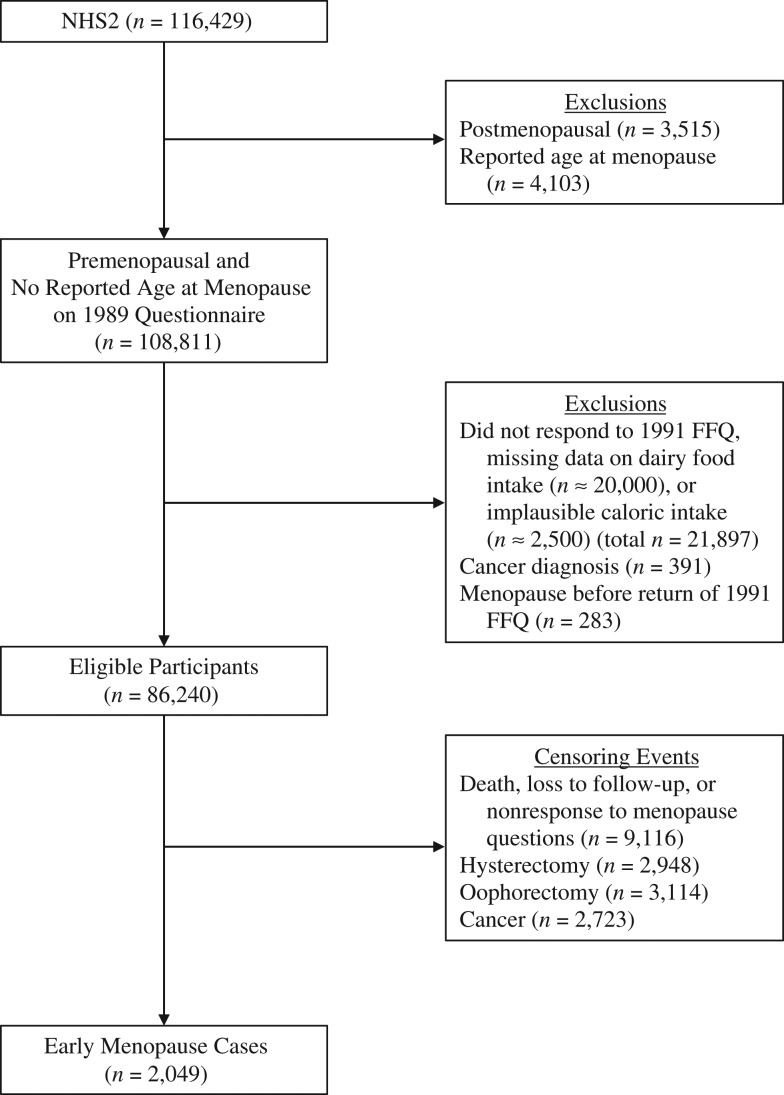
Early natural menopause, the cessation of ovarian function prior to age 45 years, affects approximately 10% of women and increases risk of cardiovascular disease and other adverse conditions. Laboratory evidence suggests a potential role of dairy foods in the ovarian aging process; however, no prior epidemiologic studies have evaluated how dairy-food intake is associated with risk of early menopause. We therefore evaluated how intakes of total, low-fat, high-fat, and individual dairy foods were associated with early menopause in Nurses' Health Study II. Women who were premenopausal at the start of follow-up in 1991 were followed until 2011 for early menopause. Food frequency questionnaires were used to assess dietary intake. In Cox proportional hazards models adjusting for age, smoking, and other factors, total baseline dairy-food intake of ≥4 servings/day versus <4 servings/week was associated with 23% lower risk of early menopause (hazard ratio = 0.77, 95% confidence interval: 0.64, 0.93; P for trend = 0.08). Associations appeared to be limited to low-fat dairy foods (for ≥2 servings/day vs. <3 servings/month, hazard ratio = 0.83, 95% confidence interval: 0.68, 1.01; P for trend = 0.02), whereas high-fat dairy-food intake was not associated with early menopause. Low-fat dairy foods may represent a modifiable risk factor for reducing risk of early menopause among premenopausal women.
Figures
References
-
- van Der Voort DJ, van Der Weijer PH, Barentsen R. Early menopause: increased fracture risk at older age. Osteoporos Int. 2003;14(6):525–530. - PubMed
-
- Fauser B. Female health implications of premature ovarian insufficiency [abstract]. Presented at the International Federation of Fertility Societies 21st World Congress on Fertility and Sterility and the 69th Annual Meeting of the American Society for Reproductive Medicine, Boston, Massachusetts, October 12–17, 2013.
Publication types
MeSH terms
Substances
Grants and funding
LinkOut - more resources
Full Text Sources
Other Literature Sources
Medical
