


A Case-Control Study to Identify Community Venues Associated with Genetically-clustered, Multidrug-resistant Tuberculosis Disease in Lima, Peru
- PMID: 30239609
- PMCID: PMC7181380
- DOI: 10.1093/cid/ciy746
A Case-Control Study to Identify Community Venues Associated with Genetically-clustered, Multidrug-resistant Tuberculosis Disease in Lima, Peru
Abstract
Background: The majority of tuberculosis transmission occurs in community settings. Our primary aim in this study was to assess the association between exposure to community venues and multidrug-resistant (MDR) tuberculosis. Our secondary aim was to describe the social networks of MDR tuberculosis cases and controls.
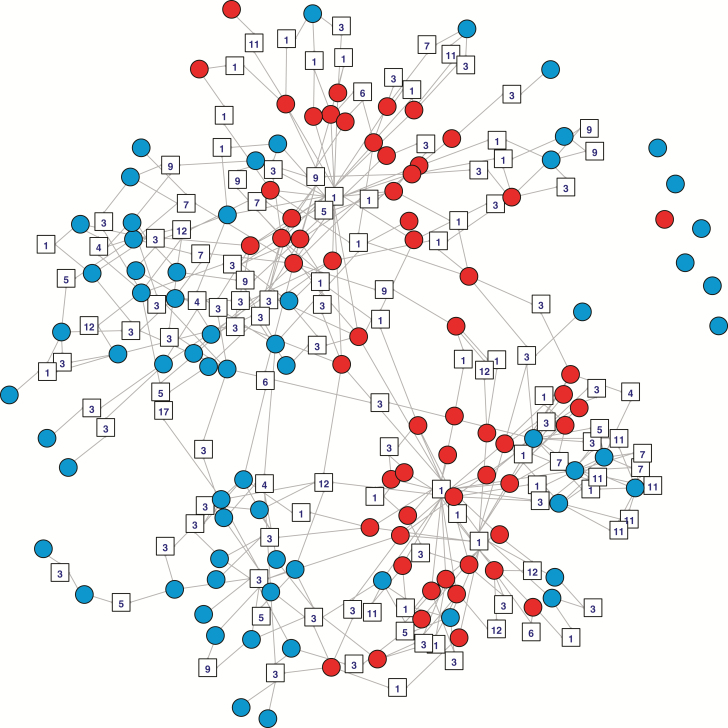
Methods: We recruited laboratory-confirmed MDR tuberculosis cases and community controls that were matched on age and sex. Whole-genome sequencing was used to identify genetically clustered cases. Venue tracing interviews (nonblinded) were conducted to enumerate community venues frequented by participants. Logistic regression was used to assess the association between MDR tuberculosis and person-time spent in community venues. A location-based social network was constructed, with respondents connected if they reported frequenting the same venue, and an exponential random graph model (ERGM) was fitted to model the network.
Results: We enrolled 59 cases and 65 controls. Participants reported 729 unique venues. The mean number of venues reported was similar in both groups (P = .92). Person-time in healthcare venues (adjusted odds ratio [aOR] = 1.67, P = .01), schools (aOR = 1.53, P < .01), and transportation venues (aOR = 1.25, P = .03) was associated with MDR tuberculosis. Healthcare venues, markets, cinemas, and transportation venues were commonly shared among clustered cases. The ERGM indicated significant community segregation between cases and controls. Case networks were more densely connected.
Conclusions: Exposure to healthcare venues, schools, and transportation venues was associated with MDR tuberculosis. Intervention across the segregated network of case venues may be necessary to effectively stem transmission.
Keywords: community transmission; genotyping; multidrug-resistant; social network; tuberculosis.
© The Author(s) 2018. Published by Oxford University Press for the Infectious Diseases Society of America. All rights reserved. For permissions, e-mail: journals.permissions@oup.com.
Figures


References
-
- Fauci AS; NIAID Tuberculosis Working Group Multidrug-resistant and extensively drug-resistant tuberculosis: the National Institute of Allergy and Infectious Diseases Research agenda and recommendations for priority research. J Infect Dis 2008; 197:1493–8. - PubMed
-
- Madico G, Gilman RH, Checkley W, et al. Community infection ratio as an indicator for tuberculosis control. Lancet 1995; 345:416–9. - PubMed
Publication types
MeSH terms
Substances
Grants and funding
LinkOut - more resources
Full Text Sources
Other Literature Sources
