


Long-acting Opioid Use and the Risk of Serious Infections: A Retrospective Cohort Study
- PMID: 30239630
- PMCID: PMC6522680
- DOI: 10.1093/cid/ciy809
Long-acting Opioid Use and the Risk of Serious Infections: A Retrospective Cohort Study
Abstract
Background: Although evidence from animal and human studies indicates opioid analgesics increase susceptibility to infections, it is unclear whether the risk varies by specific opioid. We compared the risk of serious infection among patients initiating long-acting opioid analgesics with and without previously reported immunosuppressive properties.
Methods: We conducted a retrospective cohort study of Tennessee Medicaid enrollees age ≥18 years initiating long-acting opioids (1995-2015). Hospitalizations for serious infection were identified using validated coding algorithms. We used multivariable Poisson regression models to calculate adjusted incidence rate ratios (aIRR) and 95% confidence intervals (CI) to compare the infection risk among patients using long-acting opioids with known immunosuppressive properties (morphine, fentanyl, methadone) to the infection risk among patients using long-acting opioids without known immunosuppressive properties (oxycodone, oxymorphone, tramadol) accounting for demographics, opioid dose, comorbidities and pain conditions, medication use, frailty indicators, and healthcare encounter history using exposure propensity scores. We further compared users of individual long-acting opioids to long-acting morphine users (considered the prototypical immunosuppressive opioid).
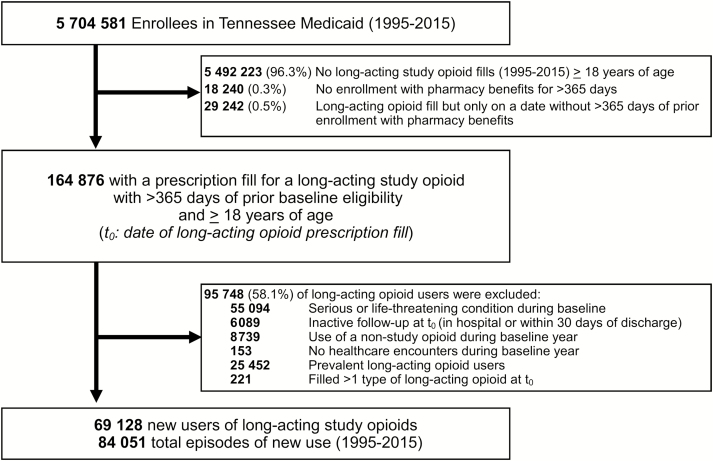
Results: Among the 61 240 patients initiating opioids with immunosuppressive properties and 22 811 patients initiating opioids without immunosuppressive properties, we identified 1906 serious infections. Nonimmunosuppressive opioid users had a lower rate of infections than immunosuppressive opioid users (aIRR:0.78 [CI: 0.66-0.91]). Among individual opioids, oxycodone users had a lower rate of infection than morphine users (aIRR:0.73 [CI: 0.60-0.89]). There were no significant differences in the infection risk between other opioids and morphine.
Conclusion: The risk of serious infections among long-acting opioid users varies by opioid type. Providers should carefully consider the risk of serious infections when making pain management decisions.
Keywords: opioid analgesics; serious infections.
© The Author(s) 2018. Published by Oxford University Press for the Infectious Diseases Society of America. All rights reserved. For permissions, e-mail: journals.permissions@oup.com.
Figures
Comment in
-
Long-Acting Opioid Use Reporting.Clin Infect Dis. 2020 Aug 22;71(5):1355. doi: 10.1093/cid/ciz1135. Clin Infect Dis. 2020. PMID: 31740921 No abstract available.
-
Reply to Boettiger.Clin Infect Dis. 2020 Aug 22;71(5):1355-1356. doi: 10.1093/cid/ciz1136. Clin Infect Dis. 2020. PMID: 31740925 Free PMC article. No abstract available.
References
-
- Okie S. A flood of opioids, a rising tide of deaths. N Engl J Med 2010; 363:1981–5. - PubMed
-
- Dart RC, Surratt HL, Cicero TJ, et al. Trends in opioid analgesic abuse and mortality in the United States. N Engl J Med 2015; 372:241–8. - PubMed
-
- Solomon DH, Rassen JA, Glynn RJ, et al. The comparative safety of opioids for nonmalignant pain in older adults. Arch Intern Med 2010; 170:1979–86. - PubMed
-
- Dowell D, Haegerich TM, Chou R. CDC guideline for prescribing opioids for chronic pain: United States, 2016. MMWR Recomm Rep 2016; 65:1–49. - PubMed
Publication types
MeSH terms
Substances
Grants and funding
LinkOut - more resources
Full Text Sources
Other Literature Sources
Medical
Molecular Biology Databases
