. 2018 Jan 1:2018:bay094.
doi: 10.1093/database/bay094.

PubMed Labs: an experimental system for improving biomedical literature search

Affiliations

PubMed Labs: an experimental system for improving biomedical literature search

Nicolas Fiorini et al. Database (Oxford). .

Abstract

PubMed is a freely accessible system for searching the biomedical literature, with ~ 2.5 million users worldwide on an average workday. In order to better meet our users' needs in an era of information overload, we have recently developed PubMed Labs (www.pubmed.gov/labs), an experimental system for users to test new search features/tools (e.g. Best Match) and provide feedback, which enables us to make more informed decisions about potential changes to improve the search quality and overall usability of PubMed. In addition, PubMed Labs features a mobile-first and responsive layout that offers better support for accessing PubMed from increasingly popular mobiles and small-screen devices. In this paper, we detail PubMed Labs, its purpose, new features and best practices. We also encourage users to share their experience with us; based on which we are continuously improving PubMed Labs with more advanced features and better user experience.


Figures
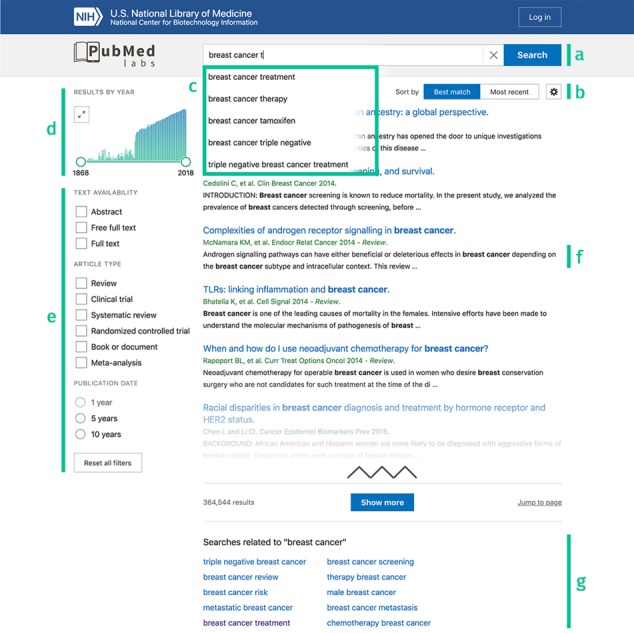
Figure 1
Figure 1
PubMed Labs’ search results page with highlighted features. (a) Search box. (b) Sort order toggle and display options. (c) Query auto completion. (d) Results by year. (e) Search facets. (f) Highlighted search terms in title and snippet. (g) Related searches.
Figure 2
Figure 2
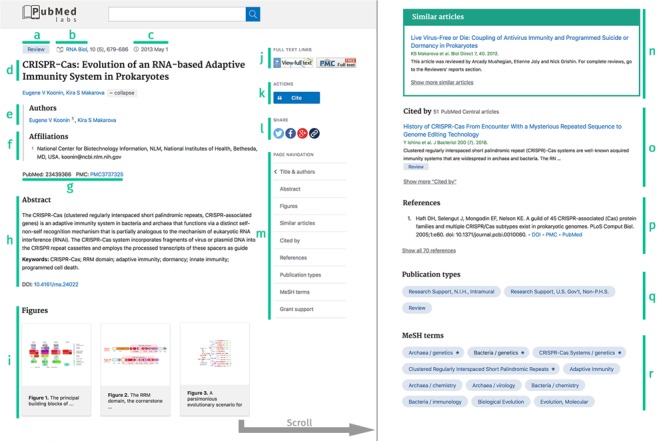
PubMed Labs abstract page with highlighted content. (a) Major publication type. (b) Abbreviated journal name. (c) Publication date. (d) Title. (e) List of full author names. (f) Author affiliations. (g) PMID and PMCID. (h) Abstract. (i) Figures. (j) Full text links. (k) Cite button. (l) Sharing options. (m) Navigation menu. (n) Similar article list. (o) List of articles citing this paper in PMC. (p) References listed in this article. (q) Full list of publication types. (r) MeSH concepts indexing this article.
Figure 3
Figure 3
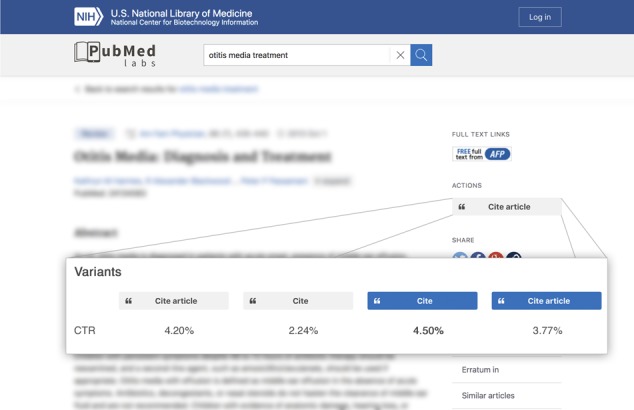
An experiment currently running on PubMed Labs where variants of the cite button design are being tested with their associated click-through rates.
Figure 4
Figure 4
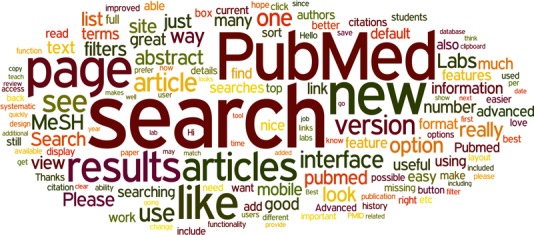
A word cloud representing the most popular words contained in the feedback comments on PubMed Labs.

References

    1. Fiorini N., Lipman D.J. and Lu Z. (2017) Towards PubMed 2.0. eLife, 6, e28801. - PMC - PubMed
    1. Lu Z. (2011) PubMed and beyond: a survey of web tools for searching biomedical literature. Database (Oxford), 2011, baq036. - PMC - PubMed
    1. Hersh W. (2008) Information Retrieval: A Health and Biomedical Perspective. Springer Science & Business Media., New York, NY, USA.
    1. Levchenko M., Gou Y., Graef F. et al. (2018) Europe PMC in 2017. Nucleic Acids Res., 46, D1254–D1260. - PMC - PubMed
    1. Doms A. and Schroeder M. (2005) GoPubMed: exploring PubMed with the gene ontology. Nucleic Acids Res., 33, W783–W786. - PMC - PubMed

Publication types