


doi: 10.1093/infdis/jiy551.
Azithromycin Susceptibility Among Neisseria gonorrhoeae Isolates and Seasonal Macrolide Use
Affiliations
- PMID: 30239814
- PMCID: PMC6350947
- DOI: 10.1093/infdis/jiy551
Item in Clipboard
Azithromycin Susceptibility Among Neisseria gonorrhoeae Isolates and Seasonal Macrolide Use
J Infect Dis.
.
Abstract
Rising azithromycin nonsusceptibility among Neisseria gonorrhoeae isolates threatens current treatment recommendations, but the cause of this rise is not well understood. We performed an ecological study of seasonal patterns in macrolide use and azithromycin resistance in N. gonorrhoeae, finding that population-wide macrolide use is associated with increased azithromycin nonsusceptibility. These results, indicative of bystander selection, have implications for antibiotic prescribing guidelines.
Figures
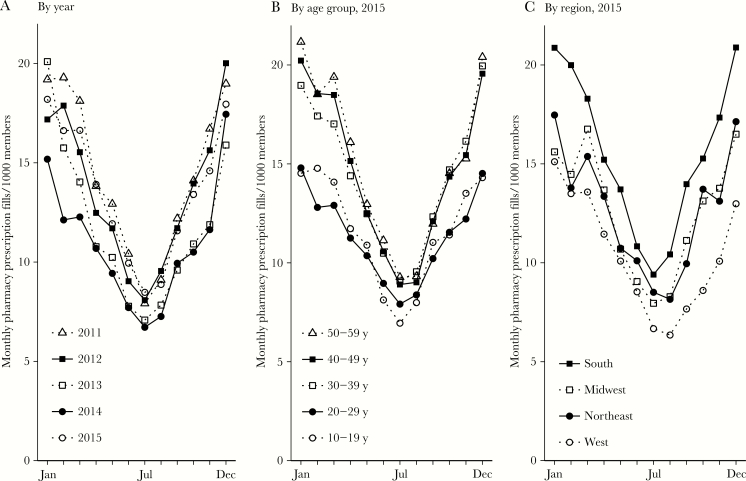
Seasonality in macrolide use among MarketScan members, 2011–2015. Points indicate monthly macrolide use among all included members, by year (A); among members in each age group in 2015 (B); and among members in each US Census region in 2015 (C).
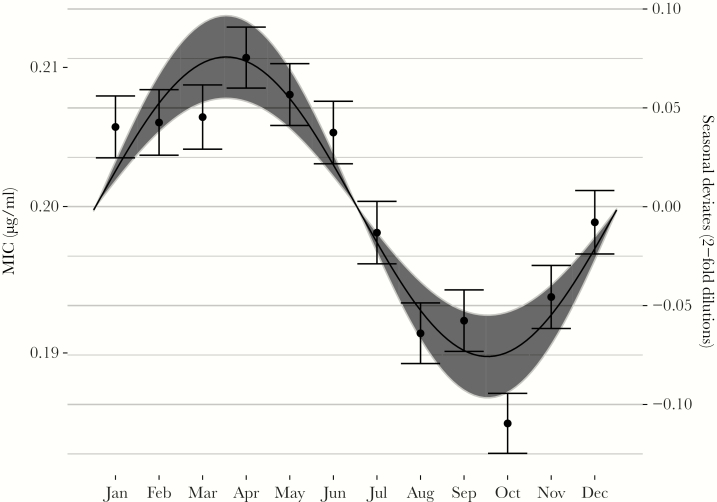
Seasonality in Neisseria gonorrhoeae azithromycin minimum inhibitory concentrations (MICs) among GISP isolates, 2005–2015. Points indicate monthly means of the seasonal deviates; error bars show standard errors of the mean. The line indicates the point estimate for the seasonal amplitude and phase from the sinusoidal model; the gray area shows the 95% confidence interval for the amplitude. MICs (left axis) were computed using seasonal deviates from year-clinic regressions (right axis) on a baseline MIC of 0.2 μg/mL.
References
-
- Wind CM, de Vries E, Schim van der Loeff MF, et al. Decreased azithromycin susceptibility of neisseria gonorrhoeae isolates in patients recently treated with azithromycin. Clin Infect Dis 2017; 65:37–45. - PubMed
-
- Clifton S, Town K, Furegato M, et al. Is previous azithromycin treatment associated with azithromycin resistance in Neisseria gonorrhoeae? A cross-sectional study using national surveillance data in England. Sex Transm Infect 2018; 94:421–6. - PubMed
Publication types
MeSH terms
Substances
Grants and funding
LinkOut - more resources
Full Text Sources
Other Literature Sources
Medical
