. 2019 Jan 1;11(1):1-13.
doi: 10.1093/jmcb/mjy052.

The SLC transporter in nutrient and metabolic sensing, regulation, and drug development

Affiliations

The SLC transporter in nutrient and metabolic sensing, regulation, and drug development

Yong Zhang et al. J Mol Cell Biol. .

Abstract

The prevalence of metabolic diseases is growing worldwide. Accumulating evidence suggests that solute carrier (SLC) transporters contribute to the etiology of various metabolic diseases. Consistent with metabolic characteristics, the top five organs in which SLC transporters are highly expressed are the kidney, brain, liver, gut, and heart. We aim to understand the molecular mechanisms of important SLC transporter-mediated physiological processes and their potentials as drug targets. SLC transporters serve as 'metabolic gate' of cells and mediate the transport of a wide range of essential nutrients and metabolites such as glucose, amino acids, vitamins, neurotransmitters, and inorganic/metal ions. Gene-modified animal models have demonstrated that SLC transporters participate in many important physiological functions including nutrient supply, metabolic transformation, energy homeostasis, tissue development, oxidative stress, host defense, and neurological regulation. Furthermore, the human genomic studies have identified that SLC transporters are susceptible or causative genes in various diseases like cancer, metabolic disease, cardiovascular disease, immunological disorders, and neurological dysfunction. Importantly, a number of SLC transporters have been successfully targeted for drug developments. This review will focus on the current understanding of SLCs in regulating physiology, nutrient sensing and uptake, and risk of diseases.


Figures
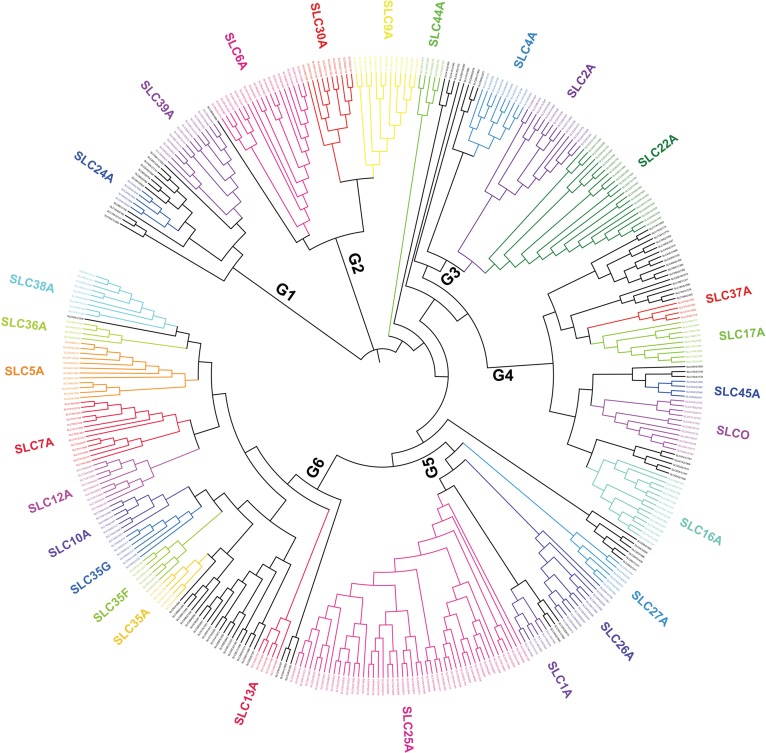
Figure 1
Figure 1
The phylogenetic tree of SLC superfamily. Different colors represent different subfamilies (see Supplementary Methods section). The SLCs are mainly classified into six groups: (i) Group 1 includes the SLC8, SLC24, and SLC39 families; (ii) Group 2 includes the SLC6, SLC9, and SLC30 families; (iii) Group 3 includes the SLC2, SLC4, SLC22, SLC28, and SLC41 families; (iv) Group 4 includes the SLC16, SLC17, SLC18, SLC37, SLC43, SLC45, and SLC47 families; (v) Group 5 includes the SLC1, SLC25, SLC26, SLC27, SLC29, and SLC34 families; (vi) Group 6 includes the SLC5, SLC7, SLC10, SLC12, SLC13, SLC23, SLC35, SLC36, and SLC38 families. Subfamily similarities may imply common ancestry and suggest possible functional similarity.
Figure 2
Figure 2
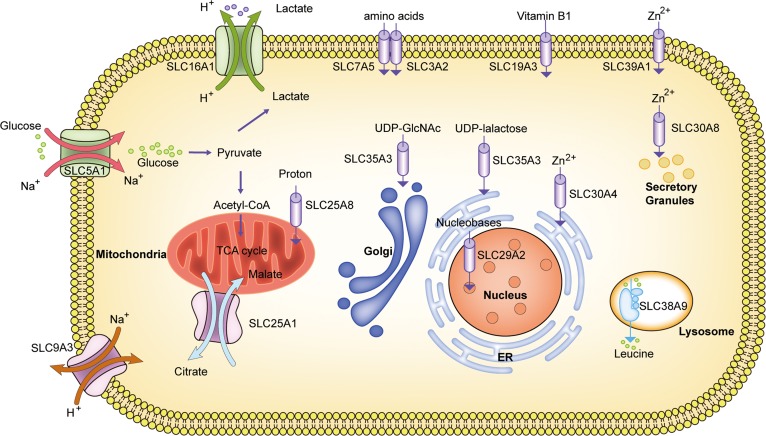
Representative modes of SLC transport. SLCs constitute a dynamic work coordination for living cells. Different modes of SLC transport, including cotransporters, exchangers, facilitated and orphan transporters, are marked by different shapes and colors. The representative SLC transporters include SLC3A2/SLC7A5 (amino acids), SLC5A1 (glucose and Na+), SLC9A3 (Na+/H+ exchanger), SLC16A1 (lactate), SLC19A3 (thiamine), SLC25A1(citrate/malate exchanger), SLC25A8 (protons), SLC29A2 (nucleobases), SLC30A4 (Zn2+ to ER), SLC30A8 (Zn2+ to granules), SLC35A3 (UDP-GlcNAc to Golgi), SLC35A3 (UDP-galactose to ER), SLC38A9 (leucine), and SLC39A1 (Zn2+ to intracellular fluid). SLCs participate in important biological functions for glycolysis, acidification, TCA cycle, and nutrient supply. Among these, SLC3A2 and SLC7A5, considered as heteromeric amino acid transporters, are collaborative for amino acid transport. The activities of SLCs cover all organelles from nucleus to cell membrane.
Figure 3
Figure 3
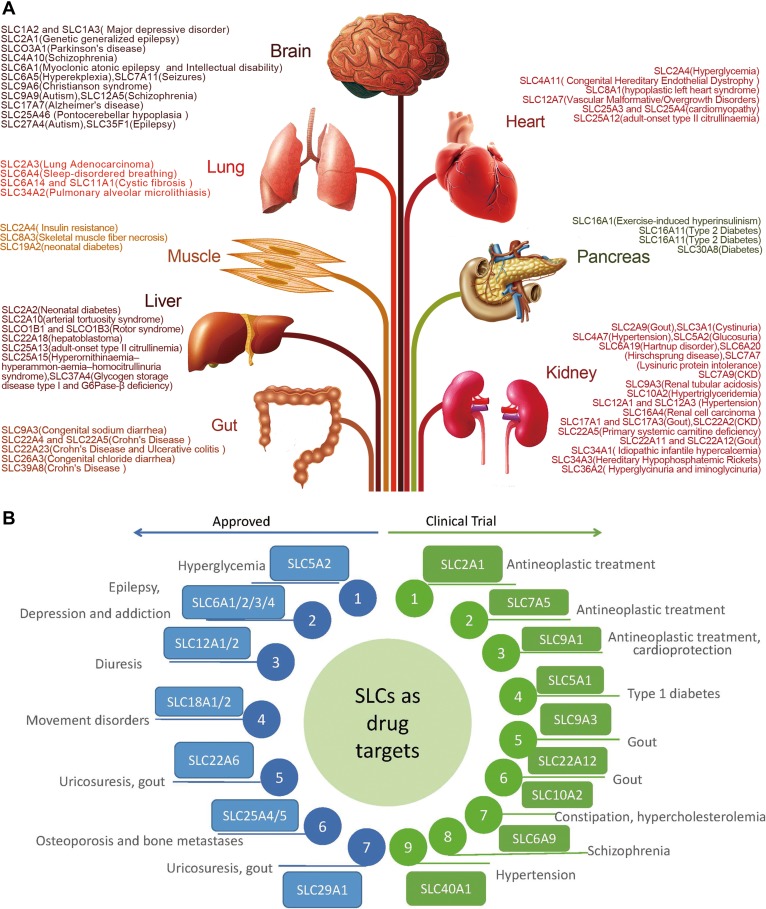
(A) Tissues and diseases associated with SLCs. Major advances in understanding of the relationship between disease susceptibility and SLCs have been made. Accumulation of gene mutations and GWAS studies have demonstrated that SLCs play a crucial role in human diseases. SLCs are specifically expressed in different organs and involved in the pathogenesis of various human diseases. SLC members in the same family have been described that differ in the organ expression with different functions. The brain and kidney are two target organs for most high expression of SLCs-mediated diseases. Thus, SLCs are promising for neurologic and metabolic target. (B) SLC inhibitors for drug targets. The current SLC drug development is promising. Previous approved drugs were widely used for treatment of hyperglycemia, diuresis, movement disorders, uricosuresis, gout, and so on. Newly testing SLC drugs have the potential to exert antineoplastic effects, ameliorate Type 1 diabetes, resist constipation, protect from hypertension and schizophrenia. Data were cited from Rask-Andersen et al. (2013) and Cesar-Razquin et al. (2015).

References

    1. Alzheimer’s Association. (2016). 2016 Alzheimer’s disease facts and figures. Alzheimers Dement. 12, 459–509. - PubMed
    1. American Psychological Association. (2013). DSM-5: Diagnostic and Statistical Manual of Mental Disorders (5th edn). Washington: American Psychiatricl Publishing.
    1. Amir Shaghaghi M., Bernstein C.N., Serrano Leon A., et al. (2014). Polymorphisms in the sodium-dependent ascorbate transporter gene SLC23A1 are associated with susceptibility to Crohn disease. Am. J. Clin. Nutr. 99, 378–383. - PubMed
    1. Anderson C.M., and Stahl A. (2013). SLC27 fatty acid transport proteins. Mol. Aspects Med. 34, 516–528. - PMC - PubMed
    1. Andrikopoulos P., Baba A., Matsuda T., et al. (2011). Ca2+ influx through reverse mode Na+/Ca2+ exchange is critical for vascular endothelial growth factor-mediated extracellular signal-regulated kinase (ERK) 1/2 activation and angiogenic functions of human endothelial cells. J. Biol. Chem. 286, 37919–37931. - PMC - PubMed

Publication types